
Best Platforms for Digital Student Recruitment in 2026
Over the past decade, student recruitment has undergone a fundamental transformation. Traditional recruitment strategies—centred around education fairs, printed brochures, and in-person outreach—are no longer sufficient in a world where students research, compare, and apply to institutions entirely online. Institutions that once relied heavily on physical presence must now operate in a digital-first environment where speed, personalization, and data visibility define success. At the same time, global competition for students has intensified. Universities and agencies are no longer competing only within their region—they are competing internationally. Students compare institutions across countries, programs, tuition models, visa processes, and post-graduation opportunities. This shift has forced institutions to rethink how they attract, engage, and convert prospects. Recruitment today is also multi-channel by default. A single prospective student may interact with an institution through a website form, Instagram ad, WhatsApp message, email campaign, webinar, and an education agent—all before submitting an application. Managing this level of complexity manually is nearly impossible. For this reason, institutions are actively searching for the best platforms for digital student recruitment. They are looking for structured systems that can unify communication, track applications, measure performance, and scale operations without increasing administrative burden. This guide will help you understand what digital student recruitment really means, why specialized platforms matter, what features define the best platforms for digital student recruitment, and how to choose the right solution for your organization. What Is Digital Student Recruitment? From Physical Outreach to Digital-First Enrollment Funnels Digital student recruitment refers to the use of online platforms, automation tools, and centralized systems to attract, manage, and convert prospective students through digital channels. Traditionally, recruitment focused heavily on physical outreach: Education fairs School visits Printed materials Face-to-face counseling While these channels still play a role, modern recruitment operates primarily through digital funnels. Students now discover institutions through search engines, social media, webinars, targeted ads, and online communities. The entire decision-making journey—from awareness to application—often happens online. This shift requires institutions to manage structured online student journeys. A digital enrollment funnel may include: Inquiry submission Automated follow-up Program guidance Application tracking Document submission Interview scheduling Offer management Without one of the best platforms for digital student recruitment, managing these stages across thousands of students becomes fragmented and inefficient. Explore the future of international student recruitment software and see how modern platforms are transforming global enrollment strategies. Why Recruitment Platforms Matter in Today’s Enrollment Landscape Digital recruitment platforms are no longer optional tools—they are operational infrastructure. The best platforms for digital student recruitment enable institutions to operate at scale, move faster, personalize engagement, and maintain visibility into performance. Scale Modern institutions handle inquiries from multiple countries and time zones. Recruitment platforms allow teams to manage large volumes of leads and applications without losing control. Speed Response time directly impacts conversion. Automated workflows and integrated communication tools allow institutions to engage prospects immediately, rather than days later. Personalization Students expect tailored communication. Recruitment platforms enable segmented messaging, program-specific follow-ups, and stage-based communication flows. Data Visibility Without centralized reporting, leadership cannot measure performance. The best platforms for digital student recruitment provide dashboards showing conversion rates, funnel health, and team performance metrics. Why Institutions Need Digital Student Recruitment Platforms Growing Competition for Domestic and International Students The international education market has become highly competitive. Institutions are competing not only on academic quality but also on digital responsiveness and student experience. Delayed follow-ups, inconsistent communication, or unclear application processes can push students toward competitors. Digital recruitment platforms give institutions a structured approach to engagement, ensuring that no inquiry is ignored and no applicant falls through the cracks. This competitive pressure is one of the primary reasons institutions invest in the best platforms for digital student recruitment. Managing Multi-Channel Lead Sources Recruitment today is multi-channel by design. Prospective students may enter the funnel from: Website forms Social media campaigns Email marketing WhatsApp or live chat Education agents Webinars and virtual events Without a centralized system, these leads remain scattered across inboxes and spreadsheets. The best platforms for digital student recruitment unify all lead sources into one structured database, allowing institutions to track source attribution and measure channel effectiveness. The Need for Data-Driven Enrollment Decisions Enrollment strategy is no longer based on intuition. Institutions must analyze performance to improve outcomes. Digital recruitment platforms support: Conversion tracking—from inquiry to enrollment ROI visibility—measuring marketing effectiveness Funnel performance analysis—identifying drop-off points Without advanced reporting, institutions cannot determine which markets are growing, which counsellors perform best, or where applicants abandon the process. Data-driven decision-making is a core benefit of the best platforms for digital student recruitment. What Defines the Best Platforms for Digital Student Recruitment Not all recruitment systems are equal. The best platforms for digital student recruitment share specific structural capabilities. Lead Capture and Source Tracking Effective platforms centralize lead intake from all channels. Multi-channel intake ensures every inquiry—regardless of source—enters one unified system. Attribution tracking allows institutions to identify which campaigns, countries, or partners generate the highest-quality leads. This visibility directly influences budget allocation and strategy refinement. Application and Enrollment Lifecycle Management Student recruitment cycles are long and multi-stage. From inquiry to final enrollment, the process may take several months. The best platforms for digital student recruitment support stage-based workflows, allowing institutions to track: Inquiry Application started Documents submitted Offer issued Acceptance confirmed Enrollment completed This lifecycle management ensures clarity for both staff and students. Automation and Communication Integration Recruitment teams spend significant time on repetitive communication tasks. Automation reduces administrative pressure and improves consistency. Modern recruitment platforms integrate: Email SMS WhatsApp Trigger-based reminders for deadlines and documents These tools allow institutions to maintain engagement without increasing staff workload. Agent and Partner Collaboration Tools International recruitment often depends on agents and regional partners. The best platforms for digital student recruitment provide structured collaboration tools where agents can submit applications, track
Study Abroad Management Software | A Smarter Way to Manage Study Abroad
Study abroad programs have evolved significantly over the past decade. What once involved managing a limited number of destinations and partner institutions has expanded into complex, multi-country operations with diverse program types, intake cycles, and regulatory requirements. Agencies and institutions are now expected to deliver a seamless experience while maintaining accuracy, transparency, and accountability across every stage of the student journey. This growth has introduced new challenges for study abroad teams. Managing higher student volumes, coordinating with international partners, handling sensitive documentation, and ensuring consistent communication across time zones all add layers of operational complexity. Traditional approaches—spreadsheets, shared folders, and email threads—were never designed to support this scale or level of coordination. As a result, many organizations are reaching a breaking point. Manual tools slow teams down, increase the risk of errors, and make it difficult to maintain visibility as programs grow. This is why study abroad management software has become essential. Purpose-built software provides the structure, automation, and oversight needed to manage modern study abroad operations efficiently and sustainably. What Is Study Abroad Management Software? Definition and Core Purpose Study abroad management software is a specialized system designed to manage the full operational lifecycle of study abroad programs. Unlike generic tools, it centralizes student data, applications, programs, documentation, communication, and internal workflows into a single, structured platform. The core purpose of study abroad management software is to replace fragmented, manual processes with coordinated, digital workflows. It helps organizations track students from initial inquiry through application, placement, enrollment, and beyond—while maintaining visibility and control at every stage. This type of software is designed specifically for education-focused organizations that manage international mobility, long student journeys, and compliance-sensitive processes. Discover a platform designed to support the next generation of international student recruitment. Who Uses Study Abroad Management Software? Study abroad agencies Agencies use study abroad management software to manage leads, applications, partner universities, documentation, and communication with students across multiple destinations. Universities and international offices Institutions rely on the software to oversee outgoing and incoming mobility programs, coordinate with partner universities, and maintain accurate reporting and compliance records. Exchange and mobility programs Organizations running exchange, internship, or cultural mobility programs use study abroad management software to manage participant lifecycles, placements, and ongoing program monitoring. Why Study Abroad Programs Are Becoming Harder to Manage Increasing Student Volume and Program Diversity Study abroad teams now manage a wider range of programs than ever before—short-term exchanges, full-degree programs, language courses, internships, and hybrid models. Each program may involve different destinations, partners, timelines, and requirements. As student volume increases alongside program diversity, manual tracking becomes unreliable. Study abroad management software provides a structured way to manage multiple programs and partners without losing clarity. Complex Application and Documentation Processes Applications for study abroad programs involve more than basic forms. Teams must manage admissions requirements, visa documentation, placement details, and supporting records—often across multiple institutions and countries. Without centralized systems, tracking what has been submitted, approved, or is still missing becomes time-consuming and error-prone. Study abroad management software centralizes documentation and application status, reducing delays and compliance risk. Communication Across Time Zones and Stakeholders Study abroad operations depend on constant communication between students, partner institutions, host organizations, and internal teams. Coordinating across time zones and cultures adds complexity. When communication is scattered across inboxes and messaging apps, teams lose context and consistency. Study abroad management software keeps communication tied to student and program records, ensuring clarity and continuity. Compliance and Reporting Requirements Accuracy and accountability are critical in international education. Institutions and agencies must maintain reliable records for internal reporting, partners, and regulators. Manual reporting processes are slow and often outdated by the time they are completed. Study abroad management software supports structured reporting and audit-ready records, helping organizations maintain confidence in their data. Explore how Ticlick supports cultural exchange organizations with purpose-built CRM workflows. Key Features of Effective Study Abroad Management Software Student and Application Lifecycle Management Effective study abroad management software tracks the entire student journey—from first inquiry to enrollment and program completion. Each stage is clearly defined, allowing teams to see progress, identify delays, and support students proactively. Program and Destination Management The software organizes programs by destination, university, intake, or program type. This allows teams to manage offerings efficiently, compare performance, and ensure students are matched to the right opportunities. Document and Compliance Tracking Secure document uploads, approval workflows, and status tracking are core capabilities. Study abroad management software ensures documents are complete, up-to-date, and easily accessible—reducing risk and administrative effort. Communication and Automation Tools Automated emails, reminders, and workflow triggers reduce repetitive follow-ups and improve response rates. Communication tools built into study abroad management software keep messaging consistent and contextual. Team Collaboration and Task Management Clear roles, task assignment, and ownership help teams work more efficiently. Collaboration features reduce internal friction and ensure accountability as programs scale. Study Abroad Management Software vs Generic CRMs Program-Based Workflows vs Sales Pipelines Generic CRMs are designed around sales pipelines and deals. Study abroad programs operate through structured stages tied to academic and administrative milestones. Study abroad management software reflects these program-based workflows, not sales logic. Long-Term Student Journeys vs Short Transactions Student journeys often span months or years. Generic CRMs prioritize quick conversions and closed deals, while study abroad management software supports long-term tracking, context preservation, and continuity. Education-Specific Compliance Needs International education involves unique compliance and reporting requirements. Specialized software is built with these needs in mind, while generic CRMs require heavy customization that often falls short. Benefits of Using Study Abroad Management Software Better Operational Visibility Real-time dashboards give teams instant insight into student progress, application status, and program performance—enabling proactive management. Reduced Manual Work and Errors Automation replaces repetitive tasks and reduces reliance on spreadsheets, lowering the risk of human error. Improved Student Experience Clear communication, transparency, and timely updates improve student confidence
CRM for Save J1 Campaign Agencies | How Ticlick Supports Advocacy
The Save J1 campaign has become a critical advocacy effort aimed at protecting cultural exchange programs and preserving their long-term viability. As policy discussions intensify and public scrutiny increases, campaign agencies working on Save J1 initiatives are expected to operate with a high level of coordination, accuracy, and credibility. Their role goes beyond messaging—it involves organizing data, managing stakeholders, and supporting evidence-based advocacy. Over time, the role of Save J1 campaign agencies has expanded significantly. These agencies now coordinate between advocacy organizations, sponsors, partners, and policymakers, while also managing sensitive documentation, case narratives, and ongoing communication. What was once manageable through informal tools has evolved into a complex operational environment. This growing complexity—spanning stakeholders, documentation, communication flows, and compliance narratives—has exposed the limits of manual systems. Spreadsheets and inboxes cannot support the scale or accountability required today. That is why choosing the right CRM for Save J1 campaign agencies is no longer optional. A CRM provides the structure needed to organize advocacy work, preserve context, and ensure campaigns remain credible, coordinated, and sustainable over time. Understanding the Role of Save J1 Campaign Agencies What Is the Save J1 Campaign? The Save J1 campaign is a policy-focused advocacy effort designed to protect J-1 exchange programs and ensure their continued operation within a fair, transparent framework. It centers on preserving cultural exchange opportunities while addressing regulatory, political, and public-interest concerns. Coordination and credibility are essential to the campaign’s success. Advocacy arguments must be supported by accurate data, consistent narratives, and clear documentation. Fragmented or poorly organized information weakens the campaign’s position. This is why operational discipline—and increasingly, a CRM for Save J1 campaign agencies—plays a foundational role in supporting credible advocacy. See how Ticlick helps education agencies prepare for 2026 with structured, scalable CRM workflows. What Do Save J1 Campaign Agencies Actually Manage? Save J1 campaign agencies manage far more than public messaging. Their daily work spans multiple layers of coordination and information management. Advocacy efforts Agencies organize advocacy initiatives, track campaign milestones, and align messaging across stakeholders. These efforts evolve over time and require historical continuity. Stakeholder communication Campaign agencies communicate with advocacy groups, sponsors, partners, and sometimes policymakers. Maintaining consistent, documented communication is essential to avoid misalignment or duplicated efforts. Case data, reports, and narratives Agencies collect and manage case-level information, supporting reports, and narrative context that informs advocacy positions. Losing this context weakens long-term strategy. Collaboration with sponsors, advocacy organizations, and partners Save J1 campaigns are collaborative by nature. Agencies act as coordination hubs, aligning efforts across multiple independent organizations. A CRM for Save J1 campaign agencies helps keep this collaboration structured rather than fragmented. Explore how Ticlick helps student recruitment teams manage leads, applications, and enrollments in one system. Why Traditional Tools Fail Save J1 Campaign Agencies Advocacy Work Is Not Sales or Ticketing Sales CRMs are built around deals, revenue stages, and short transaction cycles. Save J1 advocacy work does not follow this logic. There are no “closed deals”—only evolving campaigns, ongoing coordination, and long-term outcomes. IT ticketing tools also fall short. They treat issues as isolated tickets that are opened and closed quickly, oversimplifying advocacy cases that require context, escalation, and sustained follow-up. This mismatch is why generic tools fail to support the real needs behind a CRM for Save J1 campaign agencies. Fragmented Campaign Data and Stakeholder Records Many campaign agencies rely on spreadsheets, inboxes, and shared documents to manage their work. Over time, this creates fragmentation. Information is duplicated, outdated versions circulate, and critical context is lost when staff changes or responsibilities shift. Fragmentation breaks continuity. Agencies struggle to maintain a clear record of decisions, narratives, and outcomes. A CRM for Save J1 campaign agencies addresses this problem by centralizing campaign data and stakeholder records in one structured system. No Central View of Campaign Progress and Impact Without a centralized system, campaign leaders cannot easily answer fundamental questions: What advocacy efforts are active right now? Which stakeholders are engaged or disengaged? Where are risks emerging? Which narratives are supported by data? The absence of a central view forces agencies into reactive mode. CRM systems provide visibility across campaigns, cases, and stakeholders—turning fragmented activity into measurable progress. Why a CRM Is Critical for Save J1 Campaign Agencies Coordinating Multi-Stakeholder Advocacy Efforts Save J1 campaign agencies coordinate across a complex network that includes advocacy organizations, sponsors, partners, and coalition members. Each stakeholder brings its own priorities, timelines, and communication styles. A CRM for Save J1 campaign agencies acts as a coordination layer. It organizes relationships, tracks interactions, and ensures everyone is working from the same context—reducing friction and misalignment. Centralizing Campaign, Case, and Communication Data Advocacy relies on context. Historical decisions, supporting evidence, and communication history all matter. A CRM centralizes campaign data, case information, and communication records into one source of truth. This centralization preserves institutional memory and allows agencies to build on past work rather than restarting efforts when teams change or campaigns evolve. For Save J1 initiatives, historical context strengthens consistency and strategic clarity. Supporting Transparency and Credibility Credibility is the foundation of effective advocacy. Campaign agencies must demonstrate transparency, accuracy, and consistency—both internally and externally. Data-backed advocacy strengthens arguments and builds trust with partners and stakeholders. A CRM for Save J1 campaign agencies supports transparency by enabling consistent reporting, structured documentation, and traceable decisions. Instead of relying on anecdotal updates, agencies can support their advocacy with clear records and reliable insights—making their work more defensible and impactful. What Makes the Right CRM for Save J1 Campaign Agencies Choosing the right CRM for Save J1 campaign agencies is not about feature quantity—it’s about alignment with how advocacy campaigns actually operate. Campaign agencies manage long-running initiatives, complex relationships, and evolving narratives that require structure, continuity, and accountability. Advocacy-Centered Workflows (Not Sales Pipelines) Traditional CRMs are designed around sales pipelines and deal stages. Advocacy campaigns operate differently. The right
Best Software for J1 Advocacy Organizations | Oversight & Compliance Tools
J-1 advocacy organizations play an increasingly critical role in protecting the integrity of exchange programs and the well-being of participants. As J-1 programs expand in scope and scale, advocacy groups are expected to monitor conditions, support participant rights, document issues, and ensure transparency across complex, multi-stakeholder environments. At the same time, the operational reality has changed. Advocacy teams now manage higher case volumes, more documentation, tighter compliance expectations, and ongoing communication with sponsors, hosts, and participants. Relying on manual tools makes it difficult to keep pace with these demands. This shift is why discussions around the best software for J1 advocacy organizations are becoming more frequent—and more urgent. Technology is no longer optional for advocacy-driven J-1 operations. Purpose-built software enables organizations to centralize case management, improve oversight, and move from reactive support to structured, proactive advocacy. For organizations tasked with safeguarding programs and participants, the right technology becomes a foundation for credibility, effectiveness, and long-term impact. Understanding the Role of J-1 Advocacy Organizations What Do J-1 Advocacy Organizations Do? J-1 advocacy organizations exist to protect participant rights and promote ethical, compliant program operations. Their responsibilities extend beyond individual cases and focus on maintaining program integrity across sponsors, hosts, and regions. Protect participant rights Advocacy organizations support participants when concerns arise, whether related to workplace conditions, program expectations, or communication gaps. This requires structured case handling, evidence collection, and clear escalation paths. Support transparency and compliance By monitoring patterns and documenting issues, advocacy organizations help reinforce transparency and accountability. Their work supports compliance efforts by identifying risks early and ensuring concerns are properly tracked and addressed. Act as intermediaries between sponsors, participants, and hosts Advocacy groups often serve as neutral intermediaries, coordinating communication between multiple stakeholders. Managing this role effectively requires accurate records, consistent follow-ups, and clear visibility into each case—capabilities that define the best software for J1 advocacy organizations. How Advocacy Differs from Sponsorship Although advocacy organizations work closely with sponsors, their function is fundamentally different. Sponsors focus on program execution, while advocacy focuses on oversight and participant protection. Oversight vs execution Advocacy organizations are not responsible for running programs day-to-day. Instead, they oversee conditions, respond to concerns, and ensure that program standards are upheld across all stakeholders. Monitoring, reporting, escalation, and support Advocacy work involves tracking cases over time, documenting outcomes, and escalating issues when necessary. This creates long timelines, complex documentation needs, and ongoing communication cycles—very different from operational workflows. Multi-stakeholder coordination Each case may involve participants, sponsors, host organizations, and internal advocacy teams. Coordinating these interactions without a centralized system is challenging, which is why the best software for J1 advocacy organizations is designed to support oversight-centric workflows rather than execution-driven processes. Explore how Ticlick supports cultural exchange organizations with purpose-built CRM workflows. Key Challenges Faced by J-1 Advocacy Organizations Fragmented Participant and Case Data Many advocacy organizations manage case information across emails, spreadsheets, PDFs, and shared reports. This fragmentation makes it difficult to maintain a complete and accurate case history. Important context can be lost when data is scattered, and teams spend unnecessary time searching for information instead of resolving issues. Fragmentation also weakens accountability. Without a centralized system, it’s harder to track actions taken, timelines, and outcomes—an issue the best software for J1 advocacy organizations is specifically designed to solve. Limited Visibility Into Ongoing J-1 Programs Advocacy teams often lack real-time visibility into program conditions and active cases. It becomes difficult to answer basic questions: Which cases are unresolved? Where are delays occurring? Which sponsors or hosts generate repeated issues? Without visibility, organizations operate reactively—addressing problems only after they escalate. Software that supports centralized oversight allows advocacy organizations to monitor trends and intervene earlier, strengthening their overall impact. High Communication and Documentation Load Managing complaints, follow-ups, and supporting evidence creates a heavy communication and documentation burden. Each interaction must be recorded, each document stored securely, and each update shared with the right stakeholders. When this work is manual, it increases the risk of missed follow-ups and inconsistent records. The best software for J1 advocacy organizations reduces this burden by organizing communication histories, attaching evidence directly to cases, and keeping timelines clear and traceable. Compliance Oversight Without Centralized Systems Advocacy organizations play a key role in supporting compliance, yet many lack centralized systems to do so effectively. Without structured workflows, response times slow, reporting becomes inconsistent, and oversight loses effectiveness. Centralized software helps ensure issues are logged, tracked, and resolved in a timely manner—supporting stronger reporting and more credible oversight. This capability is essential for advocacy organizations operating in increasingly regulated environments. Explore how Ticlick supports BridgeUSA programs with structured CRM workflows and compliance-ready oversight. Why Software Is Critical for J-1 Advocacy Organizations From Reactive Support to Proactive Oversight Without software, advocacy organizations often operate in reactive mode—responding to complaints only after they surface. Technology enables early issue detection by tracking patterns, monitoring timelines, and highlighting repeat concerns. Moving to proactive oversight strengthens advocacy impact and aligns directly with what defines the best software for J1 advocacy organizations: the ability to anticipate risk rather than respond to crises. Centralized Case and Participant Management Centralized software creates structured records for each case, including participant details, communication history, documents, actions taken, and outcomes. This structure supports consistency, reduces duplication, and ensures continuity even when team members change. For advocacy organizations, centralized case management is not just an efficiency gain—it’s the foundation for credible oversight and defensible reporting. Data-Driven Advocacy and Reporting Effective advocacy relies on evidence. Software enables organizations to analyze trends, identify recurring issues, and produce reliable reports for internal leadership and external stakeholders. Data-driven insights strengthen accountability and support informed decision-making. Ultimately, the best software for J1 advocacy organizations transforms advocacy work from scattered case handling into a structured, transparent, and scalable operation. Why Generic CRMs and Ticketing Tools Fall Short Built for Sales or IT, Not Advocacy Workflows
Save J1 Program CRM Support | How CRM Protects J-1 Exchange Programs
J-1 exchange programs operate in a high-accountability environment where participant experience and regulatory compliance must move together. In recent years, many sponsors and program operators have faced a sharper mix of challenges: tighter oversight expectations, more complex workflows, and growing participant volumes across multiple locations and stakeholders. That combination makes it harder to maintain consistency, reduce risk, and deliver a smooth journey for every participant. What often breaks first is not the program model—it’s the operational system behind it. When teams rely on spreadsheets, email chains, and manual follow-ups, small gaps can quickly become large problems: missed deadlines, incomplete documentation, delayed communication, and limited visibility into what’s happening across the pipeline. This is why save J1 program CRM support has become a real operational priority, not just a “software upgrade.” Today, CRM support is increasingly critical to saving and sustaining J-1 programs because it centralizes the participant lifecycle, standardizes compliance workflows, and gives program leaders real-time oversight. With the right CRM support, teams can reduce administrative load, increase accountability, and scale programs without multiplying risk—exactly what modern J-1 sponsors need to stay resilient. Understanding the J-1 Exchange Program Landscape What Is the J-1 Program and Why It Matters The J-1 Exchange Visitor Program is a cultural exchange framework designed to promote mutual understanding through structured international experiences. Depending on the program category, participants may engage in training, internships, seasonal cultural exchange, or related approved activities. At its core, the program is about structured exchange—not simply travel or short-term placement. J-1 programs matter because they sit at the intersection of cultural impact and operational responsibility. Sponsors must deliver a meaningful, well-managed experience while ensuring participants are guided through a clear process—from eligibility and onboarding to placement, monitoring, and program completion. As programs expand, the need for reliable systems becomes more urgent, and conversations around save J1 program CRM support typically begin when organizations realize the program’s success depends on repeatable, trackable operations. Key stakeholders in the J-1 ecosystem include: Sponsors: organizations responsible for administration, oversight, and compliance workflows Participants: exchange visitors moving through stages such as application, onboarding, placement, and support Host organizations: partners that provide the workplace, training environment, or host setting, and coordinate with sponsor requirements Each stakeholder depends on accurate information, timely communication, and clear status tracking—especially when multiple programs or locations are involved. Operational and Compliance Responsibilities of J-1 Sponsors J-1 sponsors carry the operational weight of program execution and the compliance responsibility of maintaining program integrity. That responsibility typically spans multiple stages and requires consistent documentation and traceable oversight. Documentation, monitoring, and reporting Sponsors must manage participant records and supporting documents across the lifecycle—often including eligibility documentation, onboarding records, placement details, and ongoing program updates. Monitoring is not a one-time action; it’s continuous oversight to ensure participants remain on track and program rules are followed. Reporting obligations also require structure: when data is scattered across tools, teams lose time reconciling it and increase the risk of errors. Communication and participant oversight Sponsors are expected to maintain responsive communication with participants and coordinate with host organizations when issues arise. Without a centralized system, communication becomes inconsistent—messages live in different inboxes, staff members rely on personal threads, and there is no unified history. This is exactly where save J1 program CRM support becomes strategic: CRM support can unify communication, document status, and participant progress into one operational view, making oversight practical rather than reactive. Why Many J-1 Programs Struggle Without Proper CRM Support Manual Processes and Fragmented Systems Many J-1 teams still run on a patchwork of spreadsheets, shared drives, email threads, and disconnected tools. At small scale, this might feel manageable—but as participant volume increases, fragmentation creates delays and inconsistency. Teams duplicate work, lose track of updates, and spend hours searching for the “latest version” of a document or status update. Manual operations also make handoffs fragile. When one coordinator changes roles or a new staff member joins, knowledge lives in people—not in systems. A proper CRM creates continuity by embedding the workflow into the platform. That’s why save J1 program CRM support is often initiated when teams hit a growth ceiling: they don’t need more effort, they need a better operational structure. Compliance Risks and Documentation Gaps Compliance risk often comes from simple operational gaps: a missing document, an incomplete participant record, a deadline that wasn’t followed up on, or a status that wasn’t updated consistently. Without a structured process and centralized records, teams end up relying on memory, manual checklists, and last-minute auditing—none of which scale safely. When programs are audited or reviewed, the cost of scattered documentation becomes obvious: reconciling data across tools is time-consuming and increases the chance of inaccuracies. CRM support helps reduce this risk by standardizing required fields, tracking document completeness, and creating a clear history of actions taken. In practice, save J1 program CRM support is about reducing compliance exposure while increasing operational reliability. Limited Visibility Into Participant Status One of the biggest operational problems in J-1 program management is a lack of real-time visibility. Program leaders often cannot quickly answer basic questions, such as: How many participants are stuck in onboarding? Who is missing key documents? Where are bottlenecks happening across the pipeline? Which locations or partners are causing delays? Without visibility, teams manage by exception—and usually too late. A CRM built for program workflows makes participant progress trackable by stage, surfaces risks early, and supports proactive intervention. This kind of visibility is a core reason save J1 program CRM support is becoming a priority for sponsors aiming to protect program continuity. Growing Administrative Burden on Program Teams As participant volume grows, the administrative burden grows faster than the team can realistically absorb. Manual follow-ups, repeated document checks, status updates, and coordination across stakeholders create constant pressure—and staff burnout becomes a real risk. Even strong teams can become reactive when they’re buried in repetitive work. CRM support reduces administrative load
Future of Technology in Cultural Exchange Programs | Digital Transformation Guide
Cultural exchange programs have long played a vital role in connecting people across borders, fostering mutual understanding, and creating meaningful international experiences. From work and travel programs to internships and professional training, these initiatives rely on complex coordination between participants, sponsors, institutions, and regulatory bodies. As programs grow in scale and expectations rise, traditional manual processes are no longer sufficient. Organizations now face increasing pressure to manage applications, documentation, communication, and compliance efficiently—all while delivering a seamless participant experience. This shift has placed technology at the center of transformation. The future of technology in cultural exchange programs is not just about digitizing paperwork. It’s about building smarter, more connected systems that can manage the entire program lifecycle, reduce operational risk, and improve outcomes for both participants and administrators. Understanding how technology is shaping this future is essential for any organization involved in cultural exchange today. What Are Cultural Exchange Programs? Cultural exchange programs are structured initiatives designed to promote cultural understanding, professional development, and global collaboration. They allow participants to live, work, study, or train in another country while engaging directly with local communities and cultures. These programs are commonly used by governments, educational institutions, sponsors, and private organizations to support international mobility and cross-cultural learning. Common Types of Cultural Exchange Programs Work & Travel programs Internship and trainee programs Professional training exchanges Academic and study abroad programs Cultural and educational sponsorship initiatives Each program type comes with its own set of rules, timelines, documentation requirements, and compliance obligations—making program management increasingly complex. Why Cultural Exchange Programs Are Operationally Complex Managing cultural exchange programs involves coordinating multiple stakeholders across different countries and time zones. Organizations must track participant progress, verify documents, meet regulatory requirements, and maintain consistent communication throughout the program lifecycle. Without digital systems in place, these processes often rely on spreadsheets, emails, and manual follow-ups—leading to delays, errors, and limited visibility. This operational complexity is a key reason why technology is becoming essential to the future of cultural exchange programs. How Technology Is Transforming Cultural Exchange Programs Today Technology is already reshaping how cultural exchange programs are managed, laying the foundation for what the future will look like. Modern digital tools are replacing fragmented workflows with centralized, data-driven systems that support efficiency and scalability. Digital Applications and Online Onboarding Paper-based applications are rapidly being replaced by online forms and digital onboarding processes. Participants can now submit information, upload documents, and complete requirements through secure platforms, reducing processing time and administrative workload. Centralized Participant and Program Management Cloud-based systems allow organizations to manage participants, programs, sponsors, and documents from a single dashboard. This centralization improves visibility, enables real-time updates, and minimizes the risk of lost or outdated information. Automated Communication and Follow-Ups Email, SMS, and messaging integrations help organizations maintain consistent communication with participants. Automated reminders for deadlines, interviews, or missing documents significantly improve response rates and participant engagement. Improved Compliance and Document Tracking Technology enables structured document management and status tracking, helping organizations meet compliance requirements more reliably. Digital audit trails and standardized workflows reduce human error and support regulatory transparency. These advancements represent only the beginning. As systems become more intelligent and interconnected, they will continue to define the future of technology in cultural exchange programs, shifting operations from reactive management to proactive, strategic oversight. Key Challenges Cultural Exchange Programs Face Without Technology Despite their impact, many cultural exchange programs still rely on manual processes and disconnected tools. Without the right technology in place, organizations face growing operational and strategic challenges that directly affect program quality and scalability. Fragmented Processes and Manual Workflows When applications, documents, and participant data are handled through emails, spreadsheets, and paper files, workflows become fragmented. Program managers spend excessive time on administrative tasks instead of focusing on program quality and participant experience. This lack of structure slows operations and limits growth. Communication Gaps With Participants Cultural exchange programs depend heavily on timely communication. Without centralized systems, messages are often missed, delayed, or inconsistent. Participants may remain unsure about their application status, required documents, or next steps—leading to frustration and disengagement. Compliance and Documentation Risks Exchange programs often operate under strict regulatory frameworks. Managing visas, contracts, approvals, and reporting manually increases the risk of errors, missing documents, or non-compliance. These risks can result in program delays, penalties, or reputational damage. Limited Visibility and Control Without technology, organizations lack real-time visibility into participant progress, program performance, and operational bottlenecks. Decision-making becomes reactive rather than strategic, making it difficult to optimize resources or plan for future growth. These challenges highlight why technology is no longer optional. Addressing them is a critical step toward shaping the future of technology in cultural exchange programs. The Future of Technology in Cultural Exchange Programs The future of technology in cultural exchange programs is defined by intelligent systems that simplify complexity, enhance transparency, and enable scalable growth. As expectations increase from both participants and regulators, technology will become the backbone of successful program management. Automation and Smart Workflow Management Automation will play a central role in reducing manual effort. From application processing to task assignments and deadline reminders, smart workflows will ensure consistency and accuracy across every stage of the program lifecycle. Centralized Digital Ecosystems Instead of relying on multiple disconnected tools, organizations will adopt unified platforms that manage participants, programs, sponsors, documents, and communication in one place. This centralization improves coordination and provides a single source of truth. Data-Driven Program Management Advanced analytics will allow organizations to track performance, measure engagement, and identify trends. Data-driven insights will support better decision-making, helping programs improve outcomes and adapt to changing demands. Enhanced Participant Experience Through Technology Future platforms will prioritize participant experience by offering self-service portals, mobile access, and real-time updates. Transparency and ease of access will
Why J1 Visa Sponsors Need CRM Software in 2026 | Compliance & Control
The year 2026 represents a critical shift for J-1 visa sponsors. Exchange visitor programs are expanding in scale, while regulatory expectations around documentation, monitoring, and audit readiness continue to rise. Sponsors are no longer evaluated only on program delivery—they are increasingly judged on how well they document, track, and prove compliance at every stage of the participant lifecycle. This is exactly why the question of why J1 visa sponsors need CRM software in 2026 has become so relevant. Traditional tools such as spreadsheets, shared folders, and email chains were never designed to support compliance-heavy, time-sensitive programs. As participant volumes grow and oversight becomes stricter, these tools introduce unnecessary risk rather than control. In 2025, sponsors face a new reality: doing the work is no longer enough. They must also demonstrate that the work was done correctly, on time, and consistently. This shift makes technology—specifically CRM software built for exchange and education programs—a foundational requirement rather than an operational upgrade. Understanding why J1 visa sponsors need CRM software in 2026 begins with recognizing how dramatically the sponsor role itself has evolved. How the Role of J-1 Visa Sponsors Has Changed To understand why J1 visa sponsors need CRM software in 2026, it’s important to recognize how the responsibilities of sponsors have expanded beyond basic coordination. From Program Coordination to Compliance Ownership Historically, many sponsors focused on placement coordination and participant support. Today, sponsors are fully accountable for monitoring. documentation, reporting, and oversight throughout the entire exchange period. Compliance is no longer a background function—it is central to daily operations. Every check-in, update, and evaluation must be traceable and retrievable. Increased Oversight and Audit Expectations Sponsors are now expected to operate with audit readiness in mind. This means having clear records, time-stamped communication logs, and documented workflows that demonstrate consistent monitoring. In 2025, sponsors cannot afford reactive compliance practices. This growing expectation is a major reason why J1 visa sponsors need CRM software in 2026 rather than manual tracking methods. Managing More Programs Without Expanding Teams Many J-1 sponsors are scaling programs across multiple categories, regions, or partner agencies—often without increasing staff size. This creates pressure on internal teams to manage more participants, more documents, and more deadlines with the same resources. CRM systems help sponsors meet these demands by automating routine tasks and centralizing information, aligning perfectly with the evolving sponsor role. The Compliance and Operational Challenges J-1 Sponsors Face As responsibilities grow, sponsors face recurring challenges that make it increasingly clear why J1 visa sponsors need CRM software in 2026. Managing SEVIS-Related Updates and Time-Sensitive Reporting SEVIS updates, address changes, program modifications, and status reporting must be completed within strict timelines. When tracking is manual, deadlines are easily missed—especially when managing high participant volumes. Missed updates expose sponsors to compliance risk and operational stress. DS-2019 Control and Lifecycle Tracking Sponsors are responsible for issuing, updating, extending, and terminating DS-2019 forms. Without a centralized system, tracking the lifecycle of each document becomes complex and error-prone. Version confusion, unclear ownership, and missing updates are common challenges that reinforce why J1 visa sponsors need CRM software in 2026. Ongoing Monitoring That Must Be Proven Monitoring is continuous, not a one-time task. Sponsors must document participant check-ins, evaluations, and issue resolution throughout the program. Even when monitoring happens, the lack of structured documentation makes it difficult to prove compliance during reviews or audits. Fragmented Data Across Tools and Teams Participant information is often scattered across emails, spreadsheets, shared drives, and individual inboxes. This fragmentation prevents a single source of truth and makes it difficult for compliance teams to quickly assess risk or respond to inquiries. Centralization is no longer optional in 2025—it is essential. Scaling Programs Without Increasing Compliance Risk As programs grow, manual processes break down. The more participants a sponsor manages, the higher the chance of missed tasks, inconsistent documentation, and delayed responses. This scalability challenge is one of the clearest reasons why J1 visa sponsors need CRM software in 2025 to maintain control while expanding operations. Why Manual Tools and Generic Systems No Longer Work in 2025 In 2025, J-1 visa sponsorship operates in an environment that is far more complex, regulated, and data-driven than ever before. While spreadsheets, shared folders, email chains, and generic systems may have worked in the past, they no longer meet the operational and compliance demands sponsors face today. This gap is a core reason why J1 visa sponsors need CRM software in 2026. Manual tools cannot support compliance-driven workflows Spreadsheets and email are static tools. They do not enforce deadlines, trigger alerts, or document actions automatically. In compliance-heavy programs like J-1, this creates risk. Tasks depend on individual memory, personal calendars, or informal reminders—making missed updates and inconsistent documentation almost inevitable as programs scale. Generic systems are built for sales, not exchange programs Most generic CRMs are designed around short sales cycles and revenue pipelines. J-1 programs, however, follow long participant lifecycles that include onboarding, documentation, monitoring, evaluations, and completion. Generic systems lack the structure to manage ongoing monitoring and evidence-based oversight, which is central to why J1 visa sponsors need CRM software in 2026. Fragmentation increases risk and slows response times When participant data is spread across multiple tools, sponsors lose visibility and control. Compliance teams struggle to answer simple questions quickly: Is this participant fully documented? When was the last check-in completed? Are there any overdue updates? In 2025, delayed responses and incomplete records are not just operational issues—they are compliance risks. Manual systems do not scale safely As sponsors expand programs without proportionally increasing staff, manual systems break down. The more participants involved, the harder it becomes to maintain consistency, accuracy, and oversight. This scalability challenge clearly illustrates why J1 visa sponsors need CRM software in 2026 rather than relying on outdated tools. Why J-1 Visa Sponsors Need CRM Software in 2025 Understanding why J1 visa sponsors need CRM software in
Best Tools for Managing Work and Travel Programs | CRM & Operations
Work and Travel programs are among the most operationally intensive exchange programs to manage. Agencies are responsible for coordinating large volumes of participants within short seasonal timeframes while simultaneously communicating with host employers, sponsors, and internal teams. From pre-arrival preparation to on-program monitoring, every stage requires accuracy, speed, and clear documentation. As these programs continue to scale globally, many agencies discover that manual tools—such as spreadsheets, email chains, and messaging apps—are no longer sufficient. This is why the demand for the best tools for managing work and travel programs has grown significantly. Agencies need systems that can handle high participant volumes, track real-time status, automate follow-ups, and provide visibility across the entire program lifecycle. Work and Travel programs also involve continuous monitoring during peak seasons, when delays or missed follow-ups can quickly escalate into participant issues or operational bottlenecks. Without centralized systems, teams struggle to stay aligned, supervisors lose visibility, and managers are forced into reactive problem-solving. Understanding the best tools for managing work and travel programs is no longer just about improving efficiency—it is about maintaining control, reducing risk, and delivering a consistent participant experience even under seasonal pressure. Modern program management tools, especially CRM platforms built for education and exchange workflows, play a critical role in helping agencies operate smoothly and scale without chaos. What Makes Work and Travel Programs Operationally Challenging Work and Travel programs are uniquely demanding because they combine high-volume seasonal operations with multi-stakeholder coordination and ongoing monitoring. To understand what defines the best tools for managing work and travel programs, it helps to first look at the operational realities agencies face throughout the program lifecycle. High participant volume in short timeframes Most Work and Travel programs operate in peak seasons, where agencies onboard large groups within limited time windows. This creates pressure on screening, documentation, placement coordination, and pre-departure support—all at once. When high volume meets tight timelines, small delays can quickly ripple into major operational bottlenecks. Multiple stakeholders that must stay aligned Agencies rarely manage Work and Travel programs alone. They coordinate participants, host employers, supervisors, sponsors, and sometimes partner agencies across countries. Each stakeholder has different responsibilities, documentation needs, and communication habits. Keeping everyone aligned requires centralized records, clear ownership, and reliable communication tracking—core capabilities of the best tools for managing work and travel programs. Continuous monitoring during the program Work and Travel doesn’t end when the participant arrives. Agencies must handle ongoing monitoring, check-ins, job confirmations, issue reporting, and changes in job role or location. During peak season, monitoring becomes operationally heavy, and without structured tracking, agencies struggle to prove oversight or respond quickly to emerging issues. Documentation-heavy workflows with deadline sensitivity Work and travel programs generate a constant stream of documents—contracts, job offers, insurance, arrival confirmations, and supporting paperwork. These documents often require approvals, updates, and version control. Without a structured system, teams experience missing files, outdated versions, and repeated requests that slow down operations. This is why documentation and compliance readiness remain central when evaluating the best tools for managing work and travel programs. Ready to Elevate Your Work & Travel Program Management? 👉 Discover a CRM Designed for Cultural Exchange & Work and Travel Organizations The Biggest Challenges Agencies Face in Work and Travel Programs The operational complexity of Work and Travel programs translates into consistent challenges across agencies, especially as volume and seasonal pressure increase. These challenges define what agencies look for when searching for the best tools for managing work and travel programs. Fragmented communication across channels Agencies typically communicate through email with hosts and sponsors, WhatsApp with participants, and internal chat tools for team coordination. The result is scattered conversations and missing context. Staff may not know what was promised, what was submitted, or what is pending—leading to delays, inconsistent support, and repeated follow-ups. Manual tracking and duplicate data Many agencies still rely on spreadsheets to track participant stages, documents, and host details. Over time, spreadsheets become inconsistent and difficult to maintain, especially when multiple team members update them. Duplicate records, outdated status updates, and data errors become frequent—making it hard to maintain operational control during peak season. Missed follow-ups during peak season Work and Travel programs require constant follow-ups: missing documents, pre-arrival preparation, arrival confirmation, and on-program check-ins. During peak season, staff workloads increase rapidly, and manual follow-up processes lead to missed tasks. This impacts participant experience and creates operational risk—one of the primary reasons agencies seek the best tools for managing work and travel programs. Lack of real-time visibility for managers Without dashboards or centralized pipelines, managers cannot quickly answer key operational questions: Who is ready for placement confirmation? Who is missing critical documents? Who has arrived and completed check-in requirements? Which issues are unresolved or escalating? This lack of visibility makes decision-making reactive, not proactive. Difficulty proving monitoring and oversight Even when agencies do check-ins and provide support, the evidence may be scattered in chats and emails. When agencies need to demonstrate structured monitoring, it becomes time-consuming to retrieve records. This “evidence retrieval” problem is a major operational challenge that the best tools for managing work and travel programs must solve. Ready to Streamline Your Exchange Visitor Programs? 👉 Explore a CRM Built for Exchange Visitor Programs Best Tools for Managing Work and Travel Programs When agencies search for the best tools for managing work and travel programs, they typically need a connected stack that supports communication, documentation, workflows, and real-time visibility. The most effective tools fall into five practical categories. CRM platforms built for education and exchange programs A CRM is often the foundation of high-performing work and travel operations because it centralizes participant and host data into structured profiles. Unlike generic sales CRMs, education and exchange-focused CRMs support lifecycle tracking, pipeline stages, task workflows, and compliance-style documentation. A purpose-built CRM is frequently the most powerful category within the best tools for managing work and travel programs. Communication and follow-up automation
Challenges J1 agencies face and how CRM solves them
J-1 programs are built on cultural exchange—but behind the scenes, they are powered by strict timelines, heavy documentation, and ongoing monitoring requirements. For J-1 agencies, success is not only measured by placements and participant satisfaction but also by operational control and compliance readiness. In practice, agencies must coordinate participants, host organizations, and sponsor requirements while maintaining consistent records and fast response times across every stage of the program. This reality explains why the topic of challenges J1 agencies face and how CRM solves them has become increasingly important. Many agencies still rely on spreadsheets, email threads, and messaging apps to manage participant information and program tasks. These tools may work at a small scale, but they become risky as volume grows—especially when deadlines, document updates, and monitoring activities must be tracked and proven. As J-1 programs expand, agencies face two pressures at the same time: delivering a smooth participant experience and maintaining reliable documentation for sponsor oversight and audits. Understanding challenges J1 agencies face and how CRM solves them starts with recognizing that J-1 operations are not “simple recruitment.” They are compliance-driven workflows that require structure, automation, and visibility—qualities that modern CRM systems are designed to deliver. What Makes J-1 Programs Operationally Complex To fully understand challenges J1 agencies face and how CRM solves them, it helps to look at what makes J-1 operations fundamentally different from standard student recruitment or internship placement workflows. First, J-1 programs involve multiple stakeholders with shared responsibilities. Agencies coordinate between participants, host organizations, supervisors, and sponsors, often across different time zones and communication channels. Each stakeholder contributes documents, approvals, and updates—creating a constant flow of information that must be captured accurately. When data is spread across email, WhatsApp, shared drives, and spreadsheets, it becomes difficult to maintain a “single source of truth,” and even small miscommunications can lead to operational delays. Second, the J-1 journey includes strict, ongoing program monitoring and evidence-based documentation. Beyond onboarding and placement, agencies must support check-ins, evaluations, incident tracking, and updates throughout the program lifecycle. This is where operational complexity increases: it’s not enough to “do the work”—teams must be able to prove tasks were completed, records were updated, and communication occurred on schedule. Third, J-1 programs are built around timeline-sensitive processes. Participants move through stages such as screening, placement confirmation, documentation, pre-arrival preparation, arrival support, and on-program monitoring. Each stage includes deadlines and dependencies—meaning one missing document or delayed update can cascade into visa delays, host issues, or disrupted program timelines. This is why the challenges J1 agencies face and how CRM solves them are practical, operational topics—not just technology conversations. Ready to Simplify J-1 Operations and Reduce Compliance Risk? 👉 Explore CRM Tools Designed for Study Abroad & Exchange Agencies The Biggest Challenges J-1 Agencies Face The operational reality of J-1 programs creates recurring pain points for agencies—especially as programs scale. Below are the biggest reasons challenges J1 agencies face and how CRM solves them is a high-intent topic for agencies searching for better systems and workflows. Fragmented Communication Across Email, WhatsApp, and Partners J-1 agencies often communicate across multiple channels simultaneously: email for sponsors and hosts, WhatsApp for participants, and internal chat tools for staff. This fragmentation creates gaps in context and missing information. It becomes difficult to track what was requested, what was submitted, and what is still pending—especially when multiple staff members interact with the same participant. Over time, these communication silos lead to delays, repeated requests, and a higher risk of mistakes. Compliance-Heavy Deadlines and Missed Follow-Ups J-1 workflows include many time-sensitive steps such as document collection, approvals, evaluations, and status updates. When deadlines are managed manually, agencies rely on memory, calendars, and spreadsheets. This makes follow-ups inconsistent and increases the risk of missed tasks. One missed deadline can mean a delayed participant timeline, incomplete documentation, or compliance exposure. This is one of the core challenges J1 agencies face and how CRM solves them in practice: deadlines need automation, not manual tracking. Difficulty Proving Monitoring and Program Oversight Monitoring is not a one-time step—it is an ongoing responsibility. Agencies often perform check-ins and coordination, but the challenge is maintaining consistent, audit-ready documentation. When notes and evaluations are scattered across emails, files, or personal devices, it becomes hard to demonstrate that monitoring occurred properly. This “evidence retrieval” issue is one of the most underestimated challenges J1 agencies face and how CRM solves them, because compliance depends not only on actions but also on documented proof. Document Overload and Version Confusion J-1 programs generate a high volume of documents across participants and hosts—applications, IDs, training plans, evaluations, insurance, agreements, and supporting files. Without structured document management, teams struggle with outdated versions, missing attachments, and unclear approval status. This leads to rework, delays, and frequent back-and-forth communication that drains counsellor and coordinator time. Limited Visibility Across the Full Participant Lifecycle As J-1 programs grow, agencies need visibility across every stage: screening, placement, pre-arrival, arrival, on-program monitoring, and completion. Many agencies lack a clear pipeline showing where each participant stands and what actions are required next. Without real-time visibility, teams operate reactively—only discovering issues when they become urgent. Improving visibility is central to solving challenges J-1 agencies face and how CRM solves them effectively. Ready to Streamline Your Exchange Visitor Program with the Right CRM? 👉 Discover the Best CRM for Exchange Visitor Programs How CRM Solves J1 Compliance and Operations Challenges To address the challenges J1 agencies face and how CRM solves them, it helps to view CRM as a workflow engine—not just a contact database. In J-1 operations, the core risk comes from fragmentation: communication spread across channels, documents stored in multiple places, manual follow-ups, and limited visibility across participant stages. A CRM solves these issues by centralizing information, standardizing processes, and creating reliable, audit-ready records. Centralized Participant Records (One Source of Truth) One of the most practical ways CRM tackles the challenges J1 agencies face and how
How J1 Visa Sponsors Use CRM for Compliance | SEVIS & Program Oversight
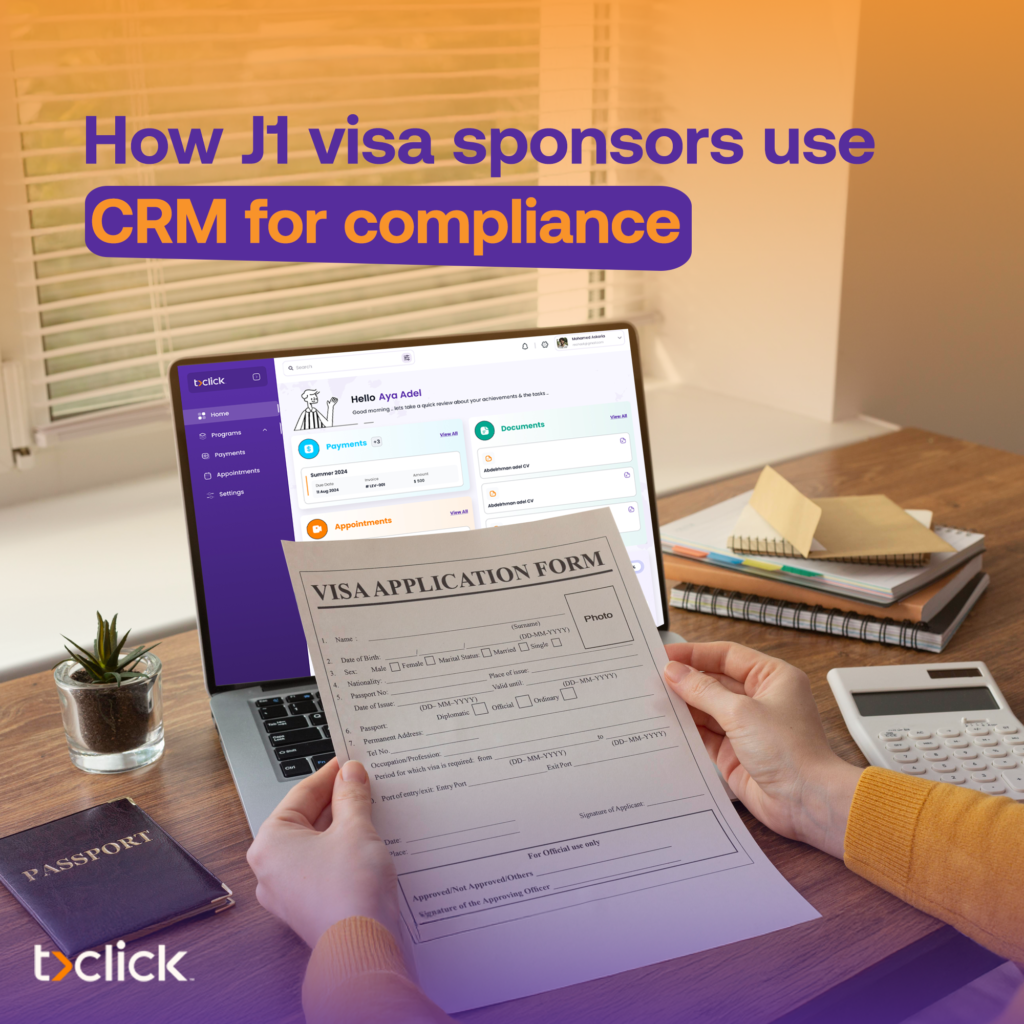
Compliance is the backbone of every successful J-1 Exchange Visitor Program. J-1 visa sponsors operate under strict U.S. Department of State regulations and are legally responsible for monitoring participants, maintaining accurate records, and reporting program activity throughout the entire exchange period. Any failure to comply can lead to audits, penalties, or even loss of sponsor designation. As J-1 programs grow in scale and complexity, manual processes are no longer sufficient to meet these regulatory demands. This is why the conversation around how J1 visa sponsors use CRM for compliance has become increasingly important. CRM systems are no longer viewed as optional administrative tools—they are now critical infrastructure for ensuring accuracy, consistency, and accountability. Modern sponsors manage hundreds or even thousands of participants across different categories, such as intern, trainee, and work & travel. Each participant generates documents, deadlines, evaluations, and reporting obligations. Without centralized systems, compliance becomes reactive instead of proactive. Understanding how J1 visa sponsors use CRM for compliance begins with understanding the regulatory responsibilities they must meet on a daily basis. What J1 Visa Sponsors Are Required to Comply With To fully understand how J1 visa sponsors use CRM for compliance, it is essential to examine the core regulatory requirements governing J-1 programs. Sponsors must adhere to a structured framework designed to protect participants, host organizations, and program integrity. SEVIS Reporting and Record Accuracy J-1 sponsors are required to maintain accurate and up-to-date records in the Student and Exchange Visitor Information System (SEVIS). This includes participant status updates, address changes, program extensions, and early terminations. Missed or delayed updates can result in serious compliance violations. CRM systems help sponsors organize and track these reporting obligations in one centralized environment. DS-2019 Issuance and Lifecycle Management Sponsors are responsible for issuing and managing Form DS-2019 for every participant. This includes tracking issuance dates, program changes, extensions, and cancellations. Understanding how J1 visa sponsors use CRM for compliance often starts here, as CRM platforms provide structured tracking and documentation for every DS-2019 action. Ongoing Monitoring and Participant Welfare Compliance does not end once a participant arrives in the U.S. Sponsors must conduct regular check-ins, evaluations, and monitoring activities to ensure participant safety, training quality, and regulatory adherence. These activities must be documented and easily retrievable—something that is extremely difficult without a CRM-based system. Host Organization Oversight J-1 sponsors must also monitor host employers or training sites, ensuring they meet program requirements and provide appropriate supervision. CRM systems help link participants to hosts, track evaluations, and document communication—key elements in demonstrating compliance during audits. Ready to Strengthen Compliance and Simplify Recruitment Operations? 👉 Discover the Best CRM for Student Recruitment & Compliance: Common Compliance Challenges for J1 Visa Sponsors Despite clear regulations, many organizations struggle with execution. These challenges explain why how J1 visa sponsors use CRM for compliance has become a critical topic across the exchange visitor industry. Fragmented Data and Disconnected Systems One of the most common challenges is having participant data spread across spreadsheets, email inboxes, shared folders, and standalone tools. This fragmentation makes it difficult to maintain a single source of truth and increases the risk of errors, outdated records, and missed reporting deadlines. Manual Tracking and Missed Deadlines Without automation, sponsors rely on calendars, reminders, or manual follow-ups to track compliance tasks. This approach is highly error-prone, especially when managing large participant volumes. Many compliance failures occur not due to lack of knowledge, but due to missed deadlines—one of the main reasons how J1 visa sponsors use CRM for compliance is gaining attention. Inconsistent Monitoring and Documentation Sponsors are required to document participant check-ins, evaluations, and communications. When these records are inconsistent or incomplete, sponsors struggle to demonstrate compliance during audits. CRM systems standardize monitoring workflows and ensure documentation is consistent and audit-ready. Limited Visibility for Compliance Teams Compliance officers and program managers often lack real-time visibility into participant status, outstanding tasks, or risk areas. Without dashboards and structured reporting, identifying potential compliance issues becomes reactive rather than preventative—undermining the entire compliance strategy. 👉 Why Education Agencies Need a CRM in 2026—Discover the key reasons agencies are adopting smarter systems to scale and compete: How J1 Visa Sponsors Use CRM for Compliance Understanding how J1 visa sponsors use CRM for compliance starts with recognizing CRM as a compliance management system—not just a database. For J-1 sponsors, CRM platforms act as a centralized operational hub that connects participant records, documentation, deadlines, communication, and monitoring activities in one structured environment. J-1 visa sponsors use CRM systems to maintain complete participant profiles that include DS-2019 records, SEVIS-related data, host organization details, insurance verification, and program timelines. By consolidating this information, sponsors reduce the risk of errors caused by scattered data and manual updates. Another critical way how J1 visa sponsors use CRM for compliance is through automated alerts and reminders. CRMs notify staff about upcoming SEVIS updates, evaluation deadlines, document expirations, and required participant check-ins. This automation ensures that compliance tasks are completed on time, even when managing large volumes of participants across multiple program categories. CRM systems also support real-time monitoring by allowing sponsors to track participant status throughout the program lifecycle. From pre-arrival documentation to on-program evaluations and final reporting, every action is logged and time-stamped. This creates a clear compliance trail that can be easily reviewed during internal audits or Department of State inspections. The Role of CRM in Simplifying Sponsor Responsibilities The regulatory responsibilities placed on J-1 visa sponsors are extensive, and manual processes significantly increase compliance risk. This is why the role of CRM is central to how J1 visa sponsors use CRM for compliance in a sustainable way. CRM platforms simplify sponsor responsibilities by standardizing workflows. Instead of relying on individual staff members to remember compliance steps, CRMs embed regulatory requirements directly into daily operations. Tasks such as participant onboarding, document verification, host evaluations, and periodic check-ins follow predefined workflows that reduce human error.
Future of International Student Recruitment Software | Trends, CRM & Growth
The future of international student recruitment software is being reshaped by profound changes in how students discover, evaluate, and choose international education opportunities. What was once a relationship-driven, manual process has evolved into a technology-intensive ecosystem where speed, personalization, and data accuracy define success. International student recruitment today is no longer limited to managing applications or responding to email inquiries. Agencies and institutions must handle multi-channel communication, long decision cycles, complex compliance requirements, and rising student expectations—all at the same time. As competition for international students increases globally, relying on spreadsheets, disconnected tools, or outdated systems is no longer sustainable. Students now expect immediate responses, personalized guidance, and seamless digital experiences from the very first interaction. They compare destinations, programs, and agencies online, often engaging with multiple providers simultaneously. In this environment, the future of international student recruitment software lies in platforms that can centralize data, automate workflows, and provide real-time visibility across the entire student journey. At the same time, recruitment teams face growing operational pressure. Managing leads from different regions, tracking application progress, handling documents, and meeting visa deadlines require systems that are purpose-built for international education workflows. This growing complexity is why recruitment software is no longer just a support tool—it has become a strategic foundation for growth. Understanding the future of international student recruitment software starts with recognizing the global shifts that are redefining how agencies and institutions attract, engage, and convert international students. Global Shifts Shaping International Student Recruitment The future of international student recruitment software is closely tied to major global shifts that are transforming the international education landscape. These changes are not temporary trends—they represent long-term structural shifts that recruitment platforms must adapt to. Changing Student Behavior and Expectations International students today are digitally native, research-driven, and highly informed. They expect transparent information, fast communication, and tailored recommendations based on their academic background and career goals. Traditional one-size-fits-all recruitment approaches no longer meet these expectations, pushing agencies to adopt smarter recruitment software that supports personalization at scale. Increased Global Competition More countries and institutions are actively competing for international students, offering new programs, flexible pathways, and post-study opportunities. As competition intensifies, agencies must respond faster, manage higher lead volumes, and optimize conversion rates. The future of international student recruitment software depends on systems that help agencies stand out through efficiency, responsiveness, and superior student experience. Digital-First Recruitment Journeys International recruitment has shifted decisively toward digital channels. Students now begin their journey through websites, social media, virtual fairs, messaging apps, and online consultations. Recruitment software must be able to capture, track, and manage engagement across all these channels in one centralized platform. This omnichannel reality is a defining factor in the future of international student recruitment software. Longer and More Complex Decision Cycles Unlike domestic admissions, international student recruitment involves longer timelines and multiple decision points, including program selection, document preparation, visa processing, financial planning, and pre-departure steps. Software solutions must support these extended journeys with clear pipelines, reminders, and progress tracking to prevent drop-offs and delays. Growing Importance of Data-Driven Decisions Recruitment strategies are increasingly guided by data rather than intuition. Agencies need insights into lead sources, conversion performance, regional demand, and counsellor productivity. The future of international student recruitment software lies in platforms that transform raw data into actionable intelligence—helping organizations allocate resources more effectively and improve outcomes. Key Trends in Student Recruitment Software The future of international student recruitment software is being driven by rapid technological innovation and changing expectations from both students and recruitment teams. Modern recruitment platforms are no longer static databases—they are evolving into intelligent, adaptive systems that actively support decision-making and engagement. AI-Powered Communication and Automation Artificial intelligence is becoming a core component of the future of international student recruitment software. AI-driven chatbots, smart response tools, and automated messaging systems enable agencies to respond instantly to student inquiries across time zones. Automation reduces response delays, ensures consistency, and allows recruitment teams to focus on high-value counselling rather than repetitive follow-ups. Omnichannel Lead Management Students interact with agencies across multiple platforms, including websites, social media, WhatsApp, email, and virtual fairs. One of the strongest trends in the future of international student recruitment software is centralized lead management that captures and synchronizes all interactions in one system. This eliminates fragmented communication and ensures no inquiry is lost. Predictive Analytics and Lead Prioritization Recruitment software is moving beyond reporting past performance to predicting future outcomes. Advanced analytics help agencies identify high-intent students, forecast enrollment trends, and prioritize leads more effectively. In the future of international student recruitment software, data-driven prioritization will play a critical role in improving conversion rates and resource allocation. Personalized Student Journeys at Scale Students expect tailored guidance that reflects their academic profiles, goals, and destination preferences. Recruitment platforms are increasingly designed to support personalized communication and recommendations at scale. Personalization is no longer optional—it is a defining feature of the future of international student recruitment software. Seamless Integration with Digital Tools Modern recruitment systems are integrating with video conferencing tools, document platforms, digital forms, and external education ecosystems. The future of international student recruitment software depends on flexible integrations that create a seamless experience for students and staff alike. Challenges Recruitment Software Needs to Solve Despite technological progress, recruitment teams continue to face structural challenges that shape the future of international student recruitment software. Addressing these challenges is essential for sustainable growth. Fragmented Communication and Data Silos When student data is spread across emails, messaging apps, spreadsheets, and CRM tools, teams lose visibility and control. One of the biggest challenges recruitment software must solve is unifying communication and data into a single source of truth—a core requirement for the future of international student recruitment software. Managing Long and Complex Student Journeys International student recruitment involves extended timelines and multiple stages, including counselling, applications, document submission, visa processing, and payments. Recruitment software must support these complex journeys
Challenges in student recruitment and how CRM solves them
Student recruitment has changed dramatically over the past few years, and agencies are now operating in one of the most competitive and complex environments the education sector has ever seen. What was once a relatively straightforward process—capturing inquiries, counselling students, and submitting applications—has evolved into a multi-channel, multi-stage journey that demands speed, accuracy, and constant follow-up. Today’s students interact with education agencies through websites, social media platforms, WhatsApp, email, referrals, and education fairs—often at the same time. They expect immediate responses, clear guidance, and personalized communication throughout their decision-making process. Any delay, missed message, or unclear requirement can quickly push them toward a competing agency. At the same time, student journeys have become longer and more fragmented. A single student may explore multiple destinations, compare different programs, submit documents in phases, and require continuous follow-up for visas, payments, interviews, and pre-departure preparation. Managing all of this manually creates operational strain, lost opportunities, and inconsistent student experiences. These realities explain why challenges in student recruitment and how CRM solves them have become critical topics for education agencies today. Without structured systems and centralized workflows, agencies struggle to scale, maintain quality, and compete effectively in an increasingly crowded market. The Biggest Challenges in Student Recruitment Today Understanding the challenges in student recruitment is the first step toward solving them. While every agency faces unique circumstances, several core challenges consistently impact recruitment performance across the industry. Managing Leads Across Too Many Channels Student inquiries no longer come from a single source. Websites, paid ads, social media, WhatsApp messages, walk-ins, and referrals all generate leads. When these inquiries are tracked manually or across disconnected tools, leads are easily lost, duplicated, or followed up too late. This lack of centralization directly reduces conversion rates. Slow Response Times and Inconsistent Follow-Ups Speed matters in student recruitment. Students often contact multiple agencies at once, and the first agency to respond professionally usually gains their trust. Manual follow-ups lead to delays, missed messages, and inconsistent communication—making it harder to convert interested students into applicants. Lack of Visibility Across the Student Journey From initial inquiry to enrollment, student recruitment involves multiple stages: counselling, application submission, document collection, visa processing, payments, and placements. Without a clear system to track progress, teams lose visibility into where each student stands. This results in missed deadlines, repeated requests, and internal confusion. Document Overload and Compliance Risks Education agencies handle large volumes of sensitive documents such as passports, transcripts, offer letters, and visa forms. Managing these files through email or shared folders increases the risk of errors, lost documents, and compliance issues—especially when dealing with multiple destinations and regulations. Counsellor Burnout and Operational Chaos When teams rely on spreadsheets and messaging apps, counsellors spend more time chasing students, searching for information, and updating records than providing meaningful guidance. This leads to burnout, lower productivity, and inconsistent student support during peak seasons. Lack of Data and Performance Insights Many agencies struggle to answer basic questions: Which lead sources convert best? Where do students drop off? Which counsellors perform strongest? Without structured data and reporting, decisions are based on assumptions instead of measurable insights—limiting growth potential. 👉 Experience the difference yourself: Discover the Best CRM for Cultural Exchange & Education Agencies How CRM Solves Student Recruitment Challenges This is where CRM technology becomes transformative. Addressing challenges in student recruitment and how CRM solves them requires more than contact management—it requires a system built around the full student lifecycle. Centralized Lead Management and Faster Response A CRM captures all student inquiries from every channel into one centralized system. Leads are automatically assigned to counsellors, tracked from first contact, and followed up consistently. This eliminates lost leads and dramatically improves response times. Automated Follow-Ups and Communication CRMs automate reminders and follow-ups based on real actions—such as missing documents, upcoming interviews, or overdue payments. Messages are sent via WhatsApp, email, or SMS, ensuring students receive timely communication without manual chasing. End-to-End Student Lifecycle Tracking Instead of fragmented records, a CRM provides full visibility across the entire student journey. Teams can instantly see each student’s stage, pending tasks, uploaded documents, and deadlines—reducing errors and internal misalignment. Structured Document and Compliance Management CRMs centralize document uploads, approvals, and status tracking. Every file is linked to the student profile, creating a clear audit trail and reducing compliance risks—especially important for visa-heavy programs. Balanced Workloads and Clear Accountability Task management and ownership tracking ensure that responsibilities are clearly assigned. Counsellors know exactly what they need to do, managers can monitor progress, and workloads remain balanced—even during peak recruitment seasons. Data-Driven Decisions and Performance Optimization With dashboards and reports, agencies gain insights into conversion rates, lead sources, counsellor performance, and bottlenecks. These insights enable smarter recruitment strategies and continuous improvement—one of the strongest ways CRM solves modern recruitment challenges. Why Education-Specific CRMs Outperform Generic Tools At first glance, many education agencies assume that any CRM system can support their recruitment operations. Generic CRMs are often marketed as flexible, all-in-one solutions that can be adapted to any industry. However, in practice, student recruitment is fundamentally different from traditional sales, and this is where generic CRMs fall short. Education agencies do not manage simple sales pipelines. They manage long, complex student journeys that involve counselling, applications, documentation, compliance, visas, payments, and multiple stakeholders. A CRM that is not designed specifically for this environment quickly becomes a limitation rather than a solution. Education Recruitment Is Not a Sales Funnel Generic CRMs are built around linear sales funnels: lead → contact → deal → close. Student recruitment does not work this way. A single student may: Apply to multiple destinations or institutions Pause and resume their journey across intakes Submit documents in stages Require visa support, interviews, and pre-departure steps Generic CRMs struggle to represent these nonlinear journeys. Education-specific CRMs, by contrast, are designed around student lifecycle pipelines, allowing agencies to track progress