
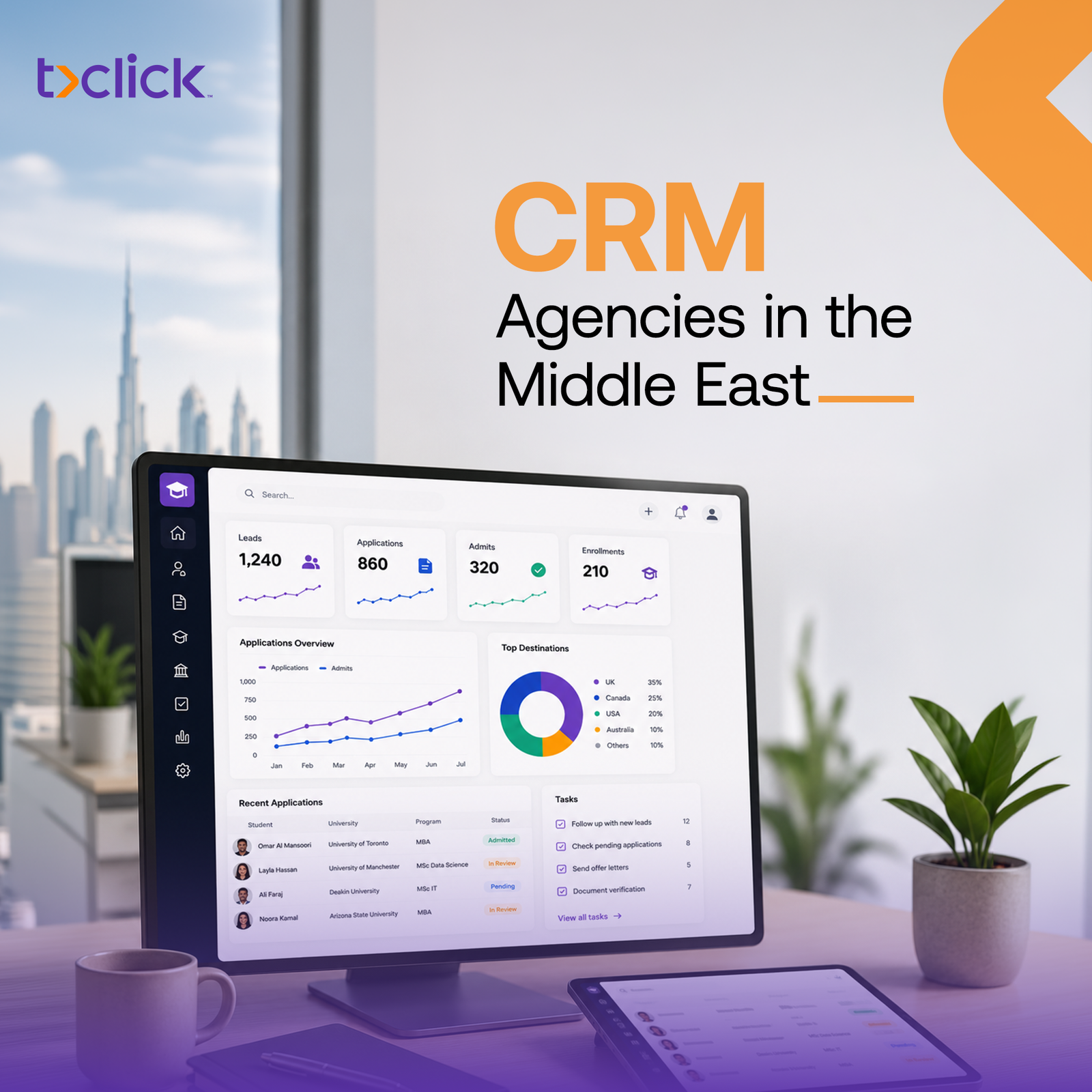
The Middle East has become one of the fastest-growing regions for international education, student mobility, and cross-border academic partnerships. Countries such as Saudi Arabia, the United Arab Emirates, Qatar, Kuwait, Bahrain, Oman, Jordan, and Egypt are investing heavily in education, digital transformation, and international collaboration, creating new opportunities for education agencies across the region.
As demand for studying abroad, language programs, exchange opportunities, and international admissions continues to rise, education agencies are managing significantly more student inquiries, university partnerships, applications, and recruitment campaigns than ever before.
However, growth also brings new operational challenges.
Many education agencies still rely on spreadsheets, emails, WhatsApp conversations, and disconnected systems to manage student recruitment. While these methods may work for smaller teams, they quickly become difficult to manage as recruitment volumes increase.
Missed follow-ups, scattered student records, delayed application processing, and limited visibility into recruitment performance can all slow growth and negatively impact the student experience.
This is why more organizations are investing in a CRM for education agencies in the Middle East.
Unlike generic CRM platforms, education-focused CRM software is designed to support the complete student lifecycle—from the first inquiry to enrollment and beyond. It helps agencies centralize student information, automate recruitment workflows, improve collaboration, strengthen university partnerships, and gain real-time visibility into recruitment performance.
Instead of switching between multiple tools, education organizations can manage recruitment, admissions, communication, and reporting from one centralized platform.
In this guide, you’ll learn why CRM software has become essential for education agencies across the Middle East, the challenges it solves, the features that matter most, and how the right solution can help organizations improve recruitment performance while supporting sustainable growth.
Why Education Agencies Across the Middle East Are Transforming Their Operations
The education sector across the Middle East has changed dramatically over the past decade.
Digital transformation initiatives, growing investments in higher education, and increasing demand for international study opportunities have reshaped the way education agencies operate.
Organizations are no longer competing solely on the universities they represent—they are also competing on service quality, operational efficiency, and the overall student experience.
To remain competitive, agencies need systems that help them manage larger recruitment pipelines while delivering personalized support at every stage of the student journey.
Growing Demand for International Education
More students across the Middle East are exploring educational opportunities abroad than ever before.
Whether pursuing undergraduate degrees, postgraduate programs, language courses, exchange programs, or professional certifications, students are actively seeking guidance from education agencies that can help them navigate increasingly complex admissions processes.
Popular study destinations include:
| Destination | Why Students Choose It |
| United Kingdom | Globally recognized universities and postgraduate opportunities |
| Canada | High-quality education and post-study work opportunities |
| Australia | Strong student support and career pathways |
| United States | Diverse academic programs and research excellence |
| Germany | Affordable tuition and engineering programs |
| Ireland | Growing technology and business education opportunities |
As recruitment demand grows, agencies must manage more consultations, applications, university partnerships, and student communication without sacrificing service quality.
A CRM provides the operational structure needed to support this growth efficiently.
Digital Transformation Across the Education Sector
Governments and educational institutions throughout the Middle East continue to invest heavily in digital transformation.
Students have also embraced digital-first communication.
Today, prospective students expect to:
- Submit inquiries online
- Schedule virtual consultations
- Receive application updates quickly
- Communicate through WhatsApp and email
- Upload documents digitally
- Track their progress throughout the admissions process
Education agencies must therefore operate with the same level of digital efficiency.
A CRM helps organizations centralize these interactions while improving communication and operational consistency.
Student Expectations Are Changing
Today’s students expect more than basic admissions support.
They want agencies that understand their academic goals, respond promptly, and provide personalized guidance throughout their journey.
Students increasingly expect:
- Fast response times
- Personalized program recommendations
- Transparent admissions guidance
- Regular progress updates
- Professional communication
- Consistent support from inquiry to enrollment
Meeting these expectations becomes challenging when student information is spread across multiple systems.
A CRM creates a complete student profile containing communication history, consultation notes, applications, documents, and upcoming tasks, allowing consultants to provide more informed and personalized support.
Recruitment Is Becoming More Competitive
The international education sector in the Middle East has become increasingly competitive.
Students can choose between:
- Local education agencies
- International recruitment firms
- University admissions offices
- Online recruitment platforms
- Independent education consultants
As competition grows, agencies must differentiate themselves through operational excellence rather than simply offering access to universities.
Organizations that respond quickly, maintain organized recruitment processes, and provide exceptional student experiences are more likely to build trust and improve enrollment outcomes.
CRM software helps agencies achieve this by streamlining workflows and improving collaboration across recruitment teams.
Multi-Country Recruitment Requires Better Systems
Many education agencies in the Middle East operate across multiple countries or recruit students for institutions worldwide.
A single agency may support students from Saudi Arabia, Jordan, Egypt, and the UAE while working with universities in the UK, Canada, Australia, and Europe.
Managing these cross-border operations introduces additional complexity.
Recruitment teams must coordinate:
- Multiple destination countries
- Different admissions requirements
- Various visa processes
- International university partnerships
- Students from different markets
- Recruitment campaigns across several regions
Without centralized systems, maintaining visibility across these operations becomes increasingly difficult.
A CRM provides one platform where organizations can manage international recruitment workflows, monitor student progress, and coordinate communication across teams and partner institutions.
Better Visibility Leads to Better Decisions
As agencies expand, leadership teams need accurate, real-time insights into recruitment performance.
Questions such as the following become essential:
- Which recruitment channels generate the highest-quality leads?
- Which counselors achieve the best conversion rates?
- Which university partnerships deliver the strongest results?
- Which markets generate the highest enrollment numbers?
- Where are students dropping out of the recruitment process?
Without centralized reporting, answering these questions often requires manual spreadsheets and time-consuming analysis.
A CRM transforms recruitment data into actionable insights through real-time dashboards and analytics, enabling managers to make faster, more informed strategic decisions.
👉 Learn how education-focused CRM software simplifies student recruitment and daily operations.
The Biggest Challenges Facing Education Agencies in the Middle East
The education sector in the Middle East has experienced significant growth over the past decade. While this expansion has created new opportunities for education agencies, it has also introduced operational challenges that become more difficult to manage as organizations scale.
From handling thousands of student inquiries to coordinating with international universities, agencies need structured processes that support efficiency and long-term growth.
Let’s explore some of the most common challenges education agencies face across the region.
Managing Thousands of Student Inquiries
Student inquiries now come from a wide range of online and offline channels.
These may include:
- Google Search
- Social media campaigns
- Agency websites
- Email marketing
- Education fairs
- University events
- Referral programs
While generating more inquiries is a positive sign, managing them manually often creates bottlenecks.
Without a centralized system, agencies may struggle to:
- Respond to inquiries quickly
- Assign leads to the appropriate counselor
- Track follow-up activities
- Monitor recruitment progress
- Prevent duplicate student records
A CRM centralizes lead management, ensuring every prospective student is captured, tracked, and nurtured throughout the recruitment process.
Operating Across Multiple Countries
Many education agencies in the Middle East recruit students from several countries while working with universities around the world.
Managing these cross-border operations requires careful coordination.
Agencies often need to handle:
- Country-specific admission requirements
- Different academic calendars
- Multiple visa processes
- Regional marketing campaigns
- International university partnerships
Without standardized workflows, maintaining consistency across multiple markets becomes increasingly difficult.
A CRM enables organizations to manage all recruitment activities from one platform, regardless of where students or university partners are located.
Managing Multiple University Partnerships
Strong university partnerships are essential for successful student recruitment.
However, as agencies expand their network of institutions, keeping track of communication, agreements, recruitment performance, and application requirements becomes increasingly complex.
A CRM allows organizations to centralize partnership information by storing:
- University profiles
- Key contacts
- Admission requirements
- Communication history
- Recruitment performance
- Student placement records
This improves collaboration while helping agencies build stronger long-term relationships with partner institutions.
Keeping Student Data Organized
Every student generates a significant amount of information throughout the recruitment journey.
This may include:
- Personal information
- Consultation notes
- Academic records
- Program preferences
- Application documents
- Visa updates
- Communication history
When this information is stored across multiple systems, finding the right data becomes time-consuming and increases the risk of errors.
A CRM creates a single, centralized student profile that gives authorized team members instant access to everything they need.
Coordinating Admissions and Visa Processes
Admissions and visa support are among the most detailed stages of international student recruitment.
Agencies must manage:
- University applications
- Required documents
- Offer letters
- Deposit deadlines
- Visa documentation
- Embassy appointments
- Pre-departure preparation
Because every destination has different requirements and timelines, manual tracking can easily lead to delays or missed deadlines.
A CRM provides structured workflows that help recruitment teams monitor progress and ensure every student completes the required steps on time.
Communication Across Multiple Channels
Modern students communicate through multiple platforms throughout their recruitment journey.
These commonly include:
- Phone calls
- Video meetings
- Social media
- Website chat
Keeping track of conversations across different platforms can quickly become overwhelming.
A CRM stores every interaction within the student’s profile, giving consultants a complete communication history and ensuring every conversation continues seamlessly.
Limited Recruitment Visibility
As recruitment operations grow, managers need real-time insights into performance.
Without centralized reporting, it becomes difficult to answer questions like:
- Which recruitment campaigns generate the best results?
- Which counselors have the highest conversion rates?
- Which universities produce the most enrollments?
- Where are students getting stuck in the recruitment process?
CRM software provides real-time dashboards that help organizations monitor recruitment performance, identify bottlenecks, and make data-driven decisions.
👉 Discover how student recruitment software supports growing education organizations.
Common Operational Challenges
| Challenge | Business Impact |
| Manual follow-ups | Lost enrollment opportunities |
| Scattered student records | Limited operational visibility |
| Multiple disconnected systems | Reduced productivity |
| Slow reporting | Delayed decision-making |
| Manual administrative tasks | Increased operational costs |
| Poor collaboration | Inconsistent student experiences |
What Is a CRM for Education Agencies?
A CRM for education agencies is much more than a contact management system.
It is a specialized platform designed to help organizations manage the complete student recruitment lifecycle—from the first inquiry through enrollment, alumni engagement, and ongoing university relationships.
Instead of managing recruitment through separate spreadsheets, emails, and messaging platforms, agencies can centralize every stage of the student journey within one integrated system.
This creates better visibility, stronger collaboration, and a more consistent experience for both students and recruitment teams.
More Than a Traditional CRM
Traditional CRM platforms are designed primarily for sales organizations.
While they can manage leads and customer relationships, they often lack the functionality education agencies require.
Education organizations need software capable of supporting:
- Student inquiry management
- Consultation tracking
- Program recommendations
- Admissions workflows
- Application management
- Document collection
- Visa tracking
- University partnership management
- Student lifecycle management
A purpose-built education CRM combines all of these functions into one platform, reducing the need for multiple disconnected systems.
Built Around the Student Lifecycle
Every prospective student follows a journey that involves several stages before enrollment.
These stages typically include:
Inquiry → Consultation → Qualification → Program Matching → Application → Offer Letter → Visa Support → Enrollment → Alumni
A CRM provides visibility into every stage, allowing recruitment teams to monitor progress, automate follow-ups, and provide personalized support throughout the student journey.
This structured approach improves both operational efficiency and the overall student experience.
Why Generic CRM Platforms Fall Short
Generic CRM systems are designed to support sales pipelines—not admissions and student recruitment.
While they may offer basic contact management, they often require extensive customization before they can support education-specific workflows.
Education agencies need features such as:
- Application tracking
- Admissions workflows
- University partnership management
- Student document management
- Recruitment reporting
- Student lifecycle visibility
Choosing a CRM built specifically for education organizations reduces implementation complexity while providing tools that directly support recruitment success.
Traditional CRM vs Education CRM
| Traditional CRM | Education CRM |
| Built for sales teams | Built for education organizations |
| Generic sales pipelines | Student recruitment lifecycle |
| Basic contact management | Complete student lifecycle management |
| Limited workflow automation | Admissions and recruitment automation |
| Generic reporting | Recruitment and enrollment analytics |
| Requires extensive customization | Ready-to-use education workflows |
👉 Learn how automation can improve response times and reduce manual work.
The Student Recruitment Lifecycle Every Education Agency Should Manage
Every prospective student follows a journey before becoming successfully enrolled.
From the initial inquiry to final enrollment, each stage requires timely communication, accurate documentation, and effective collaboration between recruitment teams and university partners.
Without a structured process, agencies may experience missed follow-ups, application delays, and inconsistent student experiences.
A CRM helps education agencies manage the entire recruitment lifecycle from one centralized platform, ensuring every student receives the right support at the right time.
Inquiry and Lead Capture
The recruitment journey begins when a prospective student expresses interest in studying abroad.
Whether the inquiry comes from a website, social media campaign, education fair, or referral partner, every lead should be captured automatically and assigned to the appropriate recruitment consultant.
Centralized lead management ensures that no inquiry is missed while giving agencies complete visibility into their recruitment pipeline.
Student Consultation
The consultation stage is where agencies begin understanding a student’s academic background, career goals, budget, and preferred study destination.
A CRM enables consultants to record meeting notes, schedule follow-ups, and maintain a complete history of every interaction.
Having all consultation details in one place allows teams to provide more personalized guidance throughout the recruitment process.
Qualification and Counseling
Not every student is eligible for every university or program.
During qualification, counselors evaluate factors such as:
- Academic performance
- English language proficiency
- Financial readiness
- Career objectives
- Preferred destination
Recording this information within a CRM helps agencies recommend suitable programs while reducing unnecessary application submissions.
Program and University Matching
Selecting the right institution is one of the most important decisions for prospective students.
A CRM allows consultants to match students with universities based on their qualifications, interests, and long-term goals while keeping track of recommended institutions and application priorities.
This structured approach improves the quality of counselling and increases the likelihood of successful admissions.
Application Management
Application management involves multiple documents, deadlines, and communication with partner institutions.
A CRM centralizes the entire process, allowing recruitment teams to monitor:
- Submitted applications
- Outstanding requirements
- University responses
- Offer letters
- Acceptance deadlines
With better visibility into every application, agencies can reduce delays and improve operational efficiency.
Offer Letter Tracking
Receiving an offer letter is an important milestone, but it also introduces new responsibilities.
Education agencies must monitor offer conditions, acceptance deadlines, tuition deposits, and student decisions.
A CRM helps teams manage these activities efficiently while ensuring students receive timely guidance during the decision-making process.
Visa and Pre-Departure Support
After accepting an offer, students require ongoing support before traveling abroad.
Agencies often assist with:
- Visa documentation
- Embassy appointments
- Financial requirements
- Accommodation guidance
- Travel preparation
- Pre-departure orientations
Tracking these activities within a CRM helps ensure every requirement is completed before departure.
Enrollment and Beyond
The student journey doesn’t end after enrollment.
Many agencies continue supporting students through onboarding, follow-up communication, and alumni engagement.
Maintaining these relationships can also generate referrals, testimonials, and future recruitment opportunities.
A CRM enables agencies to continue building long-term relationships long after the admissions process is complete.
👉 Explore secure CRM solutions built specifically for education organizations.
Essential CRM Features for Education Agencies in the Middle East
While every education agency has unique operational requirements, certain CRM capabilities are essential for managing student recruitment effectively.
The right platform should simplify daily operations while supporting long-term organizational growth.
Student Lifecycle Management
A complete view of the student journey allows recruitment teams to monitor progress from the initial inquiry through enrollment.
Centralizing lifecycle management improves visibility, enhances collaboration, and ensures every student receives consistent support.
Lead Management
A CRM should automatically capture, organize, and track inquiries from multiple recruitment channels.
This helps agencies respond faster, assign leads efficiently, and improve conversion rates.
Recruitment Pipelines
Visual recruitment pipelines provide real-time visibility into every student’s progress.
Consultants and managers can quickly identify where students are in the admissions process and prioritize follow-up activities accordingly.
Application Tracking
Managing multiple university applications becomes significantly easier when deadlines, documents, and admission decisions are tracked from one centralized platform.
This reduces administrative work while improving application accuracy.
Secure Document Management
Education agencies handle large volumes of confidential student information.
A CRM should provide secure document storage, allowing authorized users to upload, organize, and retrieve files quickly while maintaining data security.
University Partner Management
Strong relationships with partner institutions are essential for long-term recruitment success.
A CRM enables agencies to organize university contacts, partnership details, recruitment performance, and communication history within one system.
Workflow Automation
Automation helps eliminate repetitive administrative tasks by automatically assigning leads, creating reminders, updating recruitment stages, and notifying team members about important deadlines.
This improves productivity while ensuring consistency across recruitment operations.
Reporting and Analytics
Real-time reporting helps agencies measure recruitment performance and identify opportunities for improvement.
Key metrics such as lead conversion, application progress, enrollment rates, and counselor productivity enable managers to make better business decisions.
Team Collaboration
A centralized CRM creates a shared workspace where recruitment consultants, admissions teams, visa specialists, and managers can collaborate using the same up-to-date student information.
This reduces communication gaps while improving operational efficiency.
Security and Permissions
Protecting student information is essential.
A professional education CRM should include role-based access controls, secure cloud storage, activity tracking, and permission management to safeguard sensitive student and institutional data.
CRM Feature Checklist
| Feature | Essential |
| Student Lifecycle Management | ✅ |
| Lead Management | ✅ |
| Recruitment Pipeline | ✅ |
| Application Tracking | ✅ |
| Secure Document Management | ✅ |
| University Partner Management | ✅ |
| Workflow Automation | ✅ |
| Reporting & Dashboards | ✅ |
| Team Collaboration | ✅ |
| Security & Permissions | ✅ |
How CRM Software Improves Student Recruitment
A CRM does more than organize student information—it helps education agencies build a more efficient and scalable recruitment process.
By centralizing recruitment activities and automating routine tasks, agencies can:
- Respond to inquiries faster
- Improve follow-up consistency
- Increase student conversion rates
- Streamline admissions workflows
- Strengthen collaboration across teams
- Make better decisions using real-time data
Ultimately, a CRM enables agencies to deliver a better student experience while supporting sustainable business growth.
Before CRM vs After CRM
| Before CRM | After CRM |
| Manual follow-ups | Automated workflows |
| Scattered student records | Centralized database |
| Limited reporting | Real-time dashboards |
| Slow response times | Faster student engagement |
| Difficult to scale | Growth-ready operations |
How to Choose the Right CRM for Your Education Agency
Not every CRM is designed for the education industry. Before making a decision, agencies should evaluate whether the platform supports their current needs while remaining flexible enough for future growth.
Consider the following factors:
- Education-specific functionality
- Student lifecycle management
- Workflow automation
- Reporting and analytics
- Multi-country recruitment support
- Data security and user permissions
- Ease of implementation
- Reliable customer support
Choosing a CRM that aligns with your recruitment process will help maximize both operational efficiency and long-term return on investment.
Why Ticlick Is Built for Education Agencies in the Middle East
Ticlick is designed specifically for organizations involved in international student recruitment.
Instead of adapting a generic CRM, education agencies can manage the complete student lifecycle through one centralized platform.
With Ticlick, organizations can:
- Centralize student recruitment and admissions
- Track applications and documents
- Automate repetitive recruitment tasks
- Manage university partnerships
- Monitor recruitment performance with real-time reporting
- Support teams operating across multiple countries
Whether your agency is expanding locally or recruiting students across the Middle East, Ticlick provides the tools needed to improve efficiency and support sustainable growth.
Frequently Asked Questions
What is a CRM for education agencies?
A CRM for education agencies is software that helps organizations manage student recruitment, admissions, communication, applications, and university partnerships from one centralized platform.
Why do education agencies in the Middle East need a CRM?
A CRM helps agencies manage growing recruitment volumes, automate workflows, improve collaboration, and provide a better experience for prospective students.
Can a CRM improve student recruitment?
Yes. By organizing recruitment activities, automating follow-ups, and providing real-time insights, CRM software helps agencies increase efficiency and improve enrollment outcomes.
What features should an education CRM include?
Key features include lead management, student lifecycle management, application tracking, workflow automation, document management, reporting, and university partnership management.
Conclusion
As international education continues to grow across the Middle East, education agencies need smarter systems to manage increasing recruitment demands. Manual processes and disconnected tools can slow operations and limit an organization’s ability to scale.
A purpose-built CRM helps agencies centralize recruitment, streamline admissions, improve collaboration, and deliver a more personalized student experience.
Solutions like Ticlick provide education agencies with the technology needed to manage the complete student lifecycle, strengthen university partnerships, and support sustainable growth in an increasingly competitive education market.