
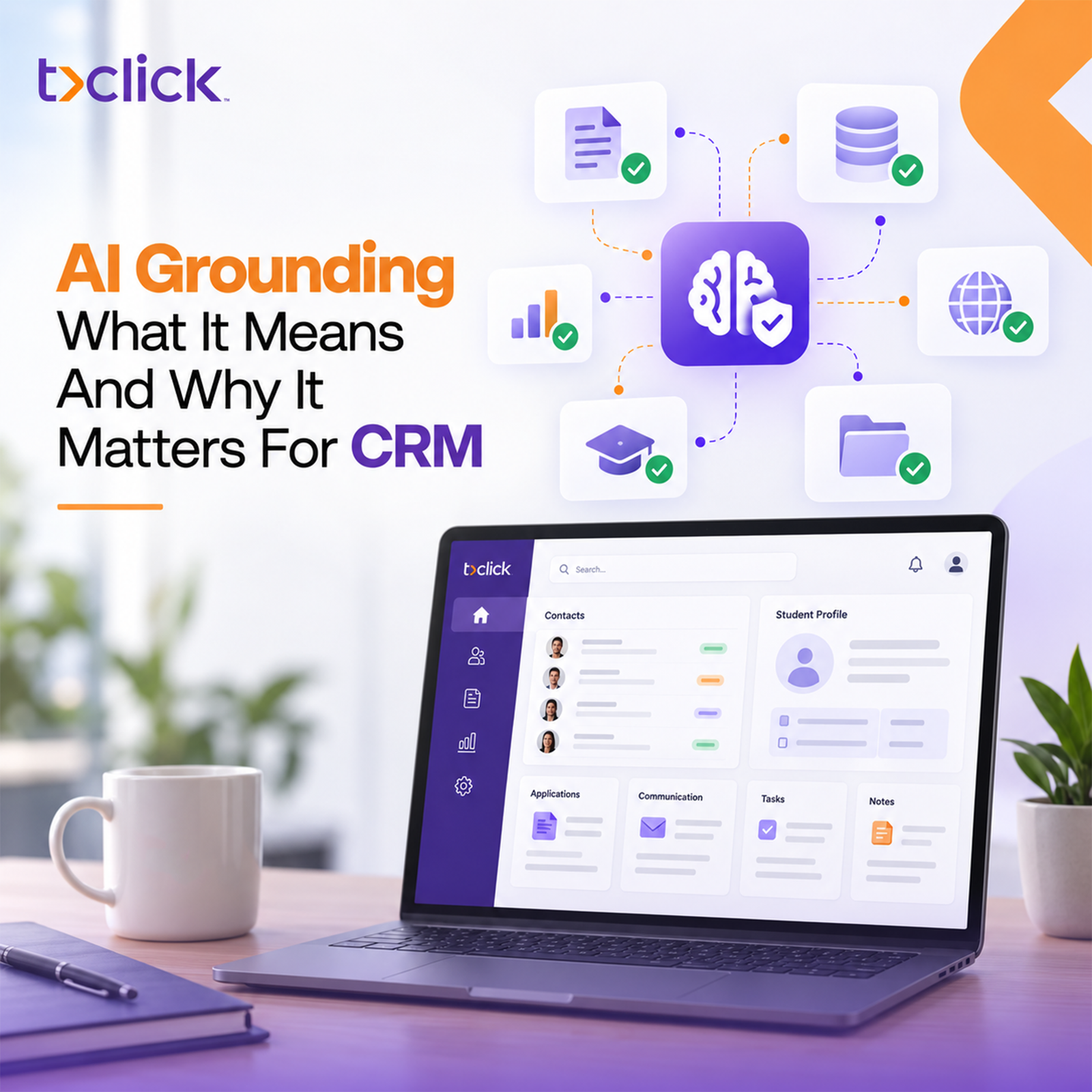
A CRM can contain thousands of customer or student records, years of communication history, documents, tasks, application updates, payment information, notes, and operational data.
An AI model, however, does not automatically understand any of it.
This distinction is becoming increasingly important as AI assistants move from standalone productivity tools into business systems. It is relatively easy to give users a chatbot that can generate an email or answer a general question. It is much harder to build an AI experience that understands what is actually happening inside an organization and produces answers based on information the organization can trust.
That is where AI grounding becomes important.
Grounding connects AI-generated responses to relevant, verifiable information rather than relying exclusively on the model’s general knowledge. In a CRM environment, that information can potentially include authorized CRM records, communication histories, internal knowledge, documents, policies, and other business data.
For organizations exploring AI-powered CRM, grounding is therefore not simply another technical term. It helps answer a fundamental question:
What information is the AI using when it gives us this answer?
Understanding that question is essential if businesses want AI that is not only impressive in conversation, but genuinely useful in day-to-day operations.
What Is AI Grounding?
AI grounding is the process of connecting an AI model’s output to relevant sources of information that can provide factual or contextual support for its response.
Large language models are trained on enormous amounts of data and can perform tasks such as answering questions, generating text, summarizing information, and interpreting natural language. However, their general training does not automatically give them access to an organization’s current CRM records or private operational context.
Grounding helps bridge that gap.
A simplified model looks like this:
User Question → Relevant Trusted Information → AI Model → Contextual Response
Without grounding, the AI may answer using its general knowledge and whatever information the user includes in the prompt.
With grounding, relevant external information can be provided to the model so its response is anchored more closely to the organization’s actual context.
This is particularly important in CRM.
A general AI model might understand what an “application deadline” means.
It does not automatically know that a particular student is applying to a particular institution, has two missing documents, was contacted three days ago, and has a deadline approaching next week.
That information exists inside the organization’s operational environment.
Grounding is part of what can make that context useful to AI.
Why Does AI Need Grounding?
Generative AI is powerful partly because it can produce fluent, confident responses across a wide range of subjects.
That strength can also create a problem.
A response can sound convincing without being adequately supported by the facts relevant to the specific situation.
AI systems can generate incorrect or unsupported information, commonly described as hallucination. Grounding is one technique used to reduce this risk by connecting model responses to relevant sources.
But reducing hallucinations is only one reason grounding matters.
General AI Does Not Automatically Know Your Business
A model may understand common CRM concepts.
It does not inherently know:
- Your current customers or students
- Their latest status
- Your internal processes
- Recent conversations
- Current applications
- Outstanding documents
- Your organization’s policies
- Current tasks and deadlines
- Internal knowledge that was never part of its training data
The difference is between knowing how businesses generally operate and knowing what is happening inside your business now.
For CRM use cases, the second type of knowledge is often what employees actually need.
Business Information Changes Constantly
CRM information is dynamic.
A lead becomes qualified.
A student submits a document.
An application moves to another stage.
A customer replies.
A payment is recorded.
A task is completed.
A deadline changes.
Even if an AI model had previously encountered some related information, business operations continue changing.
Grounding allows an AI system to work with relevant information retrieved from connected sources at the time it is needed rather than depending entirely on what the model learned during training.
Business Questions Require Business Context
Consider the question:
“Which applications need attention today?”
A general model cannot answer that meaningfully without access to relevant operational information.
To produce a useful response, the system may need context such as:
- Active applications
- Current application stages
- Deadlines
- Missing requirements
- Recent activity
- Outstanding tasks
- Assigned staff
The quality of the answer therefore depends not only on the intelligence of the model, but also on the quality and relevance of the context available to it.
Grounded AI vs Ungrounded AI
The difference becomes clearer with a simple CRM example.
Imagine a study abroad counselor asks:
“What should I know before my call with this student?”
An AI tool without access to the student’s record cannot reliably know the answer.
It might provide general advice about preparing for a student consultation.
A grounded CRM experience could potentially use authorized information from the student’s record to help summarize:
Preferred Destination → Programs Discussed → Application Status → Previous Communication → Missing Documents → Upcoming Actions
The difference is substantial.
| Ungrounded AI | Grounded AI |
| Relies mainly on general model knowledge and prompt context | Uses relevant external information as additional context |
| May provide a generic response | Can provide an organization-specific response |
| Does not inherently know current CRM records | Can work with retrieved CRM information when appropriately connected |
| May lack current business context | Can use more recent operational information |
| Harder to connect an answer to internal facts | Can be designed to make supporting sources more visible |
The important point is that grounding does not make AI infallible.
It gives the model a stronger factual and contextual foundation for producing its response.
What Does AI Grounding Mean in CRM?
In CRM, grounding means giving an AI system access to relevant, permitted business information that can help it respond within the context of the organization’s actual operation.
Depending on the architecture and use case, grounding sources could include:
- CRM records
- Customer or student profiles
- Communication histories
- Application information
- Case histories
- Internal knowledge bases
- Product or service information
- Documents
- Policies and procedures
- Tasks and workflow data
The exact source should depend on the question.
If an employee asks about a student’s application, the AI should not need every piece of information in the entire CRM. It needs the information relevant to that student, that application, and that request.
A useful conceptual flow is:
Question → Retrieve Relevant Context → Generate Response From That Context → Show or Preserve Supporting Evidence → Human Action
This is why grounding is closely connected to information retrieval.
The goal is not simply to give AI more data.
The goal is to give it the right data for the current task.
A Practical Example of AI Grounding in a Study Abroad CRM
Consider an international education agency with thousands of student records.
A counselor asks:
“Summarize this student’s application history before my consultation.”
Without CRM context, a general AI model cannot know the student’s history.
A grounded workflow could potentially operate like this:
- Counselor asks the question.
↓
- The system identifies the relevant student record.
↓
- Authorized information related to the student’s journey is retrieved.
↓
- Relevant context is provided to the AI model.
↓
- The model generates a summary based on that context.
↓
- The counselor reviews the result and can verify important information against the CRM.
Instead of receiving generic consultation advice, the counselor gets information related to the actual case.
The same principle could apply to questions such as:
- Which applications have deadlines this week?
- Which active students still have missing documents?
- What happened during this student’s last interaction?
- Which applications have not progressed recently?
- Which cases require follow-up?
Ticlick’s current AI Assistant content describes these types of natural-language interactions with CRM information, including student-history summaries and identifying applications that may require attention.
The value does not come from conversation alone.
It comes from connecting conversation with meaningful recruitment context.
Want to see what this can look like in international education? Explore AI Assistant for Study Abroad CRM to learn how CRM-connected AI can help recruitment teams work with student and application information more efficiently.
AI Grounding vs RAG: Are They the Same Thing?
AI grounding and retrieval-augmented generation, or RAG, are closely related, but it is more accurate not to treat them as identical terms.
Grounding is the broader objective: connecting AI output to relevant, verifiable information.
RAG is a common technique for achieving that objective.
RAG typically introduces a retrieval step before generation.
A simplified RAG workflow looks like:
User Question → Search/Retrieve Relevant Information → Add Information to Model Context → Generate Response
Instead of expecting the language model to answer exclusively from what it learned during training, the system retrieves relevant external information and provides that information as context for generation.
This makes RAG particularly useful when organizations want AI to work with proprietary, specialized, or frequently changing information.
So:
Grounding = The Goal
RAG = One Common Method Used to Achieve It
Keeping this distinction clear matters because not every grounded system needs to be described in exactly the same architectural terms.
Grounding Is Not the Same as Training an AI Model
Another common misconception is that connecting AI to company information means retraining the model on all company data.
That is not necessarily how grounding works.
Model training changes what the model learns as part of its parameters.
Grounding can instead provide relevant external context when a request is being processed.
Conceptually:
Training:
Information becomes part of what the model learns.
Grounding:
Relevant information is supplied or retrieved as context when the model needs to answer.
This difference matters for CRM because business data changes constantly.
Retraining a model every time a student submits a document or a sales opportunity changes stage would not be a practical way to maintain current operational context.
Retrieval-based grounding can instead work with information available from connected sources at the time of the request.
Why AI Grounding Matters for CRM
Grounding becomes particularly important in CRM because CRM systems contain context that general AI models do not inherently possess.
1. Grounding Can Make AI Responses More Relevant
A generic AI response may be technically correct but operationally useless.
Suppose a counselor asks:
“What should happen next with this application?”
A generic model can describe typical admissions processes.
A CRM-connected system can potentially use relevant information such as the current stage, outstanding requirements, deadlines, previous actions, and approved workflows to produce a more contextual response.
The improvement is:
General Knowledge → Organizational Context
That is what turns AI from a broad information tool into something potentially useful inside daily CRM work.
2. Grounding Can Reduce Hallucination Risk
One of the major reasons organizations use grounding is to reduce unsupported AI responses.
When relevant facts are retrieved and provided to the model, it has a stronger basis for generating an answer than if it relied exclusively on general model knowledge.
However, the wording here matters.
Grounding can reduce hallucination risk.
It does not eliminate it.
An AI model may still misunderstand retrieved information, combine facts incorrectly, overlook an important source, or generate a conclusion that is not fully supported.
The correct model is therefore:
Grounding → Better Evidence → Lower Risk
not:
Grounding → Guaranteed Truth
For consequential CRM decisions, verification and appropriate human review remain necessary.
3. Grounding Can Make AI More Useful With Current Information
CRM data changes continuously.
A student who had missing documents yesterday may have submitted them this morning.
A customer who had not replied may have responded ten minutes ago.
An application that was pending may now have moved to another stage.
Grounding can allow AI systems to work with more current information from connected sources instead of relying only on static model knowledge.
The exact freshness depends on how the underlying system retrieves, indexes, synchronizes, and updates its data.
This means “grounded” should not automatically be interpreted as “real-time.”
A grounded response is only as current as the information available to the grounding process.
4. Grounding Can Make AI Responses More Specific to the Organization
Two study abroad agencies may manage similar student journeys while having different:
- Internal processes
- Destinations
- Programs
- Team structures
- Service models
- Application procedures
- Communication standards
- Policies
- Responsibilities
A generic AI model may understand international student recruitment.
Grounding can help an AI system work with information specific to the organization using it.
That difference can be summarized as:
Generic AI:
“What normally happens?”
Grounded CRM AI:
“What does our available information say is happening here?”
For business use, that second question is often more valuable.
5. Grounding Can Reduce Time Spent Searching for Information
One of the biggest CRM problems is not necessarily a lack of information.
It is the effort required to find it.
Employees may need to:
Search → Filter → Open Record → Read Notes → Check Messages → Review Tasks → Combine Context
An appropriately designed AI assistant can potentially shorten that journey:
Ask → Retrieve → Summarize → Review
For study abroad teams, this could mean faster answers to operational questions such as:
“Which September applicants still have missing documents?”
or:
“Summarize this student’s journey before my call.”
Ticlick’s current AI Assistant material focuses heavily on this use case: helping users interact with student recruitment information through natural-language requests instead of repeatedly navigating records and filters.
This is one reason grounding matters beyond accuracy.
It can also improve how easily employees use the information already stored in CRM.
6. Grounding Can Support Better Personalization
AI personalization is often discussed as though adding a student’s first name to a generated message makes communication personal.
Real personalization requires context.
Relevant CRM context might include:
- Destination preference
- Intake
- Program interest
- Application stage
- Previous conversation
- Outstanding action
- Communication history
When AI has access to appropriate and permitted context, it can potentially help prepare communication that reflects where the person actually is in the journey.
Compare:
Generic:
“Hi, just following up on your application.”
with a context-aware draft based on verified CRM information:
Contextual:
A follow-up that addresses the specific outstanding requirement and relevant next step.
The goal is not longer or more sophisticated communication.
It is more relevant communication.
7. Grounding Can Improve AI Summaries
Summarization is one of the most practical CRM use cases for generative AI.
But a summary is useful only when the system has access to the right material.
For example, a student summary based only on the latest CRM note may miss important information in the application history.
A better grounding process may retrieve multiple relevant sources before the model creates the summary.
This introduces another important principle:
AI output quality depends not only on the model, but also on what information is retrieved for the model to use.
That is why grounding is partly an information-management problem, not simply an AI problem.
Grounding Does Not Fix Bad CRM Data
Connecting AI to CRM data does not automatically make that data correct.
Suppose a student has:
Old CRM Record: Preferred destination: Germany
but the student’s latest verified preference is:
Current Preference: Netherlands
If the CRM was never updated, a grounded AI system could confidently use the wrong information.
The response may be grounded in the CRM and still be operationally wrong.
This creates an important chain:
CRM Data Quality → Grounding Quality → AI Response Quality
Poor inputs can produce poor grounded responses.
Common CRM data problems include:
- Outdated records
- Duplicate records
- Missing fields
- Inconsistent stage definitions
- Incomplete notes
- Conflicting information
- Unstructured information stored in the wrong places
Before organizations ask, “How intelligent is our AI?” they should also ask:
“How reliable is the information we are asking it to use?”
AI grounding makes CRM data quality more important, not less.
Grounding Does Not Mean Giving AI Access to Everything
More context is not automatically better context.
If an employee asks about a student’s application, the AI should not need unrestricted access to every confidential record in the organization.
Grounding should work alongside access control.
A sensible principle is:
User Permission → Permitted Data → Relevant Retrieval → AI Response
not:
AI Request → Entire Database
This matters because CRM systems may contain sensitive personal, financial, commercial, or internal information.
Ticlick’s current AI Assistant material makes a similar point: an AI assistant should not become a way to bypass CRM permissions. If a user is not authorized to access information normally, asking the AI should not provide a new route to that information.
For education organizations, user roles and permissions in an education CRM therefore remain important even as CRM experiences become more intelligent.
Grounding, Permissions, and Privacy Need to Work Together
An AI-powered CRM needs more than accurate retrieval.
It needs controlled retrieval.
Before using CRM information as AI context, organizations should consider questions such as:
- Which sources can the AI access?
- Which fields can each user access?
- Can sensitive information be excluded?
- Are permissions enforced during retrieval?
- Can users understand where an answer came from?
- How long is AI-related data retained?
- Which vendors or services process the information?
- What happens when access rights change?
- Can AI actions be audited?
The answers depend on the platform, implementation, applicable laws, contracts, and organizational policies.
The broader principle is straightforward:
Grounding should not expand a user’s access beyond what that user is permitted to know.
What Makes a Good Grounding Source?
Not every available document should automatically become an AI source.
A useful grounding source should ideally be:
Relevant
The information should help answer the type of question being asked.
Accurate
Incorrect information becomes dangerous when an AI system presents it fluently.
Current
Old policies, expired program details, or outdated student information can lead to misleading responses.
Authoritative
Organizations should distinguish official sources from drafts, informal notes, or unverified material.
Accessible to the Right Users
The grounding system should respect organizational permissions.
Structured Enough to Retrieve Effectively
If important information is buried in inconsistent files with unclear naming and duplicate versions, retrieval becomes harder.
This means AI readiness often begins before AI.
It begins with information architecture.
More Data Does Not Always Mean Better Grounding
A common instinct is to connect AI to as much information as possible.
That can be counterproductive.
Imagine asking:
“What is the status of Sarah’s application?”
The useful context may be a small collection of records relating to Sarah, her current application, recent communication, and outstanding tasks.
Retrieving hundreds of unrelated records does not necessarily improve the answer.
It may introduce noise.
Effective grounding therefore involves both access and selection.
Available Information ≠ Relevant Information
A good system needs a way to identify which information is most useful for the current request.
Why Source Visibility Matters
Grounding becomes more valuable when users can understand what supports an AI response.
For a low-stakes task, a generated draft may be sufficient.
For an important operational question, the employee may need to know:
Where did this information come from?
This is especially relevant when an answer influences an application, payment, deadline, or student communication.
Source visibility can help users:
- Verify important claims
- Detect outdated information
- Understand why the AI produced an answer
- Resolve conflicting records
- Maintain appropriate human oversight
The objective should not be to make employees trust AI automatically.
It should be to make AI output easier to verify when verification matters.
Can Grounded AI Still Be Wrong?
Yes.
This is one of the most important facts to understand about AI grounding.
A grounded system can still produce an incorrect answer.
Several things can go wrong.
The Wrong Information May Be Retrieved
The relevant source may exist, but the retrieval system may select a less relevant document.
The Source Itself May Be Wrong
Grounding cannot correct a CRM record simply because it is stored in the CRM.
The Information May Be Outdated
A previous policy or student status may no longer apply.
The Model May Misinterpret the Source
Correct information can still be summarized incorrectly.
Relevant Context May Be Missing
The system may retrieve only part of the information required to answer safely.
Therefore:
Grounded ≠ Guaranteed Correct
A better interpretation is:
Grounded = The Response Has a Relevant Evidence Base That Can Improve Accuracy and Verifiability
That is a much more realistic standard for enterprise AI.
AI Grounding and Human Review
The amount of human review required should depend on the consequence of the AI output.
For example:
Low Consequence:
Summarizing internal notes for a counselor to review.
Moderate Consequence:
Preparing a student follow-up draft.
Higher Consequence:
Providing information related to admissions eligibility, payments, or visa requirements.
As consequences increase, human verification should become stronger.
A useful framework is:
Ground → Generate → Verify → Act
Grounding improves the information available to AI.
Verification determines whether the output is appropriate to use.
The two should complement each other.
Why Grounding Matters for AI Assistants Inside CRM
AI assistants are moving CRM interaction away from purely menu-based navigation.
Instead of always asking:
“Where is the report?”
users can increasingly ask:
“Which applications need attention?”
Instead of:
“Where are this student’s notes?”
they can ask:
“Summarize what happened with this student.”
But natural-language interfaces only become operationally valuable when the answers connect to the right information.
Otherwise, businesses have simply placed a generic chatbot inside a CRM screen.
A useful CRM assistant needs more than language generation.
It needs context.
That is why the relationship can be expressed as:
CRM = Operational Data
Grounding = Connection to Relevant Context
AI = Interpretation and Generation
Human = Verification, Judgment, and Action
Each layer has a different role.
Why Grounding Matters Even More for Study Abroad CRM
International student recruitment creates an unusually context-heavy CRM environment.
A student’s journey can involve:
- Personal information
- Academic history
- Destination preferences
- Multiple programs
- Multiple applications
- Intakes
- Documents
- Counseling notes
- Offers
- Payments
- Visa progress
- Communication history
- Deadlines
- Tasks
- Agents
- Internal team members
A useful answer may depend on several of those pieces at once.
For example:
“Which students should we contact about incomplete applications today?”
The system may need to consider current application status, missing requirements, deadlines, previous communication, and ownership.
That is very different from asking a general chatbot:
“Write a follow-up email for a student.”
The first question requires organizational context.
This is exactly why grounding matters in specialized CRM environments.
AI Grounding vs Fine-Tuning
Grounding is also different from fine-tuning.
Fine-tuning adapts a model by training it further on examples so that it performs particular tasks or follows desired patterns more effectively.
Grounding supplies relevant information at the time of use.
A simplified distinction is:
| Grounding | Fine-Tuning |
| Supplies relevant external context | Further adapts model behavior through training |
| Useful for current or changing information | Useful for specialized patterns or tasks |
| Can retrieve organization-specific information | Changes how the model responds based on training examples |
| Does not require every business update to become training data | Requires a training process |
The technologies can complement each other.
They solve different problems.
If the question is:
“What is this student’s current application status?”
current CRM context matters more than teaching the model a general pattern for what application statuses look like.
How Organizations Should Prepare CRM Data for AI Grounding
Grounding is only as useful as the information environment behind it.
Before relying heavily on grounded AI, organizations should strengthen several areas.
Clean Duplicate and Outdated Data
Multiple versions of the same truth make retrieval less reliable.
Define CRM Fields Consistently
Teams should agree on what stages, statuses, and fields actually mean.
Improve Note Quality
If important decisions are never recorded, AI cannot retrieve them later.
Establish Authoritative Sources
Employees and AI systems should be able to distinguish current official information from drafts and old material.
Review Roles and Permissions
Users should receive only the information they are authorized to access.
Create Clear Data Ownership
Someone should be responsible for keeping important information accurate.
Build Verification Into High-Stakes Workflows
The system should make it practical for employees to check important AI output before acting.
Organizations should not think of these steps as preparation for a distant AI future.
They are good CRM practices already.
AI simply makes their importance more visible.
How Should Businesses Evaluate Grounding in an AI-Powered CRM?
When evaluating an AI-enabled CRM, asking “Does it have AI?” is not enough.
More useful questions include:
What Information Can the AI Use?
Does it work only from the user’s prompt, or can it use relevant CRM context?
Where Does the Information Come From?
Can it work with records, communication, documents, knowledge sources, or other operational information?
How Current Is the Information?
How quickly do source updates become available to the AI experience?
Does It Respect Existing Permissions?
Can the AI expose information the user could not normally access?
Can Important Answers Be Verified?
Does the experience make it possible to inspect relevant source information?
What Happens When Sources Conflict?
Does the system surface uncertainty, choose one source silently, or allow users to investigate?
What Does the AI Do When It Cannot Find Enough Evidence?
A system should not always be rewarded for producing an answer.
Sometimes the safer response is effectively:
“I do not have enough reliable information to answer that.”
That can be more valuable than a confident guess.
AI Grounding Is Not Just an AI Problem
One of the biggest misconceptions about grounding is that it belongs entirely to the technical team.
In reality, effective grounding depends on several parts of the organization.
Technology teams determine how systems connect and retrieve information.
Operations teams define processes and authoritative sources.
Managers establish access and accountability.
Employees maintain the CRM information used as context.
Compliance and security teams determine appropriate data handling.
Grounding therefore exposes an important truth about enterprise AI:
AI quality is partly a reflection of organizational information quality.
If nobody knows which document is current, AI may not know either.
If teams use CRM stages inconsistently, AI inherits that inconsistency.
If important information remains outside the CRM, the AI may operate with incomplete context.
Better AI often starts with better information management.
How AI Grounding Fits Into Ticlick’s Approach to Smarter CRM
For international education organizations, the value of AI depends heavily on whether it understands the recruitment context surrounding a question.
Ticlick CRM is designed around student recruitment operations, where teams work with leads, student records, applications, documents, communication, tasks, payments, permissions, portals, and reporting.
That CRM foundation is important because useful AI needs meaningful operational context.
Ticlick’s current AI Assistant for Study Abroad CRM content describes an experience where users can interact with CRM information through natural-language requests. Examples include asking which students are still missing documents, which applications have not moved, and what happened during a student’s previous interactions.
This illustrates the business reason grounding matters:
AI becomes more useful when it can work with the information that gives the question meaning.
However, organizations should distinguish that business principle from assumptions about the underlying technical implementation. Specific retrieval architecture, grounding methods, or RAG implementation should be evaluated based on documented product capabilities rather than assumed from the presence of an AI assistant.
For study abroad organizations exploring this shift, AI Assistant for Study Abroad CRM provides a closer look at how AI can make recruitment information easier to access and understand.
You can also explore Ticlick CRM to see how a purpose-built CRM connects the operational foundation behind the international student journey.
What Could a Grounded AI Experience in CRM Look Like?
The strongest way to understand grounding is to follow the information.
Imagine a counselor asks:
“Which of my students need attention today?”
A well-designed experience could conceptually follow this process:
User Question
↓
Confirm User Identity and Permissions
↓
Interpret the Request
↓
Retrieve Relevant CRM Information
↓
Provide Relevant Context to the AI
↓
Generate the Response
↓
Allow Important Information to Be Verified
↓
Counselor Reviews and Decides What to Do
This is very different from:
Question → AI Guesses → User Trusts the Answer
Grounding inserts evidence between the question and the generated response.
That evidence is what makes enterprise AI potentially more useful.
Frequently Asked Questions About AI Grounding
What Is AI Grounding?
AI grounding is the process of connecting AI-generated responses to relevant external information that can support the answer. This can make responses more contextual, specific, and reliable than relying only on the model’s general knowledge.
Why Is AI Grounding Important for CRM?
CRM questions often depend on organization-specific and frequently changing information. Grounding can give an AI system access to relevant CRM context so that its responses reflect the organization’s actual data rather than only general knowledge.
Is AI Grounding the Same as RAG?
Not exactly. Grounding is the broader goal of anchoring AI output to relevant information. Retrieval-augmented generation, or RAG, is one common technique used to achieve grounding by retrieving information and supplying it to the model during generation.
Does Grounding Prevent AI Hallucinations?
Grounding can reduce the risk of hallucinations by giving the model relevant evidence, but it cannot guarantee that every output will be correct. Retrieval errors, outdated sources, incorrect data, and model interpretation errors can still occur.
Can AI Be Grounded in CRM Data?
Yes. Depending on the system architecture, permissions, and integrations, CRM records can be used as sources of context for AI applications.
Does AI Grounding Require Training the Model on CRM Data?
Not necessarily. Grounding can retrieve relevant external information at the time of a request and provide it as context without retraining the underlying model on every CRM update.
What Types of CRM Data Can Be Used for Grounding?
Potential sources can include customer or student records, communication histories, application information, case histories, documents, knowledge bases, tasks, and other authorized business information. The exact sources depend on the implementation.
Can Grounded AI Use Real-Time CRM Data?
Potentially, but grounding does not automatically mean real-time. Freshness depends on how the system retrieves, indexes, synchronizes, and updates its information sources.
Is Grounded AI Always Accurate?
No. Grounding can improve the evidence available to the model, but the source may be outdated or incorrect, retrieval may fail, or the model may misinterpret the information. Important outputs should still be verified.
Why Does CRM Data Quality Matter for AI Grounding?
If the CRM contains incorrect, incomplete, duplicated, or outdated information, the AI may use that poor-quality information as context. Better grounding therefore depends on better source data.
Should AI Have Access to the Entire CRM?
Not automatically. AI access should follow appropriate permissions and retrieve only the information relevant and authorized for the user and task.
What Is the Difference Between Grounding and Fine-Tuning?
Grounding provides relevant external information at the time an AI request is processed. Fine-tuning further trains a model on examples to adapt its behavior or performance for particular tasks.
Can Grounding Make AI Responses More Personalized?
Yes. When an AI system can appropriately use relevant customer or student context, it can help generate responses that better reflect the person’s actual stage, history, and needs.
Why Are Sources Important in Grounded AI?
Sources make important AI outputs easier to verify. They can help users understand where information came from and identify outdated or conflicting records.
How Can Businesses Prepare for AI Grounding?
Businesses can improve data quality, remove duplicates, establish authoritative sources, define CRM fields consistently, maintain clear permissions, improve documentation, and create human-review processes for consequential AI outputs.
Grounding Turns General AI Into Context-Aware Business AI
The difference between an impressive AI demo and a useful AI-powered CRM often comes down to context.
A language model can understand the words in a question.
That does not mean it understands the customer, student, application, case, workflow, policy, or organization behind the question.
AI grounding helps close that gap.
It connects generation with relevant evidence.
For CRM, that can mean moving from generic answers toward responses based on the information that actually exists inside the business.
But grounding should not be treated as a guarantee of truth.
The source data still needs to be accurate.
Retrieval still needs to find the right information.
Permissions still need to be enforced.
Important outputs still need appropriate verification.
The strongest model is therefore not:
AI → Answer
It is:
Reliable Data → Relevant Retrieval → Grounded AI → Human Verification → Informed Action
As AI becomes more deeply integrated into CRM, that foundation will matter increasingly.
The question will no longer be simply whether a CRM has AI.
It will be whether the AI has the right context to produce an answer worth using.