
The Work & Travel industry is no longer operating within simple operational boundaries. Over the past few years, the scale of programs has expanded significantly, bringing with it a level of complexity that requires structured systems rather than manual coordination.
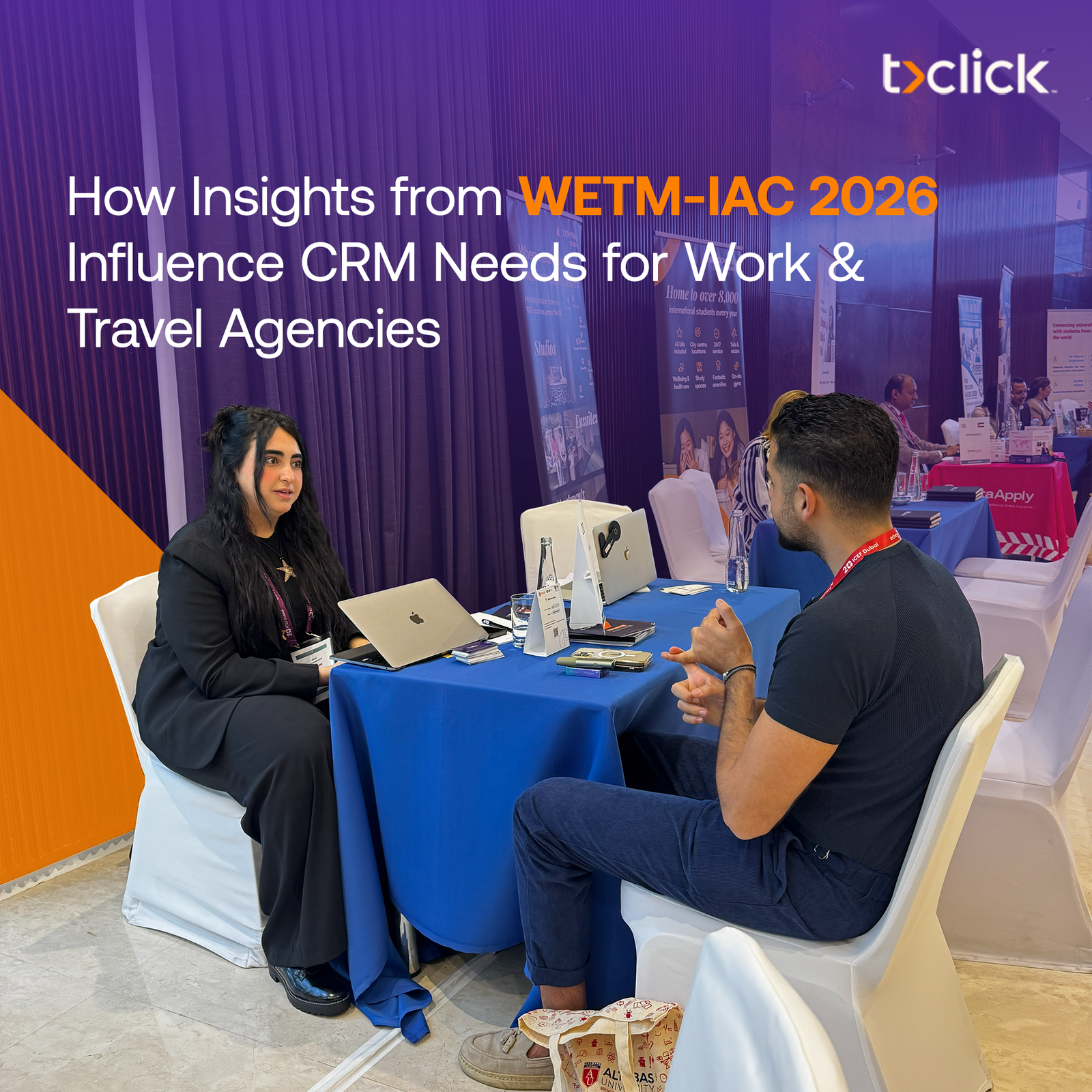
At WETM-IAC 2026, this reality became clear through real conversations between agencies, sponsors, and program providers. The focus was not on how to grow alone, but on how to manage that growth effectively without losing control.
For platforms like Ticlick, these insights highlight a fundamental shift: agencies are no longer looking for tools—they are looking for operational infrastructure.
This is where CRM systems for Work & Travel agencies are evolving. They are no longer optional systems used for organization—they are becoming central to how agencies operate, scale, and compete.
This article explores how insights from WETM-IAC 2026 are directly influencing CRM needs for work & travel agencies and what this means for the future of exchange program management.
What WETM-IAC 2026 Revealed About Agency Operations
Increasing Complexity Across Work & Travel Programs
One of the most consistent patterns observed at WETM-IAC 2026 is the rising complexity across Work & Travel programs.
Agencies are no longer dealing with a single program flow. Instead, they are managing overlapping pipelines that include work & travel, internships, seasonal programs, and cultural exchange initiatives. Each of these programs has:
- different eligibility criteria
- different documentation requirements
- different timelines and deadlines
- different partner expectations
What makes this more challenging is that these processes are not isolated—they often overlap. A single agency might be processing hundreds of participants across multiple program types simultaneously.
From an operational perspective, this creates:
- increased dependency on coordination
- higher risk of delays
- more room for human error
This is why agencies are increasingly looking for CRM systems that can structure these workflows into clear, trackable pipelines rather than relying on manual tracking.
To explore how these insights were shaped through real conversations during the event, take a closer look at Ticlick CRM at WETM-IAC 2026.
The Shift Toward Operational Efficiency
At WETM-IAC 2026, it became clear that agencies are moving beyond the mindset of “more participants = success.”
Instead, they are asking:
- How quickly can we process applications?
- How accurately can we manage documents?
- How efficiently can our teams operate?
Operational efficiency is now directly linked to profitability and scalability.
For example, an agency that can process applications faster without increasing team size has a clear advantage. Similarly, agencies that reduce errors in documentation avoid costly delays and maintain stronger relationships with sponsors.
This is driving demand for CRM systems that do not just store data but actively improve workflows and reduce friction.
Rising Expectations from Sponsors and Partners
Sponsors and partners are also evolving.
They are no longer satisfied with periodic updates or manual reporting. Instead, they expect:
- real-time visibility into participant status
- faster response times
- consistent communication
- structured data
From their perspective, agencies are not just service providers—they are operational partners.
This creates pressure on agencies to operate with higher levels of transparency and professionalism.
CRM systems are becoming essential here because they allow agencies to:
- share accurate data
- track participant progress
- maintain consistent communication
Without these systems, meeting partner expectations becomes difficult.
How These Insights Translate into CRM Needs
Centralized Participant Management as a Core Requirement
One of the strongest CRM needs emerging from WETM-IAC 2026 is centralization.
Many agencies still operate using multiple tools—spreadsheets for tracking, email for communication, and messaging apps for quick updates. This leads to fragmented data.
Centralized CRM systems solve this by creating a single source of truth where all participant information is stored, including:
- application data
- document status
- communication history
- program stage
This not only improves efficiency but also reduces confusion across teams.
When everyone works from the same system, coordination becomes significantly easier.
End-to-End Pipeline Visibility
Visibility is one of the most critical operational needs.
Agencies need to know:
- where each participant is in the process
- what steps are pending
- where delays are happening
Without this visibility, teams operate reactively rather than proactively.
CRM systems introduce structured pipelines that provide a visual representation of the participant journey.
This allows agencies to:
- identify bottlenecks early
- prioritize tasks
- improve overall workflow efficiency
This level of control is essential for managing complex programs at scale.
Automation of Repetitive Processes
At WETM-IAC 2026, one of the biggest frustrations expressed by agencies was the amount of time spent on repetitive tasks.
These include:
- sending follow-up emails
- reminding participants to submit documents
- updating application statuses
- assigning internal tasks
Automation within CRM systems addresses this issue by handling these tasks automatically.
This leads to:
- reduced manual workload
- faster response times
- more consistent processes
Automation also ensures that no step is missed, which is critical in compliance-heavy environments.
This shift toward automation and structured workflows has also been observed in post-event operations. Learn more about how student recruitment CRM software supports agencies after ICEF Dubai.
Document and Compliance Tracking
Compliance remains one of the most sensitive areas in Work & Travel programs.
Each participant must meet specific requirements, and missing even a single document can delay the entire process.
CRM systems are increasingly expected to provide:
- document tracking
- status updates
- compliance workflows
This allows agencies to quickly identify missing items and take action.
It also reduces the risk of errors, which can have serious consequences in visa-based programs.
Data-Driven Insights and Reporting
Another key shift is the move toward data-driven operations.
Agencies are no longer relying on intuition alone. They want to measure:
- how long applications take
- where delays occur
- how teams perform
CRM systems provide dashboards and reports that offer these insights.
This allows agencies to continuously improve their processes and make informed decisions.
The Evolving Role of CRM Systems in Work & Travel Agencies
From Support Tools to Operational Infrastructure
CRM systems are no longer just tools—they are becoming the foundation of agency operations.
Instead of being used occasionally, they are now integrated into daily workflows.
This means that every process—from application intake to final placement—is managed within a centralized, structured system that ensures consistency and control.
This shift turns CRM systems into a central part of how agencies operate.
Supporting Multi-Program Operations
Modern agencies manage multiple programs simultaneously.
CRM systems must be flexible enough to handle:
- different workflows
- different timelines
- different requirements
This flexibility allows agencies to operate efficiently without switching between multiple tools.
Enabling Scalable Growth
Scalability is one of the most important benefits of CRM systems.
Without systems, growth leads to operational stress.
With CRM systems, agencies can:
- handle more participants
- maintain process consistency
- reduce errors
This enables sustainable growth.
As these needs extend beyond exchange programs, many institutions are adopting CRM software for educational organizations to centralize data and streamline operations.
How Ticlick CRM Aligns with These Emerging Needs
Built for Work & Travel and Exchange Programs
Ticlick is designed specifically for the realities of work & travel and exchange programs.
It focuses on workflows that agencies actually use, rather than generic CRM features.
Designed for Complex Participant Lifecycles
Ticlick supports multi-stage participant journeys, allowing agencies to track every step of the process clearly.
This ensures that operations remain structured even as complexity increases.
Combining Automation, Visibility, and Structure
Ticlick integrates:
- automation
- real-time visibility
- structured workflows
This combination allows agencies to operate efficiently while maintaining control.
What This Means for the Future of CRM in the Industry
CRM Adoption Is Becoming Essential
CRM systems are becoming a standard requirement rather than an optional tool.
Systems Will Define Competitive Advantage
Agencies with better systems will operate more efficiently and scale faster.
Agencies Must Invest in Digital Infrastructure
Investing in CRM systems is essential for long-term success.
Conclusion
The insights from WETM-IAC 2026 make one thing clear: the Work & Travel industry is shifting toward more structured, system-driven operations where efficiency, visibility, and scalability are no longer optional—they are expected.
Agencies are no longer asking whether they need CRM systems. The real question has become which systems can support their growth, reduce operational complexity, and enable them to manage increasingly demanding program requirements with confidence.
In this evolving landscape, platforms like Ticlick are playing a critical role by providing solutions built around the real workflows of work & travel and exchange programs. By combining automation, centralized data, and operational clarity, these systems are helping agencies move from reactive management to structured, scalable execution.
As the industry continues to evolve, the agencies that invest in the right systems today will be the ones best positioned to lead tomorrow.