
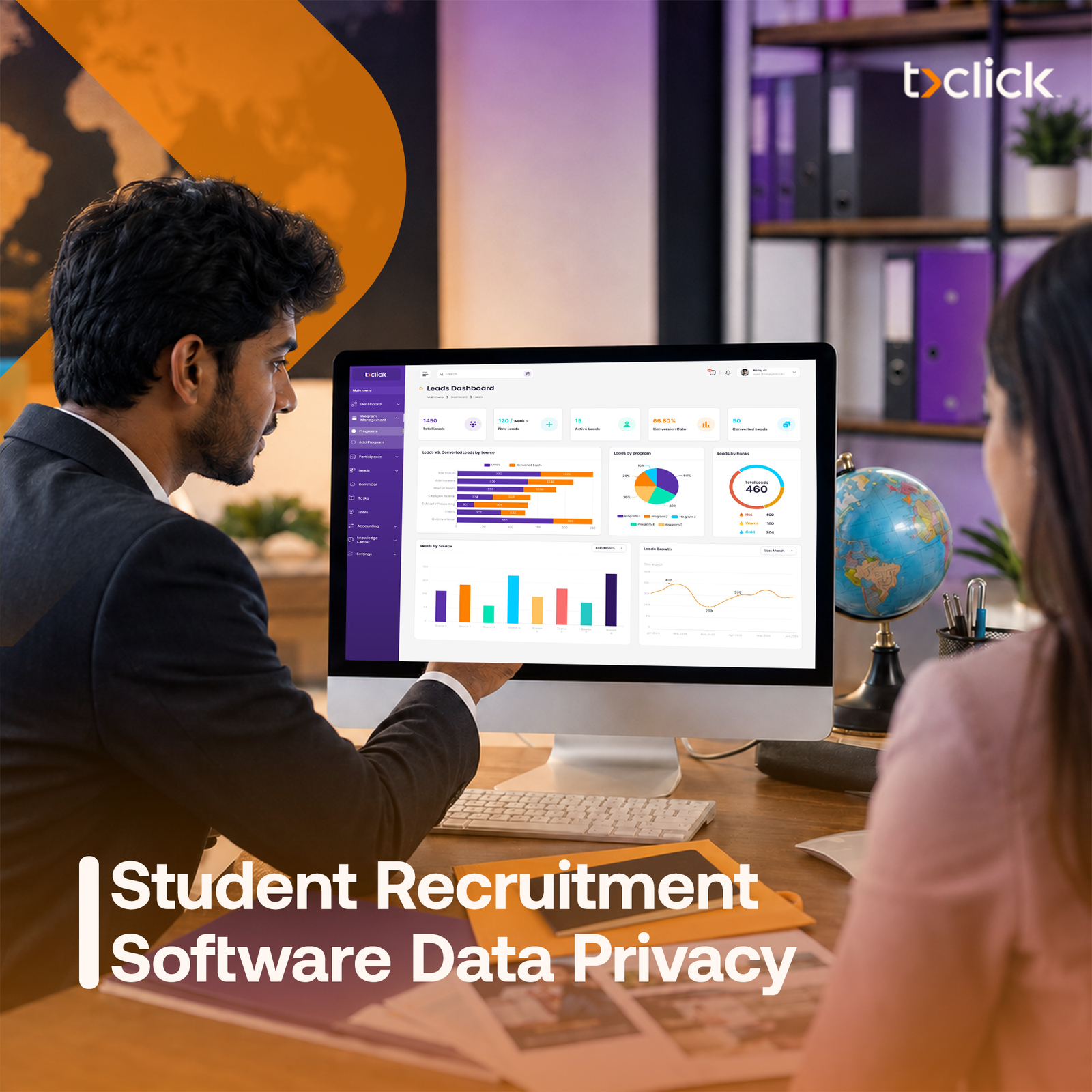
Data privacy is no longer a secondary concern in education technology. It has become a central operational priority for universities, educational institutions, and student recruitment agencies managing modern admissions and recruitment workflows.
As digital recruitment continues to expand globally, organizations are collecting and processing larger volumes of student information than ever before. From inquiry forms and academic documents to communication records and application data, institutions now handle highly sensitive information across multiple channels and systems.
At the same time, international recruitment operations are becoming more complex. Educational organizations are managing students across different countries, regulations, communication preferences, and digital environments. This has made student recruitment software data privacy a critical topic for institutions seeking secure, scalable, and trustworthy recruitment systems.
Modern recruitment software is expected to do more than automate admissions and communication. It must also support secure data handling, controlled access management, privacy-focused workflows, and responsible student information management.
Platforms like Ticlick are helping institutions centralize recruitment operations while improving visibility, workflow automation, and secure student data management within education-focused CRM environments.
In this article, we explore the importance of student recruitment software data privacy, the challenges institutions face, the key security features recruitment systems should include, and how educational organizations can build safer and more compliant recruitment operations.
What Does Student Recruitment Software Data Privacy Mean?
Understanding Data Privacy in Student Recruitment Software
Student recruitment software data privacy refers to how recruitment platforms collect, process, store, manage, and protect student information throughout the recruitment lifecycle.
Educational recruitment systems manage far more than simple contact records.
They often contain:
- personal information
- academic history
- application documents
- financial details
- communication records
- admissions notes
- immigration or visa information
Because recruitment operations increasingly rely on centralized digital systems, protecting this information has become essential.
Strong data privacy practices ensure that student information is handled responsibly while supporting operational efficiency across recruitment and admissions teams.
As educational institutions continue digitizing recruitment operations, many are adopting CRM software for educational organizations to centralize admissions, communication, and secure student data management.
What Type of Student Data Do Recruitment Systems Manage?
Modern recruitment software handles large volumes of sensitive student information.
During recruitment and admissions operations, institutions may collect:
- student names and contact details
- passport information
- transcripts and certificates
- recommendation letters
- payment records
- interview notes
- communication history
- application progress updates
In international recruitment environments, data complexity increases even further.
For example, a study abroad agency supporting students across Europe, North America, and Australia may simultaneously manage immigration documents, institutional requirements, scholarship records, and multilingual communication.
Without secure systems and structured privacy controls, this information can quickly become difficult to manage safely.
Why Data Privacy Is Becoming a Strategic Priority
The demand for secure education technology is growing rapidly.
Educational institutions are under increasing pressure to modernize recruitment operations while protecting student information effectively.
Several factors are driving this shift:
- digital admissions growth
- online recruitment expansion
- international student mobility
- stricter privacy expectations
- increasing cybersecurity risks
Students and families also expect institutions to demonstrate professional and responsible data management practices.
As a result, student recruitment software data privacy is becoming both a technology requirement and a trust factor within modern education operations.
International recruitment operations create growing security and privacy challenges. Explore the future of international student recruitment software and how institutions are adapting to evolving recruitment technology.
Why Data Privacy Matters in Student Recruitment
The Growing Digitalization of Student Recruitment
Student recruitment has become increasingly digital.
Traditional paper-based admissions processes are being replaced by:
- online inquiry forms
- digital applications
- automated follow-ups
- virtual counseling
- integrated admissions workflows
- multi-channel communication systems
While digital transformation improves efficiency, it also increases data exposure.
Recruitment teams are no longer managing information through a single database or internal platform. Student data often flows across websites, CRM systems, messaging tools, email platforms, document portals, and internal collaboration systems.
This creates new operational challenges.
Every new channel, integration, or workflow introduces additional privacy considerations.
This is why student recruitment software data privacy is becoming increasingly important for educational institutions seeking sustainable and secure digital recruitment operations.
The Risks of Mishandling Student Data
Poor data management can create serious operational consequences.
When institutions fail to protect student information properly, risks may include:
- unauthorized system access
- data breaches
- accidental exposure of private information
- lost documentation
- communication mistakes
- reputational damage
Even seemingly minor operational issues can create privacy concerns.
For example:
A recruitment advisor accidentally sending student records to the wrong applicant.
A team member downloading sensitive documents onto unsecured personal devices.
An outdated spreadsheet containing student data being shared across multiple departments without controlled access.
These scenarios are more common than many institutions expect.
Strong student recruitment software data privacy practices help reduce these risks through centralized visibility, structured permissions, and secure workflows.
International Recruitment and Cross-Border Data Challenges
International recruitment introduces additional layers of privacy complexity.
Institutions operating globally often manage student data across:
- different countries
- multiple institutional partners
- external recruitment agencies
- diverse regulatory environments
For example, a university recruiting students internationally may simultaneously process:
- European applicants
- Middle Eastern applicants
- Asian recruitment partnerships
- global admissions workflows
Each recruitment operation may involve different privacy expectations, data handling standards, and operational requirements.
This complexity makes secure software infrastructure increasingly important.
Student recruitment software must support international operations while maintaining responsible data management across multiple recruitment environments.
Modern recruitment operations increasingly depend on structured digital systems. Learn more about higher education recruitment software and how institutions manage admissions and student lifecycle workflows.
Building Student Trust Through Secure Data Practices
Trust plays a major role in education recruitment.
Students share highly personal information during admissions processes.
They expect institutions to handle that information professionally and responsibly.
Secure recruitment operations help institutions build trust through:
- transparent communication
- responsible data handling
- structured permissions
- secure document management
- controlled system access
This trust directly affects recruitment performance.
Students who feel confident about institutional professionalism are more likely to continue engagement throughout the admissions process.
Common Data Privacy Challenges in Student Recruitment Software
Fragmented Student Data Across Multiple Systems
One of the biggest operational challenges institutions face is fragmented data management.
Many organizations still operate across disconnected systems such as:
- spreadsheets
- email inboxes
- shared folders
- messaging platforms
- legacy admissions systems
This fragmentation creates visibility problems and increases privacy risks.
When data is distributed across multiple tools, institutions lose control over:
- access management
- document tracking
- communication history
- workflow visibility
A centralized recruitment CRM environment helps reduce fragmentation while improving operational security.
Limited Access Control and Visibility
Not every team member should access every student record.
However, many organizations struggle with weak access management practices.
Without structured controls, institutions may face:
- unrestricted internal access
- shared login credentials
- uncontrolled file downloads
- unclear permission hierarchies
These practices create avoidable operational vulnerabilities.
Strong student recruitment software data privacy depends heavily on structured role-based visibility and controlled access management.
Manual Data Handling Risks
Manual recruitment operations create significant privacy challenges.
When teams rely on manual processes, risks often increase.
Examples include:
- manually exporting spreadsheets
- copying student records between systems
- storing files locally
- uncontrolled document sharing
Human error becomes a major operational factor.
Automation helps reduce these risks by minimizing repetitive manual handling of sensitive student information.
Multi-Channel Communication Privacy Challenges
Modern student recruitment rarely happens through a single communication channel.
Institutions often communicate through:
- SMS
- phone calls
- website chat tools
- social messaging platforms
Managing communication across multiple channels creates additional privacy concerns.
Without centralized systems, institutions may struggle to monitor:
- communication history
- consent management
- messaging visibility
- secure recordkeeping
Recruitment software should support structured communication management across multiple channels while maintaining privacy-focused operational controls.
Difficulty Managing Data Retention and Deletion Policies
Recruitment operations often involve long student journeys.
Student information may remain active across:
- inquiries
- applications
- admissions reviews
- enrollment preparation
- ongoing communication
Managing retention timelines manually can become difficult.
Institutions must decide:
- what information should remain stored
- when data should be archived
- when records should be deleted
Secure recruitment systems help automate these processes through structured retention workflows and centralized lifecycle management.
Key Features of Secure Student Recruitment Software
Secure Student Data Storage
Secure storage is one of the most important foundations of student recruitment software data privacy.
Educational institutions should prioritize systems that support:
- encrypted databases
- secure cloud infrastructure
- centralized record management
- protected backups
Strong storage architecture improves both security and operational organization.
It reduces the risks associated with decentralized and unsecured information management.
Role-Based Access Management
Access control is critical in education recruitment systems.
Modern recruitment platforms should allow institutions to define permissions based on the following:
- role
- department
- operational responsibility
For example:
Admissions teams may require access to application workflows.
Finance teams may require payment visibility.
Recruitment advisors may require communication access without seeing unrelated sensitive records.
This structured visibility improves operational security while maintaining workflow efficiency.
Consent and Communication Management
Communication permissions are increasingly important in digital recruitment operations.
Recruitment software should help institutions manage the following:
- consent tracking
- communication preferences
- opt-in management
- permission history
These capabilities support responsible communication while strengthening privacy-focused recruitment practices.
Audit Logs and Activity Tracking
Visibility into system activity is essential.
Modern recruitment software should track:
- user activity
- record changes
- access events
- workflow modifications
- communication history
Audit tracking improves accountability and provides stronger operational oversight across recruitment operations.
Secure Document and Application Management
Admissions operations depend heavily on document handling.
Recruitment systems should support secure management for:
- applications
- transcripts
- passports
- certificates
- financial records
Protected uploads, permission-based access, and centralized storage improve both operational control and privacy management.
Automated Data Retention Policies
Automation helps institutions manage privacy workflows more efficiently.
Modern systems should support:
- archive automation
- deletion scheduling
- retention reminders
- lifecycle policies
These features reduce manual workload while improving long-term operational consistency.
Multi-Channel Communication Security
Communication security is increasingly important in recruitment technology.
Recruitment software should provide structured workflows for:
- email communication
- SMS workflows
- messaging integrations
- centralized communication records
This improves visibility and helps institutions maintain stronger privacy standards across communication operations.
Centralized Student Lifecycle Visibility
Recruitment teams need full visibility across the student lifecycle.
Secure CRM systems should support:
- inquiry management
- application tracking
- admissions workflows
- communication history
- enrollment visibility
Centralization reduces fragmentation and strengthens operational control.
Recruitment teams often communicate across multiple platforms. Discover what platforms are most effective for student recruitment and how institutions balance communication efficiency with operational organization.
How Student Recruitment Software Data Privacy Supports Educational Institutions
Improving Operational Security
Strong privacy practices do more than protect information.
They improve operational security across the entire recruitment environment.
Educational institutions managing recruitment operations across multiple teams, departments, and communication channels need systems that provide structured control and centralized oversight.
Secure student recruitment software helps organizations:
- reduce unauthorized access risks
- improve workflow visibility
- centralize communication records
- strengthen internal accountability
- minimize operational vulnerabilities
Instead of managing recruitment through disconnected tools, institutions gain a secure operational environment designed for long-term scalability.
Reducing Compliance Risks
Compliance management is becoming increasingly important within global education operations.
Institutions managing international recruitment often face growing expectations around:
- responsible data handling
- communication transparency
- secure storage practices
- access management
- privacy governance
Without structured systems, maintaining consistent compliance becomes difficult.
Secure recruitment software helps reduce operational risk through:
- centralized records
- controlled permissions
- documented workflows
- automated management capabilities
This creates a stronger foundation for responsible recruitment operations.
Supporting International Recruitment Operations
International student recruitment introduces additional operational pressure.
Organizations managing multiple recruitment markets must coordinate:
- students across countries
- regional recruitment teams
- admissions workflows
- institutional partnerships
- multi-channel communication
Student recruitment software data privacy becomes especially important in these environments because sensitive information frequently moves across complex operational structures.
Secure CRM platforms help institutions manage these operations while maintaining visibility, control, and organizational consistency.
Improving Student Confidence and Trust
Trust is becoming a competitive advantage within modern education recruitment.
Students increasingly expect institutions to demonstrate:
- professional communication
- secure digital processes
- transparent data handling
- responsible information management
Privacy-focused recruitment operations help reinforce institutional credibility.
When students feel confident that their information is managed responsibly, institutions strengthen both engagement quality and long-term reputation.
Strengthening Institutional Reputation
Data privacy failures can damage institutional credibility quickly.
Security incidents, communication mistakes, or poor information management practices can negatively affect:
- student confidence
- operational trust
- institutional reputation
- recruitment performance
Strong privacy practices help organizations demonstrate operational maturity and professionalism.
Secure recruitment systems therefore support both operational performance and brand credibility.
Institutions evaluating secure recruitment systems may also explore GDPR-compliant student CRM solutions designed to support privacy-focused education workflows.
How Institutions Can Choose Student Recruitment Software with Strong Data Privacy Features
Evaluating Security Infrastructure
Not all recruitment platforms offer the same level of security maturity.
Institutions evaluating software solutions should review:
- encryption capabilities
- cloud infrastructure security
- access management controls
- backup protection
- monitoring capabilities
Security architecture should be considered a core evaluation factor rather than a secondary technical detail.
Looking for Education-Specific CRM Workflows
Generic business software often struggles to support the complexity of education recruitment.
Student recruitment involves:
- long recruitment cycles
- application workflows
- document management
- admissions tracking
- multi-stakeholder communication
Education-focused systems provide workflows designed specifically for these operational realities.
This often improves both privacy management and operational efficiency simultaneously.
Prioritizing Automation and Visibility
Secure recruitment operations depend heavily on operational visibility.
Institutions should prioritize platforms that support:
- centralized workflow visibility
- automated communication management
- structured lifecycle tracking
- permission-based access control
Automation also helps reduce privacy risks created by manual operational processes.
Reviewing Compliance and Privacy Standards
Institutions should carefully review vendor approaches toward:
- privacy management
- compliance readiness
- security documentation
- operational governance
Software providers should demonstrate clear approaches to protecting student information across recruitment operations.
Ensuring Scalability for International Recruitment
Growth introduces additional privacy complexity.
Institutions planning international expansion should select systems capable of supporting:
- multi-country recruitment
- large student volumes
- multiple teams
- international partnerships
- complex operational environments
Scalable software reduces the need for fragmented tools as recruitment operations grow.
How Ticlick Supports Secure Student Recruitment Operations
Centralized and Secure Student Data Management
Ticlick helps educational institutions centralize recruitment operations within one structured environment.
Rather than distributing student information across spreadsheets, email threads, and disconnected systems, organizations can manage recruitment workflows through centralized visibility and organized data management.
This improves both operational control and recruitment efficiency.
Structured Recruitment and Admissions Workflows
Recruitment operations involve multiple moving parts.
Ticlick supports structured workflows across:
- inquiry management
- admissions pipelines
- application tracking
- communication management
- enrollment visibility
These workflows help institutions reduce fragmentation while maintaining clearer operational oversight.
Role-Based Visibility and Operational Control
Controlled access management is essential for secure recruitment operations.
Ticlick supports role-based visibility that helps institutions manage operational permissions more effectively.
Teams can access the information they need while maintaining stronger control over sensitive recruitment records.
This supports better internal governance and workflow organization.
Communication Management Across Multiple Channels
Modern recruitment depends on multi-channel engagement.
Ticlick helps institutions manage communication across recruitment environments while maintaining organized interaction histories and centralized visibility.
This improves both operational coordination and structured communication management.
Scalable Support for International Student Recruitment
Organizations managing international recruitment require systems capable of supporting growth.
Ticlick helps institutions and agencies manage:
- multi-market recruitment
- growing student pipelines
- operational complexity
- centralized workflow visibility
This makes it relevant for organizations navigating increasingly digital and international recruitment operations.
To explore how Ticlick helps institutions centralize recruitment operations, automate workflows, and improve secure student management, visit the official platform
The Future of Student Recruitment Software Data Privacy
AI and Secure Recruitment Automation
Artificial intelligence is expected to play a larger role in recruitment technology.
AI-driven workflows may support:
- lead prioritization
- communication automation
- recruitment forecasting
- operational optimization
However, as automation expands, privacy expectations will continue growing alongside it.
Secure AI adoption will become increasingly important within student recruitment software environments.
Privacy-First Student Recruitment Strategies
Educational institutions are moving toward privacy-first operational models.
Future recruitment strategies will increasingly prioritize:
- secure communication
- transparent workflows
- centralized governance
- responsible data handling
Privacy is becoming part of operational strategy rather than simply a technical requirement.
Increasing Global Data Protection Requirements
Global recruitment environments are likely to face growing expectations around privacy and information governance.
Institutions operating internationally should expect continued evolution in:
- compliance standards
- security expectations
- operational accountability
- responsible digital recruitment practices
Organizations investing in strong software infrastructure today will be better positioned for future operational requirements.
Fully Integrated Secure Recruitment Ecosystems
Recruitment technology is moving toward fully integrated ecosystems that combine:
- CRM capabilities
- admissions management
- communication systems
- workflow automation
- analytics visibility
- privacy-focused operations
These integrated environments will increasingly define modern education recruitment technology.
FAQs
What is student recruitment software data privacy?
Student recruitment software data privacy refers to the processes, controls, and security measures used to protect student information within recruitment and admissions software environments.
Why is data privacy important in student recruitment?
Recruitment operations handle sensitive student information including applications, academic records, communication history, and financial details. Strong privacy practices help protect this information responsibly.
What types of student data require protection?
Institutions often manage:
- personal information
- academic documents
- passport records
- financial details
- communication history
- admissions records
These data categories require secure handling and structured visibility.
What security features should recruitment software include?
Strong recruitment software should support:
- secure storage
- access management
- audit tracking
- communication controls
- document protection
- workflow visibility
How can institutions improve student recruitment data privacy?
Institutions can improve privacy through centralized systems, structured permissions, automation, secure communication management, and education-focused CRM environments.
Conclusion
Data privacy is becoming one of the defining operational priorities in modern education recruitment.
As institutions digitize admissions, communication, and international recruitment workflows, the importance of student recruitment software data privacy continues to grow.
Educational organizations require systems capable of delivering more than recruitment automation alone.
They need secure, structured environments that support:
- operational visibility
- communication management
- responsible data handling
- scalable recruitment workflows
Platforms like Ticlick are helping institutions modernize recruitment operations through centralized, education-focused systems designed to support visibility, workflow management, and secure operational growth.
As the future of education recruitment becomes increasingly digital, institutions that prioritize privacy-focused recruitment infrastructure will be better positioned to strengthen trust, improve operational resilience, and support long-term recruitment success across global education markets.