
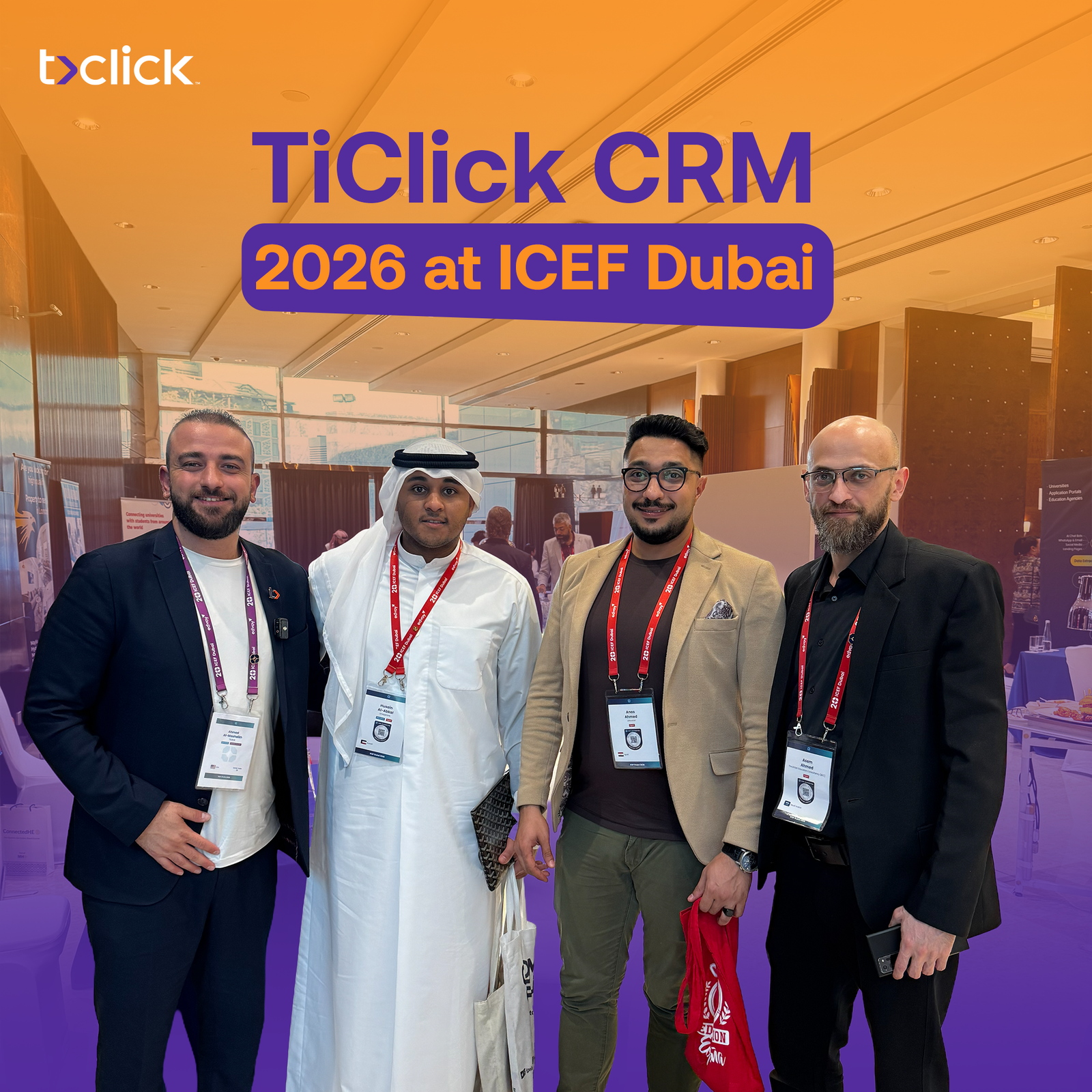
ICEF Dubai has become one of the most strategic meeting points for international student recruitment—especially for organizations building partnerships across the Middle East and North Africa. It isn’t a typical “conference recap” event. ICEF Dubai is designed as a high-impact, B2B networking environment where educators meet trusted, ICEF-accredited agents through structured conversations and scheduled meetings.
In 2026, the student recruitment landscape felt noticeably different. Institutions and agencies are navigating faster decision cycles, digital-first expectations from students, and greater pressure to show operational clarity across the entire recruitment funnel. Recruitment is no longer just marketing and lead generation—it’s execution: how quickly teams respond, how consistently they follow up, and how clearly they track progress across long student journeys.
That’s why Ticlick CRM took part in ICEF Dubai 2026. Our goal wasn’t only to attend—it was to listen closely to the reality on the ground: what agencies struggle with, what institutions want from partners, and where operational gaps are costing teams time and trust. And while this article includes a clear overview of the event, it goes beyond a recap. It highlights the trends and challenges we heard repeatedly and connects them to the growing role that modern CRM infrastructure plays in international recruitment.
ICEF Dubai 2026 – A Global Hub for International Education Partnerships
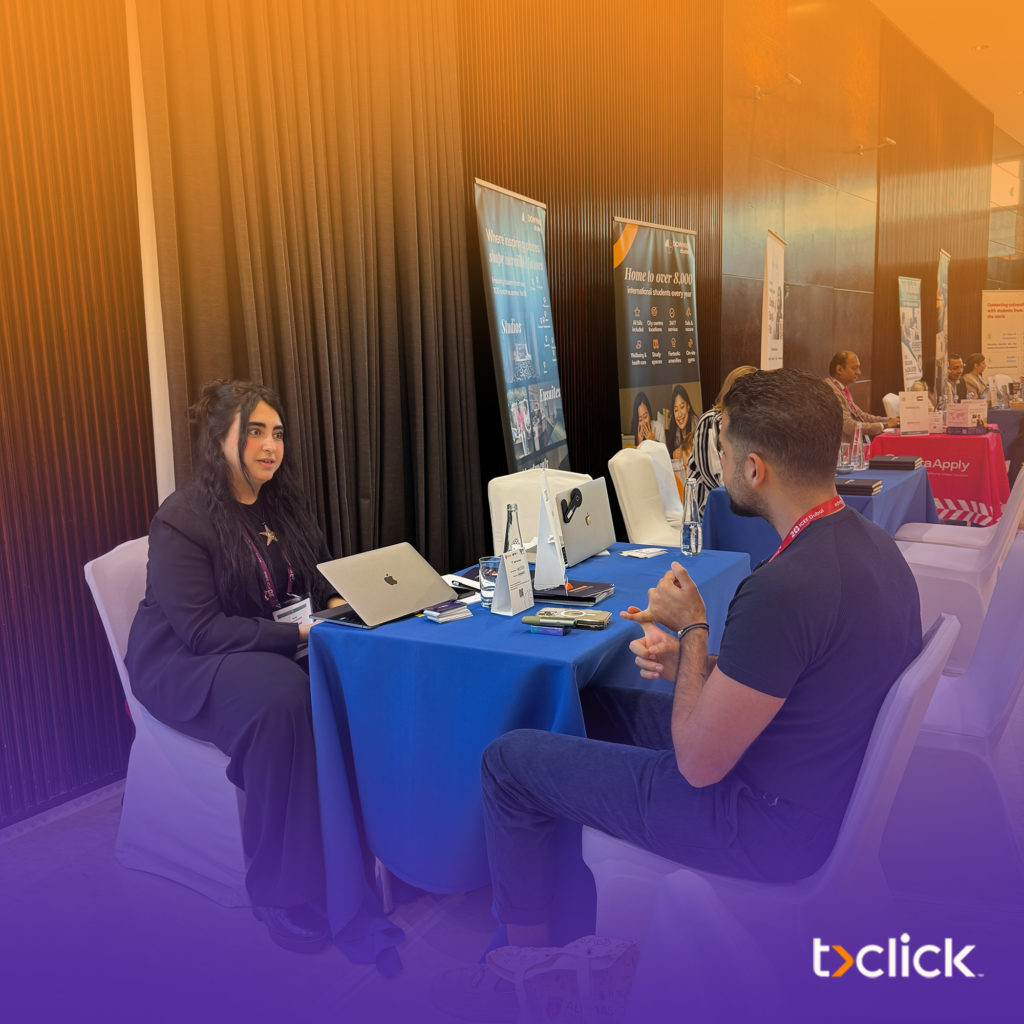
ICEF Dubai is widely recognized as a major international education networking event focused on building recruitment partnerships, particularly connected to outbound mobility from the MENA region. The event is built around purposeful meetings—helping educators and agents use their time efficiently and form relationships that translate into real recruitment outcomes.
What Makes ICEF Dubai a Strategic Event
B2B networking that’s built for outcomes
ICEF Dubai is structured around professional, pre-arranged interaction rather than informal “meet-and-greet” networking. That means conversations are typically more targeted and operational—focused on programs, markets, partner fit, and recruitment performance.
Agent–institution matching at scale
A core value of ICEF events is connecting educators with ICEF-accredited agencies and giving both sides a structured environment to explore partnerships, requirements, and expectations. The experience is supported by event tools and schedules designed to help participants maximize meetings and insights during the event.
A Middle East gateway for international education growth
Dubai’s position—and the event’s regional focus—makes ICEF Dubai especially strategic for institutions recruiting from MENA markets and for agencies representing students interested in international study pathways. That regional concentration shapes the conversations, the partnership priorities, and the operational challenges discussed.
Who Attended in 2026
ICEF Dubai brings together multiple groups involved in the student recruitment ecosystem—creating a full picture of how international enrollment is changing.
Universities and education providers
These organizations attend to expand recruitment channels, meet high-quality partners, and understand market expectations—often discussing program demand, admissions processes, and how to maintain conversion rates across multiple markets.
Study abroad agencies and recruitment agencies
Agencies attend to build new institutional partnerships and to evaluate what institutions expect in terms of communication, responsiveness, and student readiness.
Recruitment and admissions teams
Beyond partnerships, recruitment leaders attend to benchmark operations: what tools other teams use, what bottlenecks they face, and how they are adapting to multi-channel communication and longer student journeys.
EdTech and recruitment technology providers
ICEF Dubai also attracts service providers supporting recruitment operations—from automation tools to platforms that help teams manage pipelines, documents, and reporting.
The trends highlighted at ICEF Dubai 2026 are only part of a larger transformation.
Discover how recruitment and exchange programs are being redefined by technology in our detailed analysis of the future of technology in cultural exchange programs.
Ticlick CRM’s Presence at ICEF Dubai 2026
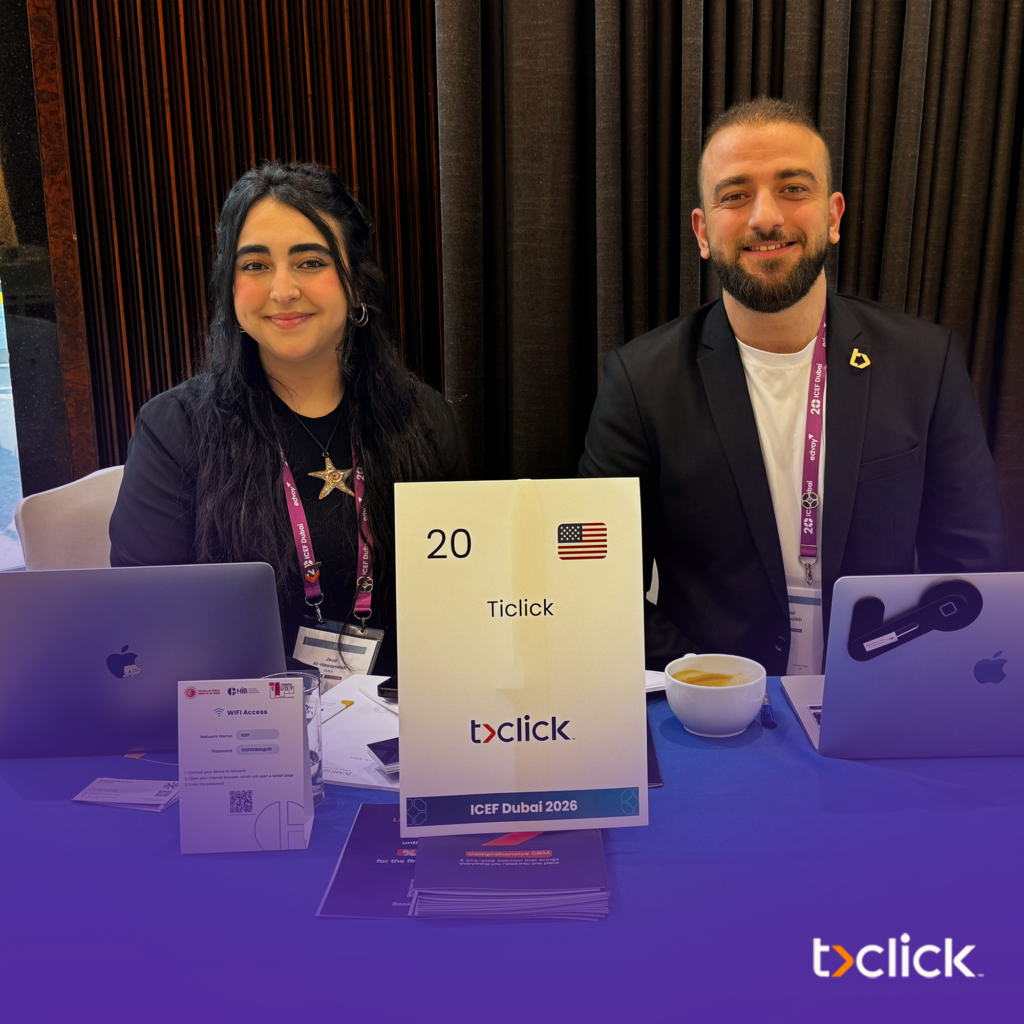
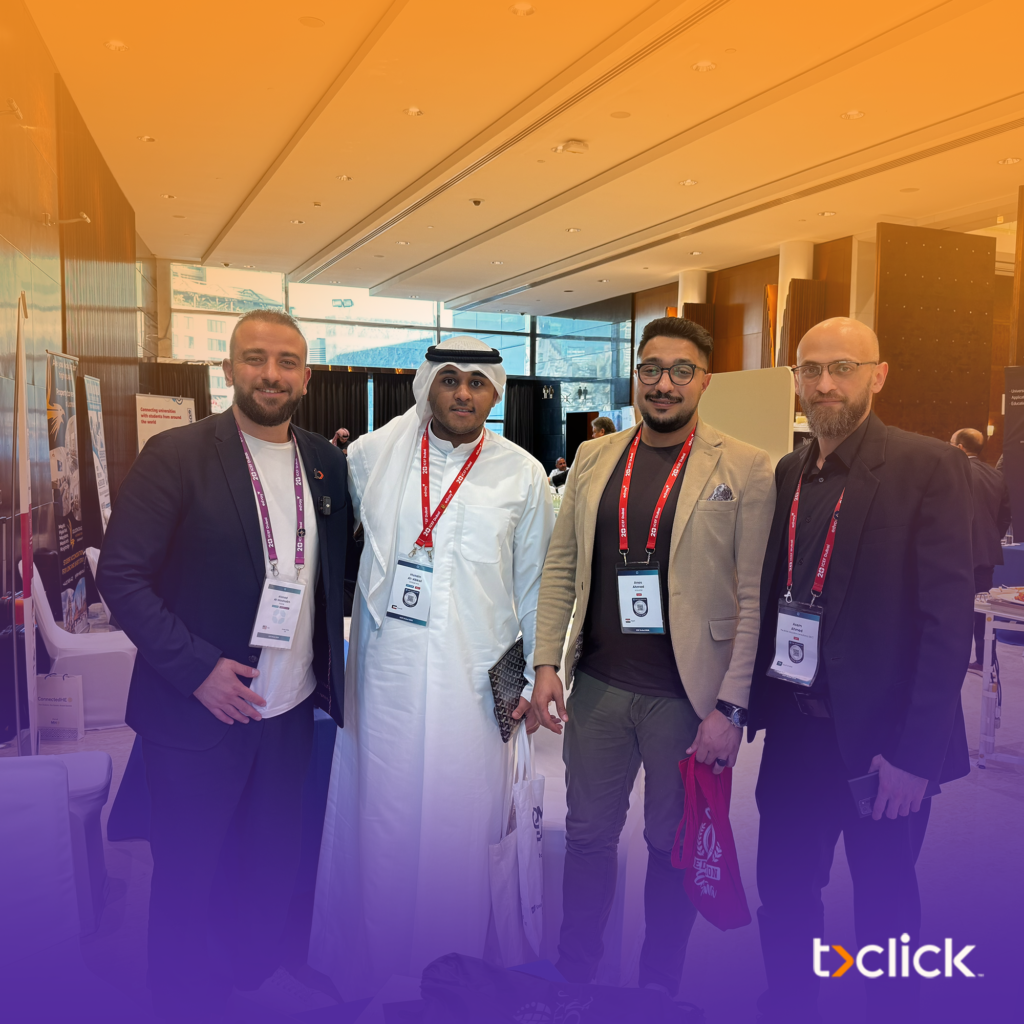
Ticlick CRM participated in ICEF Dubai 2026 as an active contributor to the evolving conversation around international student recruitment. Throughout the three-day event, our team engaged in a series of structured B2B meetings with study abroad agencies, university representatives, international recruitment managers, and operational leaders.
Rather than positioning ourselves as observers, we approached ICEF Dubai as an opportunity to evaluate how recruitment operations are being managed in 2026 — and where the gaps are becoming most visible. Each meeting focused on understanding the operational backbone behind partnerships: how institutions coordinate with agents, how applications are tracked across markets, and how recruitment teams maintain visibility over long and complex student journeys.
Our presence was centred on one core objective: aligning technology with the real operational demands of international recruitment.
Why We Participated
Ticlick CRM attended ICEF Dubai 2026 with a strategic purpose rooted in market alignment and operational insight.
First, to understand current recruitment workflows at scale. As student recruitment becomes increasingly digital and multi-channel, institutions and agencies are managing more data, more communication streams, and more documentation than ever before. Direct conversations allowed us to assess how teams are structuring these processes—and where inefficiencies are limiting growth.
Second, to strengthen international partnerships through operational clarity. Many discussions moved beyond introductions and into process alignment—how institutions expect reporting visibility, how agencies manage student documentation, and how communication speed impacts conversion rates. These conversations highlighted that strong partnerships depend on structured systems, not just agreements.
Third, to validate recurring operational challenges in the field. Rather than relying on assumptions, we gathered direct feedback from recruitment professionals actively managing high-volume pipelines across multiple markets.
Conversations That Shaped the Week
Across our meetings, several consistent themes emerged—and they reinforced the direction the industry is moving toward.
Recruitment leaders repeatedly described operational friction in areas such as the following:
- Fragmented tracking across spreadsheets, email threads, and messaging apps
- Limited real-time visibility into student progress across stages
- Manual follow-up processes that slow down conversion
- Difficulty consolidating reporting across markets and partners
- Scaling recruitment volume without increasing administrative strain
Many conversations naturally shifted toward infrastructure—not just marketing performance. Agencies and institutions are no longer asking how to generate more leads alone; they are asking how to manage complexity without losing control.
In this context, Ticlick’s role becomes clearer. Our contribution at ICEF Dubai was not about presenting a generic CRM solution but about engaging in deeper discussions around workflow structure, communication centralization, and end-to-end visibility. We positioned Ticlick CRM as a system designed specifically for education recruitment environments—where long student journeys, multi-stakeholder coordination, and compliance-sensitive documentation are standard realities.
ICEF Dubai 2026 reinforced that recruitment success in today’s market is determined by operational precision as much as partnership reach. Our participation focused on addressing that reality directly.
The technology trends highlighted at ICEF Dubai 2026 are only the beginning of a much larger transformation in global enrollment.
To understand where recruitment software is heading next, explore our in-depth analysis of the future of international student recruitment software.
Key Trends Emerging from ICEF Dubai 2026
ICEF Dubai 2026 didn’t just highlight partnerships—it revealed how fundamentally the student recruitment landscape is evolving. Across conversations with agencies, universities, and recruitment leaders, several clear industry-wide trends surfaced. These weren’t isolated comments. They were recurring themes repeated across meetings and markets.
Digital-First Recruitment Is No Longer Optional
One of the most consistent messages from ICEF Dubai 2026 was that recruitment has permanently shifted to a digital-first model.
Institutions are no longer experimenting with digital channels — they are structuring their entire recruitment strategy around them. Students now expect immediate responses, clear online application journeys, and consistent digital communication. Agencies are managing inquiries coming from websites, paid ads, social media platforms, webinars, and direct messaging apps.
What stood out during discussions was that digital adoption is no longer about visibility alone. It is about operational execution. Generating online inquiries is easy; managing them effectively across stages is where institutions either gain advantage or lose opportunities.
Recruitment leaders repeatedly emphasized that digital transformation is no longer a competitive edge—it is a baseline requirement.
Automation Is Replacing Manual Follow-Ups
Another strong theme emerging from ICEF Dubai 2026 was the increasing reliance on automation to reduce operational strain.
Recruitment teams described growing pressure on counsellors and coordinators who spend significant time manually:
- Following up on missing documents
- Sending reminder emails
- Tracking deadlines
- Updating status sheets
- Coordinating between agents and institutions
Manual processes may work at a small scale, but they become unsustainable as inquiry volume increases. Several agencies noted that response speed directly affects conversion rates, yet manual follow-up slows teams down.
Automation is no longer seen as a luxury feature. It is becoming essential for maintaining consistency, reducing human error, and freeing teams to focus on high-value interactions instead of repetitive tasks.
Agent Transparency and Performance Tracking
Accountability between institutions and agents is becoming more structured.
At ICEF Dubai 2026, many institutions expressed a desire for greater transparency into agent pipelines—not to restrict partnerships, but to understand performance metrics clearly. Questions frequently surfaced around the following:
- Lead quality
- Conversion rates by agent
- Student document readiness
- Follow-up timelines
- Drop-off points
Similarly, agents emphasized the need for clearer visibility into application status once submitted to institutions.
The overall trend is toward data-backed collaboration. Recruitment partnerships are increasingly evaluated through measurable performance rather than informal communication alone.
Data-Driven Enrollment Strategy
Perhaps the most defining trend of the event was the shift toward measurable recruitment strategy.
Recruitment leaders are asking sharper questions:
- Which markets produce the highest conversion rates?
- Where do applicants most frequently stall?
- How long does each stage take?
- What is the true inquiry-to-enrollment ratio?
Reporting is no longer a quarterly administrative task. It is becoming a continuous operational necessity.
ICEF Dubai 2026 reinforced that institutions want recruitment systems capable of delivering real-time visibility—not just contact databases.
The Biggest Challenges Recruitment Teams Shared
While trends reflect direction, the challenges shared during ICEF Dubai 2026 revealed the friction teams are currently experiencing.
Fragmented Systems and Tool Overload
One of the most common frustrations described was tool fragmentation.
Teams often operate across:
- WhatsApp for quick communication
- Email for formal documentation
- Excel sheets for tracking progress
- Shared drives for document storage
- Separate platforms for marketing
This creates duplication, miscommunication, and inconsistent data. Recruitment managers described spending excessive time reconciling information from multiple systems rather than focusing on strategic growth.
The lack of a centralized structure leads to what many participants described as “operational ‘noise’—activity without clarity.”
Long and Complex Student Journeys
International student recruitment is rarely linear. It often involves multiple stages:
- Inquiry
- Counseling
- Program selection
- Document submission
- Application review
- Offer issuance
- Visa preparation
- Enrollment confirmation
Each stage requires communication, documentation, and coordination. When processes are not structured clearly, delays compound.
Recruitment teams at ICEF Dubai consistently highlighted that the complexity of these journeys is increasing—especially with visa regulations and compliance requirements becoming more detailed.
Scaling Without Losing Control
Growth is a shared goal across institutions and agencies. However, scaling recruitment volume introduces operational risk.
Several teams described rapid inquiry growth but limited operational capacity. Without structured systems, growth can lead to
- Missed follow-ups
- Inconsistent communication
- Reporting inaccuracies
- Team burnout
ICEF Dubai 2026 made it clear that sustainable growth requires operational infrastructure — not just more leads.
Where CRM Systems Are Redefining Student Recruitment
Across discussions at ICEF Dubai, one shift became evident: CRM systems are no longer viewed as optional contact management tools. They are increasingly seen as foundational operational infrastructure.
Before introducing specific platforms, it is important to understand how CRM systems in general are reshaping recruitment workflows.
From Contact Management to Operational Infrastructure
Traditional CRMs focused on storing contact details and tracking sales deals. In student recruitment, that model is insufficient.
Modern recruitment CRM systems must manage:
- Multi-stage student lifecycles
- Agent collaboration
- Document tracking
- Task automation
- Reporting visibility
The CRM becomes the backbone that connects marketing, counselling, admissions, and partner communication into one structured workflow.
Centralizing Communication, Applications & Documents
One of the strongest themes at ICEF Dubai 2026 was the need for centralization.
A CRM system that unifies:
- Student records
- Communication history
- Application stages
- Document uploads
- Reporting dashboards
reduces fragmentation and improves transparency across teams.
Instead of jumping between tools, recruitment staff operate within a single environment that reflects real-time progress.
Supporting International and Multi-Market Recruitment
International recruitment introduces additional layers of complexity:
- Multiple markets
- Time zone differences
- Regional agents
- Visa processes
- Compliance documentation
CRM systems designed for recruitment must accommodate these realities without forcing teams into generic sales workflows.
ICEF Dubai 2026 highlighted that institutions seeking international growth are prioritizing systems that support multi-market visibility and structured collaboration.
How Ticlick CRM Aligns with the Future of Student Recruitment
The conversations at ICEF Dubai 2026 reinforced a clear reality: international student recruitment is becoming more structured, more data-driven, and more operationally complex. Institutions and agencies are no longer looking for isolated tools — they are looking for systems that reflect how recruitment actually works.
In this context, Ticlick CRM aligns naturally with where the industry is heading.
Built for International Recruitment Workflows
International recruitment does not follow a simple sales cycle. It involves multi-market coordination, agent collaboration, long documentation processes, and cross-border communication.
Ticlick CRM is structured around recruitment workflows rather than generic sales pipelines. That distinction matters. Instead of adapting deal stages to student journeys, the system reflects how international recruitment teams operate: inquiry handling, document verification, application progress, partner communication, and stage tracking.
At ICEF Dubai 2026, many recruitment leaders emphasized the importance of workflow clarity — knowing exactly where each student stands and what action is required next. That is precisely the type of operational structure modern recruitment systems must support.
Designed for Long Student Lifecycles
Unlike short commercial transactions, international student recruitment often spans several months. From first inquiry to enrollment — and sometimes beyond — the journey involves multiple touchpoints and stakeholders.
Ticlick CRM supports long student lifecycles by allowing teams to manage stage-based progress, monitor documentation requirements, and maintain communication continuity across extended timelines.
During ICEF discussions, agencies frequently described difficulty maintaining visibility over long processes, especially when information was spread across multiple tools. A recruitment-focused CRM reduces that fragmentation by centralizing lifecycle tracking within a structured system.
The shift is clear: lifecycle management is becoming as important as lead generation.
Automation, Visibility, and Scalable Structure
As recruitment volume grows, manual follow-ups and status tracking become bottlenecks. One of the recurring concerns at ICEF Dubai 2026 was operational pressure on recruitment teams managing increasing inquiry loads.
Ticlick CRM aligns with this reality through the following:
- Automation that reduces repetitive follow-ups
- Real-time visibility across student pipelines
- Structured reporting that supports decision-making
- A scalable framework that grows with recruitment volume
The future of recruitment requires systems that scale without increasing chaos. Infrastructure, not improvisation, defines sustainable growth.
What ICEF Dubai 2026 Signals for the Future of International Recruitment
ICEF Dubai 2026 offered more than partnership opportunities — it provided a clear signal about where international student recruitment is heading.
Rising Operational Complexity
Recruitment processes are becoming more detailed. Visa documentation, compliance requirements, and international coordination are increasing the number of stages teams must manage. Institutions expanding into new markets face additional regulatory and logistical layers.
This growing complexity requires structured systems capable of supporting multi-stage journeys without sacrificing clarity.
Technology as Core Infrastructure, Not Add-On
Technology is no longer viewed as an optional enhancement. It is becoming a central infrastructure for recruitment operations.
Conversations at ICEF Dubai reflected a shift in mindset: instead of asking whether to implement digital systems, teams are asking how to choose the right infrastructure to support growth.
CRM systems, automation platforms, and integrated reporting tools are increasingly seen as foundational components of modern recruitment ecosystems.
Institutions That Will Thrive
The institutions positioned to succeed in the coming years share several characteristics:
- Clear operational structure
- Centralized communication systems
- Data-driven decision-making
- Scalable workflows
- Transparent collaboration with agents and partners
Recruitment growth in 2026 and beyond will depend less on isolated marketing campaigns and more on the ability to manage the full student journey with precision.
ICEF Dubai 2026 made this direction unmistakable.
Conclusion
ICEF Dubai 2026 was not simply a networking event. It was a reflection of an industry in transition.
International student recruitment is evolving rapidly. Competition is increasing. Processes are becoming more complex. Expectations from students and partners are rising. In this environment, fragmented tools and manual workflows are no longer sustainable.
Institutions and agencies do not need more disconnected software. They need structured systems that unify communication, applications, documentation, and reporting into one coherent operational framework.
Ticlick CRM is part of this broader shift—toward recruitment infrastructure that supports clarity, scalability, and measurable growth.
As the industry moves forward, the organizations that invest in operational foundations — not just surface-level tools — will be the ones that build lasting recruitment success.