
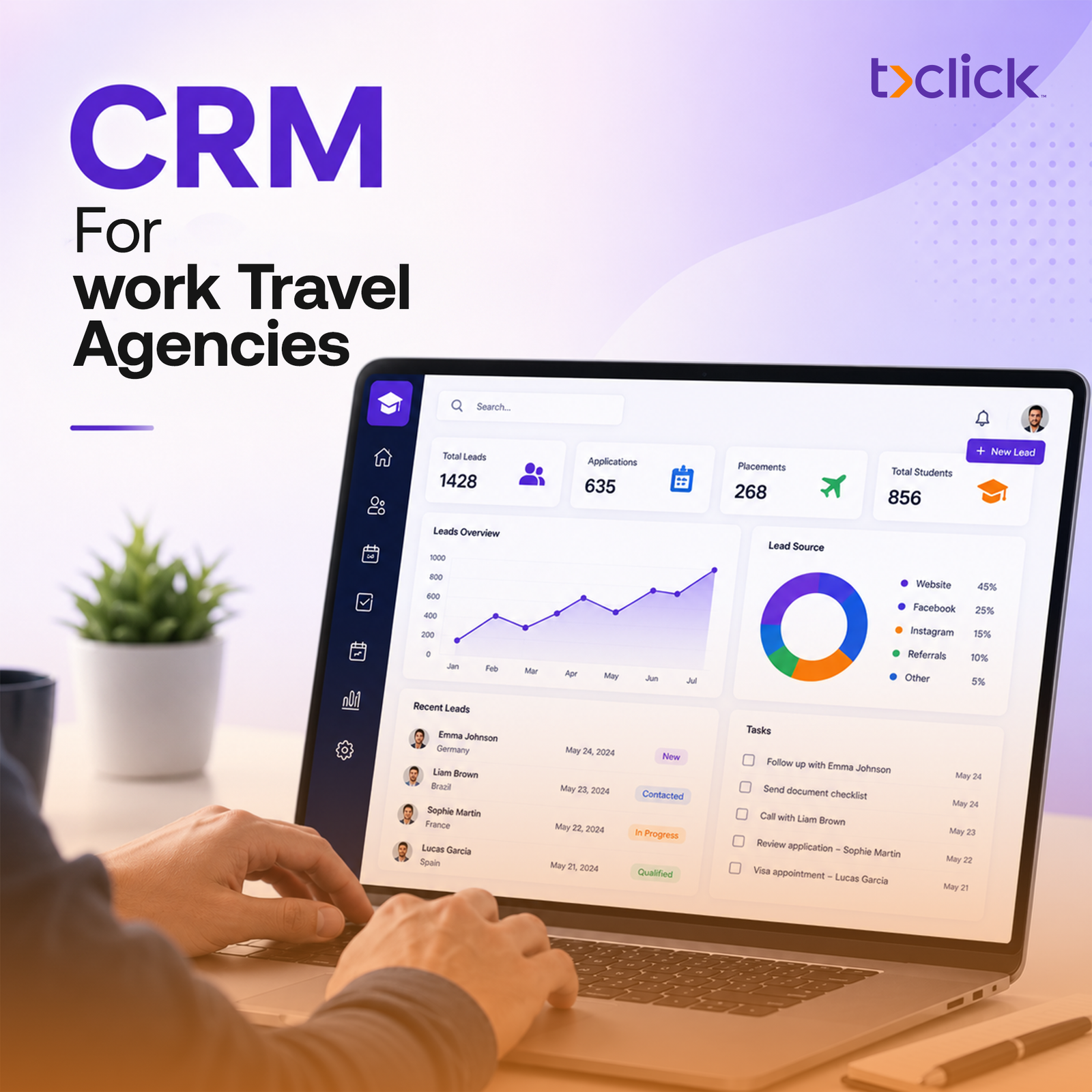
Managing a Work and Travel agency involves much more than processing student applications. Every participant moves through a complex journey that includes recruitment, counseling, employer matching, interviews, document collection, visa preparation, travel arrangements, and ongoing program support.
As agencies grow, these processes become increasingly difficult to manage using spreadsheets, emails, shared folders, and disconnected software. Recruitment teams spend valuable time searching for participant information, following up on missing documents, coordinating with employers, and tracking visa deadlines instead of focusing on helping participants prepare for their international experience.
The complexity increases even further when agencies manage multiple destinations, seasonal recruitment cycles, university partnerships, and hundreds of participants applying simultaneously. Without a centralized system, communication gaps, missed deadlines, duplicate records, and administrative errors can quickly affect both operational efficiency and participant satisfaction.
This is why more organizations are investing in a CRM for work and travel agencies.
Unlike generic CRM platforms, a specialized education CRM is designed around the complete participant lifecycle. It enables agencies to capture inquiries, manage applications, coordinate with host employers, automate repetitive tasks, monitor visa progress, organize financial records, and keep every department aligned through one centralized platform.
Instead of relying on manual processes, agencies can automate workflows, improve collaboration, and gain real-time visibility into every participant’s progress from the first inquiry until the successful completion of the program.
In this guide, we’ll explore how a CRM supports Work and Travel agencies, the operational challenges it solves, the essential features to look for, and how the right platform helps agencies scale while delivering a better experience for participants, employers, and internal teams.
What Is a CRM for Work and Travel Agencies?
A CRM for work and travel agencies is a centralized platform that helps organizations manage every stage of the participant journey, from the first inquiry to program completion.
Rather than using separate tools for recruitment, document management, employer communication, payments, and visa tracking, agencies can manage all participant information within a single system.
This creates a connected workflow where every department has access to accurate, up-to-date information while reducing manual work and improving operational efficiency.
Understanding Work and Travel Agency Operations
Work and travel agencies coordinate a wide range of activities before participants even begin their journey abroad.
These responsibilities typically include:
- Managing participant inquiries
- Conducting consultations
- Collecting applications
- Matching participants with employers
- Scheduling interviews
- Tracking required documents
- Managing visa preparation
- Coordinating travel arrangements
- Supporting participants throughout the program
Because each participant progresses at a different pace, agencies need a structured system that keeps every task organized and visible.
Why Generic CRMs Fall Short
Many agencies initially adopt general-purpose CRM platforms designed for sales teams.
While these systems help organize contacts, they often lack the specialized workflows required for Work and Travel programs.
For example, generic CRMs rarely include features for:
- Employer matching
- Visa tracking
- Document verification
- Participant status management
- Seasonal recruitment cycles
- Program-specific workflows
- Student communication portals
As a result, agencies often rely on additional spreadsheets and manual processes, creating unnecessary complexity.
How a Specialized Education CRM Supports Work and Travel Programs
A CRM built for education organizations supports the unique workflows involved in international mobility programs.
Instead of simply storing contact information, it connects every operational process into one platform.
For example, when a participant submits an application, the CRM can automatically:
- Assign the participant to a recruitment consultant.
- Create a document checklist.
- Schedule employer interviews.
- Track application progress.
- Notify teams about missing requirements.
- Trigger visa preparation workflows.
- Send participant updates automatically.
This reduces administrative work while ensuring every participant receives consistent support throughout the program.
Who Can Benefit From This Type of CRM?
Although designed for Work and Travel agencies, these platforms also support organizations involved in international mobility and cultural exchange.
Examples include:
- Work and Travel agencies
- J-1 program providers
- Cultural exchange organizations
- Internship placement agencies
- Seasonal employment agencies
- International education consultants
Whether managing hundreds or thousands of participants each year, a specialized CRM helps organizations standardize operations while improving efficiency and participant satisfaction.
👉 Learn how an education CRM helps agencies centralize recruitment, admissions, and participant management.
The Work and Travel Participant Journey
Every successful Work and Travel experience begins long before a participant boards a plane.
Behind each placement is a carefully managed process involving recruitment, employer coordination, documentation, visa preparation, and ongoing communication.
Understanding this journey helps agencies build efficient workflows while ensuring participants receive timely support at every stage.
Student Inquiry
The journey starts when prospective participants express interest through the agency’s website, social media, referrals, university events, or education fairs.
Capturing inquiries quickly and assigning them to the right recruitment consultant improves response times and increases conversion opportunities.
Lead Qualification
Not every inquiry is immediately eligible for the program.
Recruitment consultants evaluate applicants based on factors such as:
- Academic status
- English language proficiency
- Program eligibility
- Travel goals
- Destination preferences
This stage helps agencies identify qualified participants before moving forward with consultations and applications.
Program Counseling
Qualified participants receive personalized guidance about available destinations, employers, program requirements, estimated costs, and timelines.
Recording consultation notes inside the CRM ensures every team member has access to the latest participant information, creating a more consistent experience.
Employer Matching
Finding the right employer is one of the most important stages of the Work and Travel process.
A CRM allows agencies to organize employer profiles, available positions, interview schedules, and placement history, making it easier to match participants with suitable opportunities based on their skills, preferences, and program requirements.
Job Offer
Once interviews are complete, successful participants receive job offers from host employers.
The CRM tracks offer status, required confirmations, and acceptance deadlines while notifying consultants of any pending actions.
Document Collection
Before participants can continue, agencies must collect and verify multiple documents, including passports, academic records, program agreements, and supporting paperwork.
A centralized document management system ensures files are organized, easy to access, and linked directly to each participant’s profile.
Visa Preparation
Visa preparation is one of the most time-sensitive stages in any Work and Travel program.
Agencies must ensure participants complete visa applications, submit the required documents, schedule embassy appointments, and meet every deadline before departure.
Without a centralized CRM, tracking these activities manually can become overwhelming, especially when managing hundreds of participants simultaneously.
A specialized CRM helps agencies organize every visa-related task by:
- Tracking visa application progress
- Managing required documents
- Scheduling embassy appointments
- Sending automated deadline reminders
- Monitoring pending visa requirements
This minimizes delays and helps participants stay on schedule throughout the application process.
Travel Coordination
After receiving visa approval, participants begin preparing for departure.
This stage often involves coordinating:
- Flight information
- Arrival dates
- Accommodation details
- Insurance documentation
- Pre-departure orientations
- Emergency contact information
Keeping this information inside one centralized CRM allows every department to access the latest participant updates without relying on multiple spreadsheets or email threads.
Arrival and Program Support
The participant journey doesn’t end once they arrive abroad.
Many agencies continue providing support throughout the program by helping participants resolve workplace issues, update personal information, communicate with host employers, or prepare required reports.
A CRM provides a complete participant history, making it easier for support teams to respond quickly and maintain consistent communication until the program concludes.
Work and Travel Participant Workflow
Lead
↓
Consultation
↓
Application
↓
Employer Matching
↓
Interview
↓
Job Offer
↓
Document Collection
↓
Visa Preparation
↓
Travel Coordination
↓
Program Support
↓
Program Completion
This structured workflow gives every department clear visibility into each participant’s progress while ensuring no critical step is overlooked.
👉 Explore how workflow automation helps education agencies streamline daily operations.
Common Challenges Work and Travel Agencies Face
Managing international Work and Travel programs requires continuous coordination between participants, employers, universities, embassies, and internal teams.
As participant numbers increase, agencies often discover that manual processes can no longer support the growing operational demands.
Below are some of the most common challenges agencies face.
Managing Hundreds of Participants Simultaneously
Each participant progresses through the program at a different pace.
Some may still be completing applications, while others are interviewing with employers, waiting for visa approvals, or preparing to travel.
Without a centralized system, tracking every participant manually becomes increasingly difficult.
A CRM gives agencies a real-time overview of every participant, making it easier to monitor progress and prioritize follow-ups.
Employer Matching
Matching participants with suitable host employers requires balancing several factors, including skills, availability, language proficiency, and employer requirements.
Managing employer information across spreadsheets often leads to duplicate work and slower placements.
A CRM centralizes employer profiles, available positions, interview schedules, and placement history, making matching faster and more organized.
Managing Required Documents
Every participant must submit multiple documents before departure.
Missing or outdated documents can delay applications and affect visa processing.
Using a CRM, agencies can create document checklists, monitor missing files, and automatically notify participants when additional documentation is required.
Visa Deadline Management
Visa applications involve multiple deadlines that cannot be missed.
Recruitment teams must track embassy appointments, DS-2019 forms, supporting documents, and visa interviews while ensuring participants complete each step on time.
Automated reminders significantly reduce the risk of delays.
Coordinating Interviews
Interview scheduling often requires communication between participants, employers, and agency staff.
Without automation, consultants spend considerable time arranging appointments and confirming availability.
CRM platforms simplify this process by organizing interview schedules, sending reminders, and updating participant records automatically.
Payment Tracking
Work and Travel programs usually involve several payments throughout the participant journey.
These may include:
- Registration fees
- Program fees
- Visa-related expenses
- Insurance payments
- Installment plans
Tracking these payments manually increases administrative workload and makes financial reporting more difficult.
Integrated payment management keeps every transaction connected to the participant’s profile.
Communication Across Multiple Channels
Participants communicate through various channels, including email, WhatsApp, phone calls, and social media.
Without a centralized communication history, important conversations can easily become scattered.
A CRM stores every interaction in one place, allowing any team member to continue supporting participants with complete context.
Monitoring Participant Status
Managers need a clear overview of where every participant is within the program lifecycle.
Without dashboards and reporting tools, identifying delays or operational bottlenecks becomes challenging.
Real-time reporting enables agencies to monitor recruitment performance, visa progress, employer placements, and participant readiness from a single platform.
👉 Discover how payment management software simplifies financial operations for education agencies.
Common Operational Challenges
| Challenge | Business Impact |
| Manual participant tracking | Reduced productivity and higher administrative workload |
| Employer coordination | Slower placements and scheduling delays |
| Missing documents | Delayed applications and visa processing |
| Missed visa deadlines | Late departures and participant dissatisfaction |
| Scattered communication | Inconsistent participant experience |
| Manual payment tracking | Poor financial visibility |
| Limited reporting | Slower operational decision-making |
How a CRM Improves Work and Travel Operations
A CRM designed for Work and Travel agencies brings every participant, employer, document, payment, and workflow into one centralized platform.
Instead of relying on disconnected tools, agencies can automate repetitive tasks, improve collaboration, and gain complete visibility across the participant lifecycle.
In the next section, we’ll explore the essential CRM capabilities that help Work and Travel agencies operate more efficiently while delivering a better experience for participants and employer partners.
How a CRM Improves Work and Travel Operations
Running a successful Work and Travel agency requires every department to work together efficiently. Recruitment teams, employer coordinators, visa specialists, finance staff, and management all rely on accurate, up-to-date participant information.
A specialized CRM brings these processes together in one centralized platform, reducing manual work and improving visibility across the entire participant journey.
Centralized Participant Profiles
Instead of storing participant information across spreadsheets, emails, and shared folders, a CRM creates a single profile for every applicant.
Each profile can include:
- Personal information
- Academic details
- Program status
- Employer assignment
- Documents
- Payment history
- Visa progress
- Communication history
- Internal notes
This gives every department access to the information they need without switching between multiple systems.
Automated Lead Management
The recruitment process begins long before a participant submits an application.
A CRM automatically captures inquiries from websites, landing pages, social media, or referral partners and assigns them to the appropriate recruitment consultant.
This reduces response times and helps agencies convert more inquiries into applicants.
Employer Management
Managing employer relationships is just as important as managing participants.
A CRM allows agencies to build a centralized employer database containing:
- Company profiles
- Available job positions
- Interview schedules
- Placement history
- Employer requirements
- Contact information
Having this information in one place simplifies employer matching and improves long-term partnerships.
Document Tracking
Work and Travel programs require participants to submit multiple documents throughout the application process.
Rather than manually checking files, a CRM can:
- Generate document checklists
- Track uploaded documents
- Flag missing requirements
- Notify participants automatically
- Monitor document approval status
This helps agencies process applications more efficiently while reducing administrative work.
Workflow Automation
Many operational tasks follow predictable patterns.
A CRM automates repetitive activities such as:
- Creating follow-up tasks
- Assigning participants to team members
- Sending reminder emails
- Updating application stages
- Triggering internal notifications
Automation allows staff to spend more time supporting participants instead of managing routine administrative tasks.
Visa Deadline Reminders
Missing a visa deadline can delay an entire Work and Travel placement.
A CRM helps agencies stay ahead by automatically reminding participants and staff about:
- Visa application deadlines
- Embassy appointments
- DS-2019 processing
- Required documentation
- Pre-departure tasks
This reduces the likelihood of missed deadlines and improves overall program coordination.
Payment Management
Financial tracking becomes much easier when payment records are connected to participant profiles.
A CRM enables agencies to:
- Generate invoices
- Track installment plans
- Record payments
- Monitor outstanding balances
- Send automatic payment reminders
This creates greater financial visibility while reducing manual reconciliation.
Team Collaboration
Recruitment consultants, admissions staff, employer coordinators, and finance teams all contribute to the participant journey.
A centralized CRM keeps everyone working from the same information, improving communication and reducing duplicated work.
Reporting and Dashboards
Managers need real-time insights into agency performance.
A CRM provides dashboards that track:
- Active participants
- Recruitment pipeline
- Employer placements
- Visa progress
- Outstanding payments
- Team productivity
These reports support better planning and faster decision-making.
👉 Explore the top CRM features every education agency should look for.
Manual Management vs CRM
| Manual Management | CRM-Based Management |
| Multiple spreadsheets | One centralized participant database |
| Manual follow-ups | Automated workflows and reminders |
| Separate communication tools | Unified communication history |
| Paper-based document tracking | Digital document management |
| Manual reporting | Real-time dashboards and analytics |
Essential CRM Features for Work and Travel Agencies
Not every CRM is designed for international mobility programs.
When evaluating a solution, agencies should prioritize features that support both participant management and operational efficiency.
Essential features include:
- Lead management
- Participant profiles
- Employer database
- Interview scheduling
- Document management
- Visa tracking
- Payment management
- Workflow automation
- Student portal
- Reporting and analytics
- User roles and permissions
- Multi-branch support
CRM Feature Checklist
| Feature | Essential |
| Lead Management | ✅ |
| Participant Profiles | ✅ |
| Employer Management | ✅ |
| Document Tracking | ✅ |
| Visa Tracking | ✅ |
| Payment Management | ✅ |
| Workflow Automation | ✅ |
| Student Portal | ✅ |
| Reporting & Analytics | ✅ |
| User Roles & Permissions | ✅ |
Benefits of Using a CRM for Work and Travel Agencies
Implementing a CRM is about more than improving organization—it transforms the way agencies operate.
Key benefits include:
Faster Participant Processing
Automated workflows reduce delays and help participants move through each stage more efficiently.
Better Employer Coordination
Centralized employer information simplifies placements, interview scheduling, and communication.
Improved Communication
Every interaction is stored within the participant’s profile, ensuring consistent communication across departments.
Reduced Administrative Work
Automation minimizes repetitive manual tasks, allowing teams to focus on participant support and program success.
Increased Team Productivity
With streamlined workflows and centralized information, staff can manage larger participant volumes without sacrificing service quality.
Higher Participant Satisfaction
Faster responses, better communication, and organized processes create a smoother experience from inquiry to program completion.
Best Practices for Implementing a CRM
Choosing the right CRM is only the first step. To get the most value from your investment, agencies should implement the system with clear processes and well-defined workflows.
Some best practices include:
- Map your participant journey before building workflows.
- Automate repetitive administrative tasks.
- Keep participant and employer records up to date.
- Standardize document collection processes.
- Monitor recruitment and placement KPIs regularly.
- Train every department to use the CRM consistently.
Following these practices helps agencies improve efficiency while delivering a consistent participant experience.
Why Ticlick Is Built for Work and Travel Agencies
Ticlick is designed specifically for organizations managing international education, cultural exchange, and Work and Travel programs.
Instead of relying on disconnected systems, agencies can manage every stage of the participant journey from one centralized platform.
With Ticlick, agencies can:
- Capture and manage participant inquiries
- Match participants with employers
- Track applications and required documents
- Monitor visa preparation and deadlines
- Manage payments and financial records
- Automate repetitive workflows
- Improve collaboration across recruitment, admissions, finance, and visa teams
- Monitor agency performance through real-time dashboards
Whether your agency manages seasonal recruitment or year-round Work and Travel programs, Ticlick provides the flexibility needed to support growth while improving operational efficiency.
Frequently Asked Questions
What is a CRM for Work and Travel agencies?
A CRM for Work and Travel agencies is a centralized platform that helps organizations manage participant recruitment, employer matching, document collection, visa preparation, payments, and communication throughout the entire program lifecycle.
Why do Work and Travel agencies need a CRM?
A CRM helps agencies replace manual processes with automated workflows, improving organization, reducing administrative work, and providing better visibility into participant progress.
Can a CRM manage employer matching?
Yes. Modern education CRMs allow agencies to maintain employer databases, track available job opportunities, schedule interviews, and match participants with suitable employers more efficiently.
Does CRM software support visa tracking?
Absolutely. Many education CRMs include visa workflow management, document tracking, automated reminders, and deadline monitoring to help agencies keep participants on schedule.
Can agencies automate participant communication?
Yes. A CRM can automate emails, reminders, notifications, and follow-up tasks, ensuring participants receive timely updates throughout the Work and Travel process.
How does a CRM improve operational efficiency?
By centralizing participant information, automating repetitive tasks, improving collaboration, and providing real-time reporting, a CRM enables agencies to manage larger participant volumes with greater accuracy and efficiency.
Conclusion
Managing a successful Work and Travel program requires seamless coordination between participants, employers, universities, and internal teams. As agencies grow, relying on spreadsheets and manual processes can lead to delays, missed deadlines, and inconsistent communication.
A specialized CRM for work and travel agencies simplifies every stage of the participant journey by centralizing information, automating workflows, improving collaboration, and providing complete visibility into recruitment and program operations.
With Ticlick, agencies can manage participant recruitment, employer relationships, document collection, visa preparation, payments, and communication from a single platform. This allows teams to reduce administrative work, improve operational efficiency, and deliver a more organized and professional experience for every participant.