
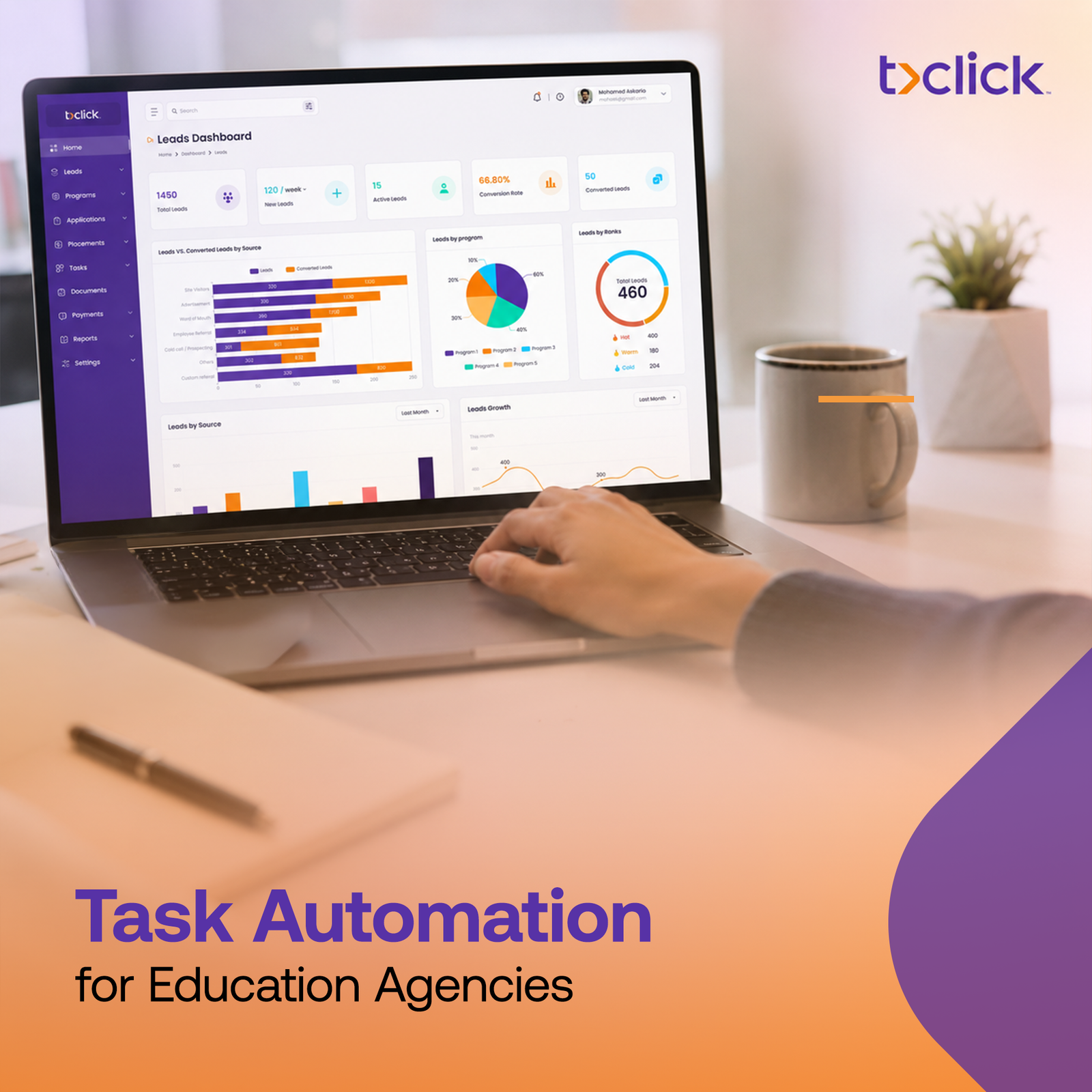
Education agencies manage far more than student inquiries and university applications.
Behind every successful enrollment is a long sequence of administrative tasks, including assigning leads, scheduling consultations, requesting documents, tracking applications, following up on payments, monitoring visa deadlines, communicating with university partners, and updating internal teams.
When an agency manages only a small number of students, these responsibilities may seem manageable through spreadsheets, shared calendars, email reminders, and messaging applications.
However, as recruitment volumes grow, manual task management quickly becomes a major operational challenge.
Recruitment consultants may forget to follow up with promising students. Admissions teams may spend hours checking missing documents. Visa specialists may need to monitor hundreds of deadlines simultaneously. Managers may struggle to understand which tasks are delayed, who is responsible, or where bottlenecks are slowing down the student journey.
These problems do not usually happen because teams lack effort. They happen because manual systems rely too heavily on memory, individual organization, and disconnected tools.
This is where task automation for education agencies becomes essential.
Task automation allows education organizations to create rules that automatically generate assignments, reminders, notifications, status updates, and follow-up activities based on specific events within the student journey.
For example, when a new inquiry is submitted, the system can create a student profile, assign the lead to the appropriate consultant, notify that consultant, and schedule an initial follow-up task without requiring any manual action.
When a student moves to the application stage, the platform can automatically request documents, assign an admissions officer, set deadlines, and notify the team about missing requirements.
Rather than replacing human interaction, automation removes the repetitive work that prevents education professionals from spending more time advising students, strengthening university partnerships, and improving enrollment outcomes.
When integrated into an education CRM, task automation connects every stage of the student lifecycle—from lead generation and consultation to application, payment, visa processing, enrollment, and alumni engagement.
In this guide, we will explore what task automation means for education agencies, which processes should be automated, the benefits it delivers, the features agencies should prioritize, and how platforms like Ticlick help education organizations build more efficient and scalable operations.
What Is Task Automation for Education Agencies?
Task automation is the use of software to create, assign, update, and monitor operational tasks automatically based on predefined rules or workflow events.
Instead of asking staff members to remember every follow-up, deadline, and internal action, the system triggers the correct task when a specific condition is met.
For example:
- When a new student inquiry arrives, assign it to a recruitment consultant.
- When a consultation is completed, create a follow-up task.
- When a student begins an application, request the required documents.
- When an invoice becomes due, send an automatic payment reminder.
- When a visa appointment approaches, notify the student and visa team.
- When an application status changes, update the relevant departments.
This creates a structured and predictable operational process.
Every student receives consistent support, while every team member understands what needs to be completed and when.
Task automation delivers the best results when it’s part of a complete education CRM that connects recruitment, admissions, communication, and student management in one platform.
Understanding the Difference Between Task Automation and Simple Reminders
A reminder is usually a single alert created manually for a specific date.
Task automation is more advanced because it connects multiple actions within a complete workflow.
For example, a simple reminder might notify a consultant to contact a student next Monday.
An automated workflow can:
- Detect that a new lead has entered the CRM.
- Assign the lead to the consultant responsible for the student’s preferred destination.
- Create a consultation task.
- Send the consultant a notification.
- Send the student a welcome message.
- Schedule a follow-up if the student does not respond.
- Update the recruitment pipeline when the consultation is completed.
The difference is important.
Reminders help individuals remember activities. Automation helps organizations manage entire processes consistently.
👉 Learn how to automate student recruitment workflows and improve response times.
Why Manual Processes Slow Down Student Recruitment
Manual task management often creates invisible delays.
A recruitment team may appear busy, but a significant amount of its time may be spent on repetitive work that adds little strategic value.
Common manual activities include:
- Copying student information between spreadsheets
- Assigning leads through email or messaging apps
- Sending the same document requests repeatedly
- Checking application deadlines manually
- Updating multiple systems after every status change
- Preparing weekly reports by combining different files
- Contacting students individually about payments or visa tasks
These activities consume time that could otherwise be spent providing consultations, resolving complex student challenges, and strengthening institutional relationships.
Manual processes also increase the likelihood of inconsistency.
One consultant may follow up after one day, while another waits for a week. One admissions officer may request every required document immediately, while another may overlook an important file.
Task automation standardizes these activities, helping agencies deliver a more consistent and professional experience.
How Task Automation Fits Within an Education CRM
Task automation delivers the greatest value when it is connected to a centralized education CRM.
The CRM stores student profiles, applications, communication history, documents, financial records, and university information. Automation uses this data to determine which actions should happen next.
For example, when a student’s profile status changes from Qualified Lead to Application Started, the CRM can automatically:
- Create an application record
- Assign an admissions officer
- Generate a document checklist
- Notify the student
- Set submission deadlines
- Schedule follow-up tasks
- Alert the manager if the application remains incomplete
Because the workflow is connected to real student data, every action is relevant to the student’s current stage.
This reduces duplicated work while giving teams complete visibility into operational progress.
Who Benefits From Task Automation?
Task automation supports every department involved in the student lifecycle.
| User | How Automation Helps |
| Recruitment consultants | Automates lead assignment, follow-ups, and consultation tasks |
| Admissions officers | Creates document requests and application deadlines |
| Visa specialists | Sends visa reminders and monitors outstanding requirements |
| Finance teams | Automates invoices, installment reminders, and overdue payment tasks |
| Managers | Provides visibility into workload, delays, and team performance |
| Students | Receives timely updates, reminders, and clearer next steps |
| University partners | Benefits from more accurate and timely applications |
The result is not only a more productive team, but also a smoother experience for students and partners.
Why Task Automation Matters for Education Agencies
Automation has become increasingly important as education agencies handle larger student volumes and more complex international recruitment processes.
Its value goes beyond saving time. It improves the way the entire organization operates.
Faster Response Times
Prospective students often contact several agencies before deciding which organization to trust.
A slow response can result in a lost enrollment opportunity.
Automation helps agencies respond faster by:
- Capturing inquiries immediately
- Assigning leads automatically
- Sending instant notifications
- Creating first-contact tasks
- Triggering welcome messages
This reduces the time between inquiry and engagement, increasing the likelihood that the student continues with the agency.
Better Team Productivity
Recruitment professionals should spend most of their time advising students and building relationships, not updating spreadsheets or creating repetitive tasks.
Automation handles predictable administrative work so teams can focus on activities that require judgment, empathy, and expertise.
For example, a consultant should personally discuss the student’s academic goals and destination options. However, the CRM can automatically schedule that consultation, send reminders, record the appointment, and create the next follow-up task.
This balance improves productivity without reducing the human quality of the service.
Reduced Human Error
Even experienced teams can overlook deadlines or forget tasks during busy recruitment periods.
Common errors include:
- Missing a follow-up
- Forgetting to request a document
- Assigning a lead to the wrong person
- Overlooking a visa deadline
- Failing to update a student status
- Sending inconsistent information
Automation reduces these risks by ensuring that predefined actions happen every time the required condition is met.
It does not eliminate the need for staff oversight, but it creates a more reliable operational foundation.
A More Consistent Student Experience
Students should receive the same level of support regardless of which consultant or department manages their case.
Without standardized workflows, experiences can vary significantly.
One student may receive frequent updates, while another hears from the agency only after asking for information.
Automated tasks and notifications create consistency by ensuring that every student receives:
- Timely follow-ups
- Clear document requests
- Deadline reminders
- Application updates
- Payment notifications
- Visa guidance
Consistency builds trust and strengthens the agency’s reputation.
Easier Operational Scaling
An agency managing 100 students may be able to rely on manual follow-ups. An agency managing 1,000 students usually cannot.
As recruitment grows, the number of tasks increases much faster than the number of staff members.
Automation allows agencies to manage higher student volumes without increasing administrative workload at the same rate.
This creates a more sustainable growth model.
Instead of hiring additional employees simply to update records and send reminders, agencies can invest in staff who provide strategic student support and develop new partnerships.
Manual Processes vs Automated Workflows
| Manual Process | Automated Workflow |
| Leads assigned manually | Leads routed automatically based on predefined rules |
| Staff create individual reminders | Tasks created automatically when stages change |
| Consultants send repeated follow-ups | Scheduled communication triggered by workflows |
| Documents requested through separate messages | Document checklists and notifications generated automatically |
| Teams update spreadsheets | CRM records update from connected actions |
| Managers request progress reports | Real-time dashboards show task and pipeline status |
| Deadlines depend on staff memory | Deadline-based alerts notify students and teams |
The difference is not simply digital versus manual.
Automation creates a connected operating system where each action triggers the next appropriate step.
Common Tasks Education Agencies Should Automate
Not every activity should be automated. Student counseling, complex decision-making, and sensitive communication still require human involvement.
However, repetitive and rules-based tasks are ideal candidates for automation.
The following processes often create the greatest operational impact.
Lead Assignment
When inquiries arrive through websites, social media, WhatsApp, education fairs, or referrals, the system should automatically assign each lead to the most appropriate consultant.
Assignment rules may be based on:
- Preferred destination
- Program type
- Student location
- Language preference
- Consultant workload
- Office or branch
- Lead source
Automatic routing reduces delays and prevents inquiries from remaining unassigned.
It also creates clearer accountability because every lead has an identified owner from the beginning.
Follow-Up Reminders
Most prospective students require several interactions before they are ready to apply.
The CRM can automatically create follow-up tasks based on the student’s stage or previous activity.
Examples include:
- Follow up one day after the initial inquiry
- Contact the student after a consultation
- Send program recommendations
- Request confirmation after sharing university options
- Re-engage inactive leads
- Follow up after an offer letter is received
This keeps students engaged without forcing consultants to manage every reminder manually.
Consultation Scheduling
Scheduling consultations often creates unnecessary back-and-forth communication.
Automation can simplify the process by:
- Sharing available appointment times
- Confirming bookings
- Sending calendar invitations
- Reminding students before the consultation
- Notifying consultants
- Creating post-consultation follow-up tasks
This improves attendance while reducing scheduling work.
Application Tracking
Applications move through several stages, each requiring specific actions.
When an application status changes, automation can create the relevant next task.
For example:
| Application Stage | Automated Action |
| Application started | Generate document checklist |
| Documents incomplete | Notify the student and admissions officer |
| Application ready | Assign final review task |
| Application submitted | Schedule university follow-up |
| Offer received | Create offer review and acceptance tasks |
| Offer accepted | Begin payment and visa workflows |
This creates a more organized admissions process and reduces delays.
Document Collection
Document collection is one of the most repetitive activities in student recruitment.
Agencies regularly request:
- Transcripts
- Certificates
- Passport copies
- Language test results
- Recommendation letters
- Financial documents
- Visa files
Automation can generate document checklists, notify students about missing items, create internal review tasks, and update the application once files are approved.
This improves application completeness and reduces repeated communication.
Payment Reminders
Payments often determine whether a student can move to the next stage.
The CRM can automatically send reminders for:
- Agency service fees
- Application fees
- Tuition deposits
- Installment payments
- Accommodation fees
- Visa-related payments
It can also notify finance teams about overdue balances and update the student record once payment is confirmed.
Student Visa Deadline Notifications
Visa workflows contain several time-sensitive milestones.
Automation can notify students and staff about:
- Document deadlines
- Embassy appointments
- Biometrics appointments
- Medical examinations
- Financial evidence
- Visa submission dates
- Pre-departure requirements
Multiple reminder intervals can be scheduled so students receive enough time to prepare.
University Application Deadlines
Agencies working with many institutions must manage different deadlines for programs, intakes, and scholarship opportunities.
The CRM can create deadline-based tasks for:
- Application submissions
- Scholarship applications
- Offer acceptance
- Tuition deposits
- Enrollment confirmation
This reduces the risk of losing opportunities because of missed institutional deadlines.
Internal Team Tasks
Automation is not limited to student communication.
It can also coordinate internal responsibilities.
For example:
- Assign document review to admissions
- Notify finance after an invoice is generated
- Alert visa teams after an offer is accepted
- Escalate overdue tasks to managers
- Create approval tasks for refunds or special requests
- Notify partner managers about university follow-ups
This strengthens collaboration and reduces reliance on internal messaging.
Student Portal Notifications
When an agency uses a student portal, automated tasks can trigger real-time student notifications.
Students can receive updates about:
- New tasks
- Missing documents
- Application progress
- Appointment confirmations
- Payment deadlines
- Visa milestones
- University decisions
This improves transparency while reducing routine status inquiries.
👉 Discover how payment management software simplifies invoicing, installment tracking, and student payments.
Example of an Automated Student Recruitment Workflow
Lead Captured
↓
Lead Automatically Assigned
↓
Welcome Message Sent
↓
Consultation Task Created
↓
Consultation Completed
↓
Program Recommendations Shared
↓
Document Checklist Generated
↓
Application Submitted
↓
Payment Reminder Triggered
↓
Visa Workflow Activated
↓
Enrollment Confirmed
Each stage can trigger tasks, reminders, notifications, and internal updates automatically, helping the agency maintain momentum throughout the student journey.
Benefits of Task Automation for Education Agencies
Task automation delivers benefits that extend far beyond saving time. It helps education agencies create more organized workflows, improve collaboration, and provide a better experience for prospective students.
As recruitment operations grow, automation becomes a key driver of efficiency and long-term scalability.
Save Time Across Departments
Many daily administrative tasks follow the same process every time.
By automating activities such as lead assignment, document requests, appointment reminders, and payment notifications, teams spend less time on repetitive work and more time supporting students.
This allows agencies to handle higher recruitment volumes without significantly increasing administrative workload.
Improve Lead Conversion Rates
Responding quickly and maintaining consistent follow-ups are critical to converting inquiries into enrolled students.
Automation ensures that every lead receives timely communication, reducing the risk of lost opportunities caused by delayed responses or missed follow-ups.
Reduce Administrative Work
Routine tasks can consume a large portion of a consultant’s day.
Automation minimizes manual data entry, repetitive reminders, and status updates, enabling recruitment teams to focus on counseling students and building stronger university partnerships.
Increase Team Collaboration
Recruitment involves multiple departments, including admissions, finance, visa support, and management.
Automated workflows notify the right people at the right time, ensuring every department works from the same information and reducing communication gaps.
Improve Student Communication
Students expect regular updates throughout their recruitment journey.
Automation keeps them informed through scheduled emails, WhatsApp messages, portal notifications, and appointment reminders, creating a more transparent and professional experience.
Eliminate Missed Deadlines
Whether it’s an application deadline, tuition payment, document submission, or visa appointment, automated reminders help students and staff stay on schedule.
This reduces delays and improves the overall enrollment process.
Standardize Recruitment Processes
Automation ensures that every student follows the same structured workflow regardless of which consultant manages their case.
This consistency improves service quality and reduces operational variations across the organization.
Increase Operational Visibility
Managers gain real-time insight into pending tasks, completed activities, overdue actions, and recruitment progress.
This visibility helps identify bottlenecks early and supports better operational decision-making.
👉 Explore the top CRM features every education agency should look for.
Before vs After Task Automation
| Before Automation | After Automation |
| Manual reminders | Automated notifications |
| Missed follow-ups | Consistent workflows |
| Duplicate administrative work | Centralized task management |
| Higher operational workload | Increased team productivity |
| Limited reporting | Real-time operational insights |
Essential Automation Features Every Education CRM Should Include
Choosing the right CRM means selecting a platform that automates the tasks your team performs every day.
The following features are essential for education agencies looking to improve operational efficiency.
Workflow Automation Builder
Allows agencies to design custom workflows based on recruitment stages, student actions, or important deadlines.
Automatic Task Assignment
Automatically assigns tasks to the appropriate team member based on predefined rules such as destination, department, or counselor availability.
Email Automation
Sends personalized emails automatically during different stages of the student journey, reducing manual communication.
WhatsApp Notifications
Delivers reminders and important updates through one of the communication channels students use most frequently.
Calendar Integration
Automatically creates appointments, reminders, and deadlines while synchronizing with team calendars.
Deadline Tracking
Monitors important milestones such as application submissions, tuition payments, visa appointments, and enrollment deadlines.
Student Portal Integration
Automatically updates students through the portal whenever application statuses, tasks, or required documents change.
Document Workflow Automation
Generates document checklists, requests missing files, and alerts staff when submissions are complete.
Payment Workflow Automation
Creates invoices, schedules installment reminders, and updates student payment status automatically after transactions are completed.
Analytics and Reporting
Measures workflow performance, task completion rates, overdue activities, and operational efficiency through real-time dashboards.
CRM Automation Checklist
| Feature | Essential |
| Workflow Builder | ✅ |
| Automatic Task Assignment | ✅ |
| Automated Reminders | ✅ |
| Email Automation | ✅ |
| WhatsApp Integration | ✅ |
| Student Portal Integration | ✅ |
| Document Automation | ✅ |
| Payment Automation | ✅ |
| Reporting & Analytics | ✅ |
Best Practices for Implementing Task Automation
To achieve the best results, agencies should introduce automation strategically rather than attempting to automate every process at once.
Some recommended practices include:
- Start with repetitive administrative tasks.
- Standardize recruitment workflows before automating them.
- Keep personalized communication for important student interactions.
- Review workflow performance regularly.
- Train staff on new automation processes.
- Continuously optimize workflows as recruitment needs evolve.
Common Mistakes to Avoid
While automation improves efficiency, poor implementation can create unnecessary complexity.
Education agencies should avoid:
- Automating every process without review.
- Using multiple disconnected systems.
- Ignoring workflow reports and analytics.
- Sending generic communication to every student.
- Failing to update workflows as admission requirements change.
Why Ticlick Helps Education Agencies Automate Smarter
Ticlick is purpose-built for education organizations and combines recruitment, admissions, communication, payments, document management, and workflow automation into one centralized platform.
With Ticlick, agencies can:
- Automate lead assignment and follow-ups.
- Create task-based recruitment workflows.
- Track applications and student progress.
- Send automated reminders for documents, payments, and visa deadlines.
- Improve collaboration between recruitment, admissions, and finance teams.
- Monitor operational performance through real-time dashboards.
By eliminating repetitive administrative work, Ticlick allows education professionals to focus on what matters most—helping students achieve their international education goals.
Frequently Asked Questions
What is task automation for education agencies?
Task automation uses software to automatically create, assign, and manage repetitive recruitment tasks, reducing manual work and improving operational efficiency.
Why is task automation important?
It helps agencies save time, reduce human error, improve collaboration, maintain consistent communication, and deliver a better student experience.
Which tasks should education agencies automate?
Common tasks include lead assignment, follow-ups, appointment scheduling, document collection, payment reminders, visa notifications, and application tracking.
Can CRM software automate student recruitment?
Yes. Modern education CRMs automate many stages of the recruitment journey, including lead management, admissions workflows, communication, and reporting.
Does automation replace recruitment consultants?
No. Automation handles repetitive administrative tasks, allowing consultants to focus on advising students and building relationships rather than managing routine processes.
How does task automation improve the student experience?
Students receive faster responses, timely reminders, transparent updates, and more consistent support throughout the recruitment journey.
Conclusion
As education agencies continue to grow, relying on manual task management becomes increasingly difficult. Repetitive administrative work slows recruitment teams, increases the risk of missed deadlines, and limits an organization’s ability to scale efficiently.
Task automation provides a smarter way to manage daily operations by streamlining workflows, reducing manual effort, and ensuring every stage of the student journey is completed consistently and on time.
With an education-focused CRM like Ticlick, agencies can automate lead management, document collection, payment reminders, visa workflows, and internal collaboration—all from one centralized platform. The result is a more productive team, a better student experience, and a scalable recruitment process that supports long-term growth.