
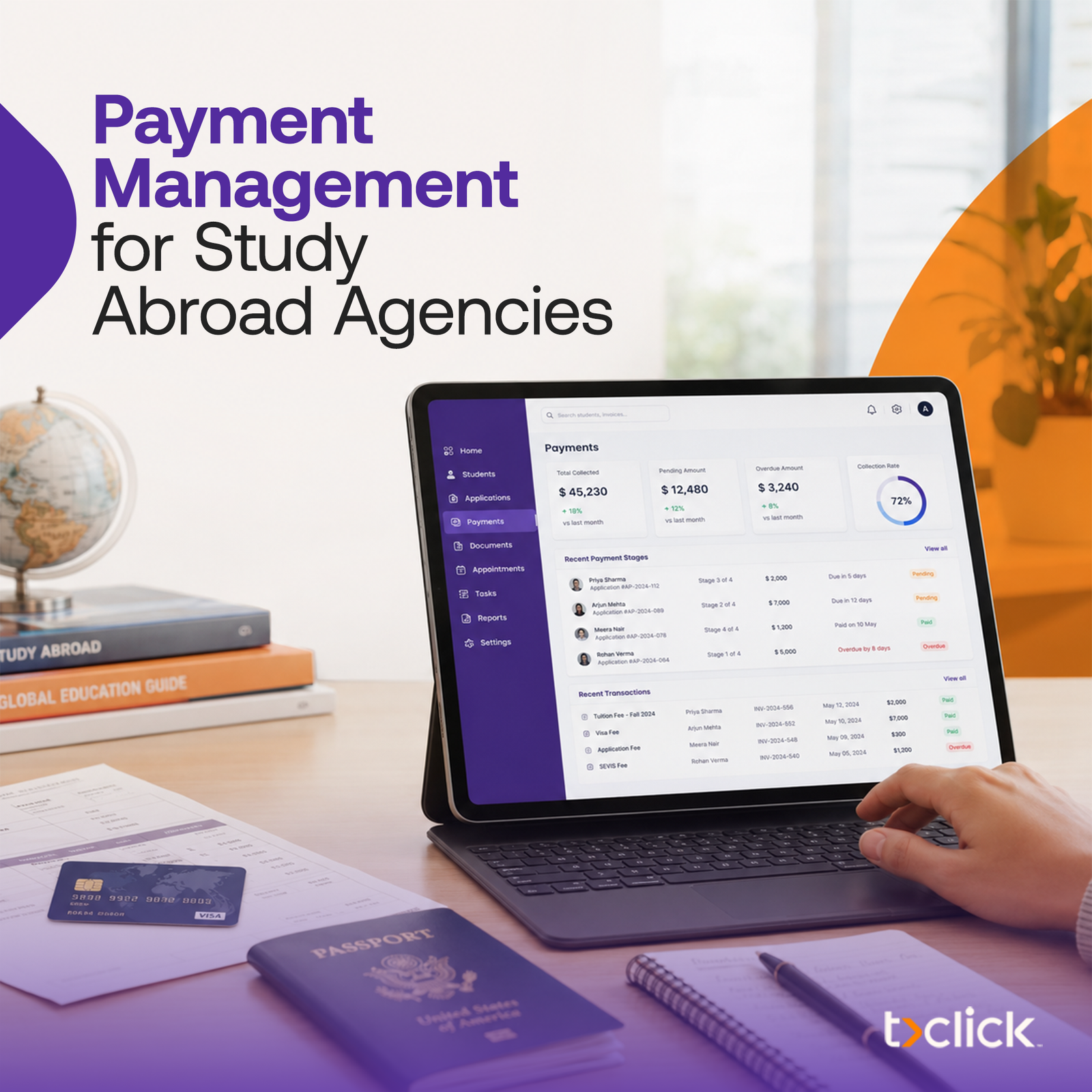
Payment Management for Study Abroad Agencies: Features & Benefits
Discover how payment management for study abroad agencies simplifies student payments, invoicing, installment tracking, and financial workflows.
Managing student payments is one of the most important responsibilities for any study abroad agency. From application fees and service charges to tuition deposits and installment plans, every financial transaction plays a direct role in keeping the student journey on track.
As agencies grow and recruit students across multiple destinations, managing payments manually becomes increasingly difficult. Finance teams often rely on spreadsheets, accounting software, emails, and bank transfer confirmations to monitor transactions. While these methods may work for a small number of students, they become inefficient as payment volumes increase.
A missed tuition deadline, an unpaid installment, or an incorrectly recorded transaction can delay university applications, impact visa processing, and create unnecessary stress for both students and agency staff.
At the same time, students expect greater transparency throughout the recruitment process. They want clear invoices, payment confirmations, installment schedules, and real-time visibility into their financial obligations without repeatedly contacting the agency.
This is why modern education organizations are investing in payment management for study abroad agencies as part of their education CRM.
Rather than treating payments as a separate financial process, an integrated payment management solution connects financial records with student profiles, applications, admissions, and recruitment workflows. This gives agencies complete visibility into each student’s financial journey while reducing administrative work and improving operational efficiency.
In this guide, we’ll explore why payment management is essential for study abroad agencies, the challenges of handling student payments manually, the key features to look for in a payment management solution, and how the right platform can simplify financial operations while improving the student experience.
Why Payment Management Matters for Study Abroad Agencies
Payment management is much more than collecting tuition fees.
It involves coordinating multiple financial transactions throughout the student’s recruitment journey while ensuring that payments are accurately recorded, deadlines are met, and both students and internal teams have complete visibility into financial progress.
A structured payment management process helps agencies operate more efficiently while building trust with students and university partners.
Managing More Than Just Tuition Payments
Many people assume education agencies only collect tuition payments.
In reality, agencies often manage several types of financial transactions throughout the recruitment process.
These may include:
- Consultation fees
- Agency service fees
- Application fees
- Tuition deposits
- Tuition installments
- Visa processing fees
- Insurance payments
- Accommodation deposits
- Pre-departure service fees
Keeping track of these payments manually can quickly become overwhelming, especially when each student follows a different payment schedule.
A centralized payment management system organizes every transaction within the student’s profile, making financial information easier to manage and access.
👉 Learn how education-focused CRM software helps agencies manage recruitment, admissions, payments, and student operations from one platform.
Multiple Payment Stages Throughout the Student Journey
Student payments are rarely completed in a single transaction.
Instead, payments are spread across different stages of the recruitment lifecycle.
For example, a typical student may complete payments in the following order:
- Agency registration fee
- University application fee
- Tuition deposit
- Remaining tuition balance
- Visa-related expenses
- Accommodation payments
- Travel or pre-departure services
Each payment often depends on the successful completion of the previous step.
Without proper tracking, agencies may struggle to determine which students are ready to move forward and which require additional follow-up.
Payment management software provides complete visibility into every financial milestone, helping agencies maintain an organized recruitment process.
Building Trust Through Transparent Financial Processes
Financial transparency plays an important role in the student experience.
Students want to understand:
- What they are paying for
- When payments are due
- Which invoices remain outstanding
- Whether payments have been received
- What the next financial step will be
Providing clear payment records and timely updates helps reduce confusion while increasing confidence in the agency’s services.
When students can easily access this information through a CRM or student portal, communication becomes smoother and trust naturally improves.
The Cost of Manual Payment Tracking
Many study abroad agencies still rely on spreadsheets and manual bookkeeping to manage student payments.
Although familiar, these methods introduce several operational risks as the organization grows.
Common challenges include:
- Missing payment deadlines
- Duplicate payment records
- Manual invoice creation
- Difficulty tracking installment plans
- Time-consuming payment reconciliation
- Limited financial reporting
These inefficiencies not only increase administrative workload but can also delay admissions, affect student satisfaction, and reduce overall operational performance.
Implementing a centralized payment management solution helps agencies eliminate these challenges while creating a more efficient and scalable financial process.
Common Payment Challenges Education Agencies Face
As recruitment volumes increase, managing student payments becomes more complex.
Education agencies must balance financial accuracy with excellent student service while coordinating payments across multiple universities, destinations, and recruitment stages.
Without the right system in place, even routine financial tasks can become time-consuming and difficult to manage.
In the next section, we’ll explore the most common payment management challenges study-abroad agencies face and how technology helps overcome them.
👉 Discover how student recruitment software helps agencies manage the full student journey from inquiry to enrollment.
Common Payment Challenges Education Agencies Face
As agencies recruit more students and expand their partnerships with international institutions, financial management becomes increasingly complex.
Without a centralized system, tracking payments, invoices, and outstanding balances can quickly become a time-consuming process that affects both operational efficiency and the student experience.
Below are some of the most common payment management challenges education agencies face.
Tracking Multiple Student Payments
Every student follows a unique financial journey.
Some students pay in full, while others choose installment plans or make payments at different stages of the admissions process.
Keeping track of dozens—or even hundreds—of payment schedules manually can increase the risk of missed transactions and inaccurate records.
A payment management system gives agencies a complete view of each student’s financial history from a single dashboard.
Managing Installment Plans
Many agencies offer flexible payment options to make studying abroad more accessible.
However, monitoring installment due dates manually can be challenging, especially when each student follows a different payment schedule.
An integrated system automatically tracks upcoming installments and helps agencies monitor completed and outstanding payments.
Following Up on Outstanding Balances
Late payments can delay applications, university admissions, and even visa processing.
Without automated tracking, recruitment teams often spend valuable time contacting students individually to remind them about overdue balances.
Automated payment reminders reduce manual follow-ups while ensuring students receive timely notifications before payment deadlines.
Handling Multiple Currencies
Study abroad agencies frequently work with universities across different countries, meaning payments may be made in multiple currencies.
Managing exchange rates and tracking payments manually can create unnecessary complexity.
A modern payment management solution helps agencies organize financial records regardless of the currency used, improving visibility across international transactions.
Reconciling Payments With Student Records
Financial information is most valuable when it’s connected to the student’s recruitment journey.
When payment records are stored separately from applications and admissions data, staff often waste time matching transactions to individual students.
Integrating payment management with an education CRM ensures every payment is automatically linked to the correct student profile.
Manual Invoice Creation
Creating invoices manually for every payment increases administrative workload and leaves room for human error.
Automated invoicing allows agencies to generate professional invoices quickly while maintaining accurate financial records and improving the overall student experience.
Limited Financial Visibility
Without centralized reporting, managers often struggle to answer questions such as:
- Which students have outstanding balances?
- How much revenue has been collected this month?
- Which invoices remain unpaid?
- Which payment stage causes the most delays?
Real-time financial dashboards provide instant insights that help agencies make informed business decisions.
👉 Learn how automation reduces manual follow-ups and improves student communication.
Common Financial Challenges
| Challenge | Business Impact |
| Manual payment tracking | Increased administrative workload |
| Missed payment deadlines | Delayed applications and enrollments |
| Disconnected financial records | Limited operational visibility |
| Manual invoice creation | Slower financial processes |
| Multiple currencies | Greater financial complexity |
| Poor payment reporting | Difficult financial planning |
What Is Payment Management Software for Study Abroad Agencies?
Payment management software is a solution that helps education agencies organize, track, and monitor every financial transaction related to the student recruitment process.
Instead of relying on spreadsheets or disconnected accounting tools, agencies can manage invoices, payment schedules, installment plans, and financial records through one centralized platform.
When integrated with an education CRM, payment management becomes part of the student’s complete recruitment journey rather than a separate administrative task.
More Than an Accounting Tool
Traditional accounting software focuses on recording financial transactions.
Payment management software for education agencies goes further by connecting payments directly to recruitment activities.
This allows agencies to see both academic and financial progress from a single student profile.
Recruitment consultants can instantly verify whether payments have been completed before moving students to the next stage of the admissions process.
How Payment Management Integrates With an Education CRM
An integrated CRM eliminates the need to switch between recruitment and finance systems.
Student profiles can include:
- Payment history
- Outstanding balances
- Generated invoices
- Installment schedules
- Payment confirmations
- Financial notes
Having all this information in one place improves collaboration between recruitment, admissions, and finance teams.
Connecting Finance With Student Recruitment
Student payments influence almost every stage of the recruitment journey.
For example, tuition deposits are often required before universities issue confirmation documents, and visa applications may depend on proof of payment.
Connecting financial records with recruitment workflows allows agencies to move students through each stage more efficiently while reducing delays caused by missing or unverified payments.
Manual Payment Tracking vs CRM-Based Payment Management
| Manual Process | CRM-Based Payment Management |
| Spreadsheets and separate files | Centralized payment records |
| Manual invoice creation | Automated invoice generation |
| Separate accounting systems | Payment data linked to student profiles |
| Manual payment reminders | Automated notifications |
| Limited reporting | Real-time financial dashboards |
👉 Explore the top CRM features education agencies need to manage students, documents, workflows, and reporting efficiently.
Essential Payment Management Features
The best payment management solution does much more than record transactions. It should simplify financial operations while integrating seamlessly with the student recruitment process.
Here are the essential features every study abroad agency should look for.
Student Payment Profiles
Every student should have a dedicated financial profile that includes payment history, invoices, installment plans, receipts, and outstanding balances.
Having all payment information linked to the student’s record allows recruitment and finance teams to access accurate information instantly.
Invoice Generation
Creating invoices manually is time-consuming and increases the risk of errors.
A modern payment management system should automatically generate professional invoices, making it easier to bill students and maintain accurate financial records.
Installment Plan Management
Many students prefer paying in installments rather than making one large payment.
A payment management solution should allow agencies to create flexible payment schedules, monitor upcoming installments, and track completed payments from one dashboard.
Online Payment Tracking
Agencies should be able to monitor every transaction in real time.
Whether a payment is pending, completed, or overdue, having instant visibility helps finance teams respond quickly and keep recruitment moving forward.
Automated Payment Reminders
One of the most valuable features is automated payment reminders.
Instead of manually contacting students before every due date, the system can automatically send reminders through email, SMS, WhatsApp, or the student portal.
This improves payment collection while reducing administrative workload.
Receipt Management
After every successful payment, students should receive an automatic payment confirmation or receipt.
This improves transparency while reducing payment-related inquiries.
Refund Tracking
Occasionally, agencies may need to process refunds because of visa refusals, deferred admissions, or changes in student plans.
Tracking refunds within the same platform ensures complete financial visibility and accurate records.
Multi-Currency Support
Study abroad agencies often work with universities in different countries.
Supporting multiple currencies allows agencies to manage international transactions more efficiently while maintaining organized financial records.
Financial Reporting
Real-time financial reports help agency managers monitor revenue, outstanding balances, payment trends, and overall financial performance.
These insights support better planning and more informed business decisions.
Role-Based Permissions
Not every team member requires access to financial information.
Role-based permissions allow agencies to control who can view, edit, approve, or manage payment records, improving both security and accountability.
Payment Management Checklist
| Feature | Essential |
| Student Payment Profiles | ✅ |
| Invoice Generation | ✅ |
| Installment Tracking | ✅ |
| Online Payment Tracking | ✅ |
| Automated Payment Reminders | ✅ |
| Receipt Management | ✅ |
| Multi-Currency Support | ✅ |
| Financial Reporting | ✅ |
| Role-Based Permissions | ✅ |
👉 See how secure CRM tools help protect sensitive student documents and financial records.
How Payment Management Improves Student Recruitment
Although payment management is often viewed as a financial function, it has a direct impact on recruitment performance.
When payments are organized and integrated with recruitment workflows, agencies can process applications faster, reduce delays, and provide a smoother experience for prospective students.
Faster Admissions Processing
Many recruitment activities depend on completed payments.
By linking payment status directly to student records, agencies can verify transactions quickly and move applications forward without unnecessary delays.
Better Student Experience
Clear invoices, transparent payment tracking, and timely reminders help students feel more confident throughout the admissions process.
Instead of contacting the agency for payment updates, they always know what has been paid and what remains outstanding.
Improved Cash Flow
Tracking invoices and outstanding balances in real time helps agencies collect payments more efficiently and maintain healthier cash flow.
Fewer Administrative Errors
Centralizing financial records reduces duplicate entries, missing invoices, and payment discrepancies, improving accuracy across the organization.
Greater Financial Transparency
Finance teams, recruitment consultants, and managers all work from the same payment information, making collaboration easier and reducing misunderstandings.
Stronger Team Collaboration
Connecting finance with recruitment ensures every department has access to the information needed to support students effectively without relying on separate systems or manual updates.
Best Practices for Managing Student Payments
Implementing payment management software is only part of the solution. To maximize efficiency and improve the student experience, agencies should establish clear financial processes that are easy for both staff and students to follow.
Some best practices include:
- Standardize payment workflows across all students.
- Automate invoice generation and payment reminders.
- Link every payment to the student’s CRM profile.
- Offer flexible installment plans when appropriate.
- Monitor outstanding balances regularly.
- Generate financial reports to support better decision-making.
Following these practices helps agencies maintain accurate financial records while reducing administrative workload.
How to Choose the Right Payment Management Solution
Not every payment management system is designed for education agencies.
When evaluating different solutions, agencies should choose a platform that supports both financial operations and student recruitment workflows.
Consider the following factors:
- Education-specific functionality
- CRM integration
- Automated invoicing and reminders
- Secure payment records
- Multi-currency support
- Financial reporting and dashboards
- Scalability as the agency grows
- Reliable customer support
The right solution should simplify daily financial operations while supporting long-term business growth.
Why Ticlick Simplifies Payment Management
Ticlick is designed specifically for education organizations, combining student recruitment, admissions, communication, and payment management within one centralized platform.
Instead of using separate systems for finance and recruitment, agencies can manage the entire student journey from a single CRM.
With Ticlick, agencies can:
- Track student payments in real time
- Generate professional invoices automatically
- Manage installment plans
- Send automated payment reminders
- Store payment history within student profiles
- Monitor financial performance through real-time reports
By connecting financial operations with recruitment workflows, Ticlick helps agencies improve efficiency, reduce manual work, and deliver a better experience for both students and staff.
Frequently Asked Questions
What is payment management for study abroad agencies?
Payment management is the process of tracking, organizing, and managing all student-related financial transactions, including invoices, tuition payments, installment plans, and payment records.
Why is payment management important for education agencies?
Effective payment management helps agencies reduce administrative work, improve cash flow, minimize financial errors, and provide students with a more transparent payment experience.
Can a CRM manage student payments?
Yes. Modern education CRM platforms allow agencies to manage invoices, payment histories, installment plans, payment reminders, and financial reporting from one centralized system.
How do automated payment reminders work?
The CRM automatically sends notifications before payment due dates through channels such as email, SMS, WhatsApp, or the student portal, helping students stay on schedule and reducing manual follow-ups.
Can agencies track installment payments?
Absolutely. Payment management software enables agencies to create customized installment plans, monitor payment progress, and receive alerts for overdue balances.
Does payment management improve student recruitment?
Yes. Organized payment management speeds up admissions, improves communication, reduces delays, and creates a smoother experience for prospective students, ultimately supporting higher enrollment rates.
Conclusion
Managing student payments is no longer just an accounting responsibility—it’s an essential part of delivering a seamless student recruitment experience. From application fees and tuition deposits to installment plans and payment confirmations, every financial interaction influences how students perceive your agency.
By replacing manual payment tracking with an integrated payment management solution, study abroad agencies can automate routine tasks, improve financial visibility, reduce administrative errors, and keep recruitment moving without unnecessary delays.
A platform like Ticlick brings together payment management, student recruitment, admissions, document management, and communication in one centralized CRM. This enables education agencies to streamline financial operations, provide greater transparency, and build a more efficient, scalable business that is ready to support future growth.