
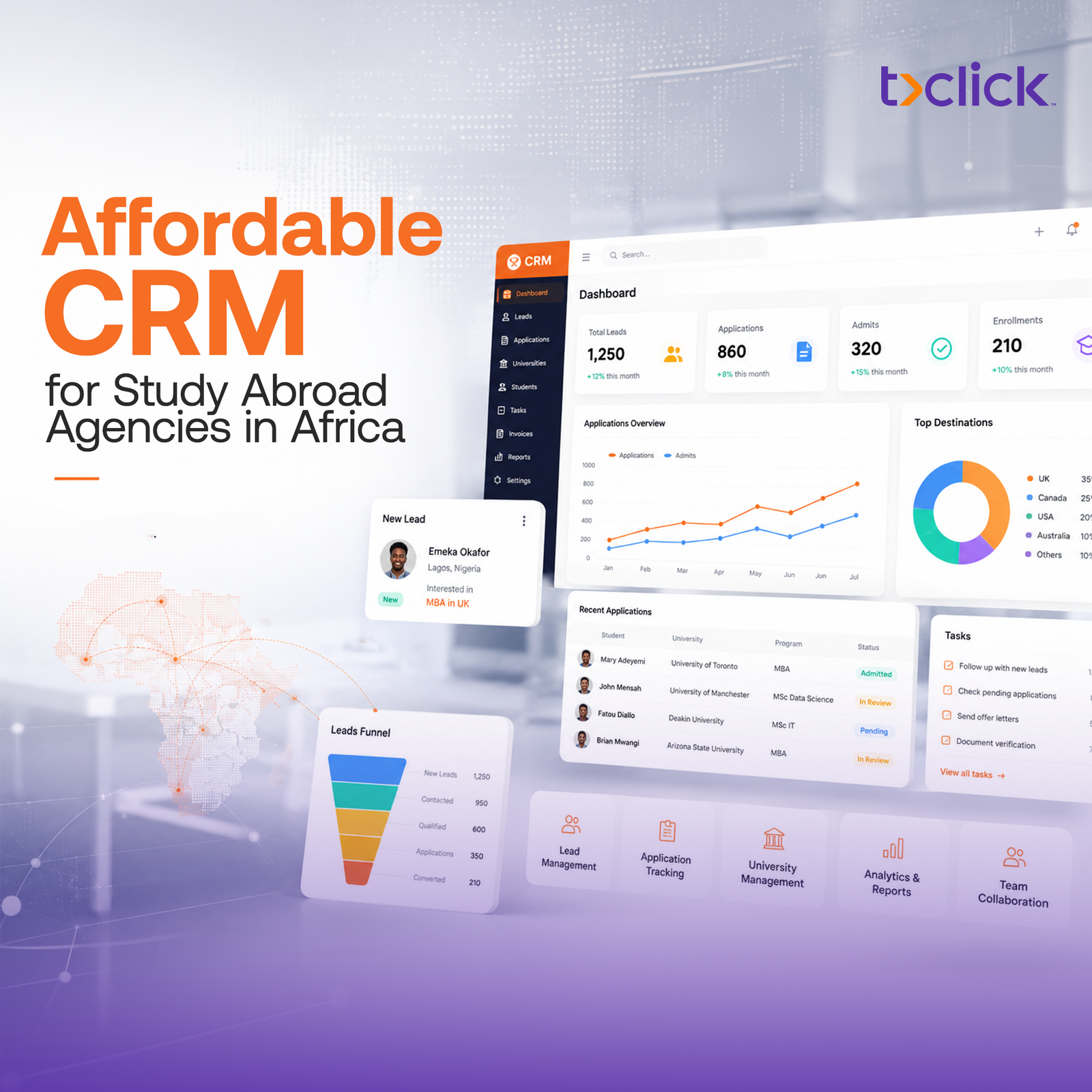
The study abroad industry across Africa is growing at an unprecedented pace.
Every year, thousands of students from countries such as Nigeria, Kenya, Ghana, Egypt, South Africa, Tanzania, Uganda, and many others choose to pursue higher education abroad. As international education becomes more accessible, study abroad agencies are managing larger volumes of student inquiries, applications, university partnerships, and admissions workflows than ever before.
This rapid growth presents tremendous opportunities, but it also introduces new operational challenges.
Modern education agencies are expected to manage every stage of the student journey, including:
- Student inquiries
- Initial consultations
- Program recommendations
- University applications
- Document collection
- Visa guidance
- Enrollment tracking
- University partnerships
- Ongoing student communication
For many agencies, these processes are still managed through spreadsheets, emails, WhatsApp conversations, and other disconnected tools.
While these methods may work for smaller teams, they quickly become inefficient as recruitment volumes increase. Teams spend more time searching for information, following up manually, and updating spreadsheets than supporting students and building relationships with university partners.
This is why more organizations are looking for an affordable CRM for study abroad agencies in Africa.
However, affordability isn’t simply about choosing the lowest-priced software.
The right CRM should help agencies reduce administrative work, improve team productivity, organize recruitment activities, and increase student enrollment without requiring a significant technology investment.
Instead of asking, “Which CRM is the cheapest?”, agencies should ask a more important question:
Which CRM delivers the greatest value while supporting long-term growth?
A purpose-built education CRM enables agencies to centralize student information, automate repetitive tasks, manage applications efficiently, strengthen university partnerships, and gain complete visibility into the entire recruitment pipeline.
Solutions like Ticlick are designed specifically for education organizations, helping study abroad agencies manage recruitment, admissions, communication, and reporting from a single centralized platform.
In this guide, you’ll learn what makes a CRM truly affordable, the essential features every study abroad agency should prioritize, how to evaluate CRM solutions based on long-term value rather than price alone, and how the right platform can help your agency grow more efficiently while delivering an exceptional student experience.
Why More Study Abroad Agencies Across Africa Are Investing in CRM Software
International Student Recruitment Is Growing Rapidly
Africa has become one of the fastest-growing regions for international student recruitment.
Students are increasingly choosing to study in destinations such as:
| Destination | Why Students Choose It |
| United Kingdom | Prestigious universities and globally recognized degrees |
| Canada | Post-graduation work opportunities and immigration pathways |
| Australia | High-quality education and excellent student support |
| United States | Diverse academic programs and research opportunities |
| Germany | Affordable tuition and strong engineering programs |
| Ireland | Expanding technology and business education opportunities |
As recruitment demand continues to grow, study abroad agencies must manage significantly more student inquiries, applications, university partnerships, and admissions processes.
Without efficient systems, this growth can overwhelm teams and reduce service quality.
A CRM provides the structure needed to support larger recruitment operations while maintaining an excellent student experience.
Many growing organizations begin by exploring CRM software for educational organizations to understand how education-focused platforms simplify recruitment, admissions, and student management.
Agencies Are Managing More Students Than Ever
Growth is exciting, but it also creates operational complexity.
Many agencies now handle:
- Thousands of student inquiries every year
- Hundreds of active applications
- Partnerships with dozens of universities
- Multiple destination countries
- Large volumes of student documentation
- Continuous communication across several channels
Managing these activities manually often results in duplicated work, missed follow-ups, and limited visibility into recruitment performance.
A centralized CRM allows every department—from recruitment consultants to admissions teams—to work from the same up-to-date information, improving both efficiency and collaboration.
Student Expectations Continue to Rise
Today’s students expect far more than assistance with university applications.
They expect a smooth, personalized, and digital-first experience from their very first interaction with an education agency.
Modern students want agencies to:
- Respond quickly to inquiries
- Recommend programs that match their academic goals
- Provide regular application updates
- Offer transparent admissions guidance
- Communicate through their preferred channels
- Be available whenever they need support
For agencies, meeting these expectations becomes increasingly difficult when student information is spread across spreadsheets, emails, WhatsApp chats, and paper records.
Imagine a student asking about studying in Canada on WhatsApp, emailing academic transcripts a few days later, and then calling another consultant to ask about scholarship opportunities.
Without a centralized system, consultants often spend valuable time searching for previous conversations instead of helping the student.
A CRM solves this challenge by creating a complete student profile that includes communication history, documents, applications, notes, and upcoming tasks in one place.
This allows consultants to deliver faster, more personalized support while creating a consistent experience throughout the recruitment journey.
Operational Efficiency Has Become a Competitive Advantage
In today’s education recruitment market, agencies are no longer competing solely based on the universities they represent.
They also compete on the quality and speed of the services they provide.
Students are far more likely to choose an agency that:
- Responds promptly
- Keeps them informed throughout the admissions process
- Provides organized guidance
- Processes applications efficiently
- Maintains professional communication
Operational efficiency has become a key differentiator.
The agencies that can manage larger recruitment volumes without compromising service quality are the ones most likely to achieve sustainable growth.
An affordable CRM gives agencies the tools to improve efficiency without requiring a large investment in additional staff or complex technology.
By automating repetitive tasks and centralizing recruitment workflows, agencies can focus more on advising students and building relationships rather than handling administrative work.
The Hidden Cost of Managing Your Agency Without a CRM
Many agency owners evaluate CRM software based solely on its subscription price.
However, the biggest cost often isn’t the software—it’s the inefficiencies that come from operating without one.
Manual processes may appear inexpensive at first, but they consume valuable time, reduce productivity, and create missed recruitment opportunities that directly impact revenue.
Instead of asking “How much does a CRM cost?”, agencies should ask:
“How much is my agency losing by not having one?”
Let’s look at the hidden costs that many growing study abroad agencies experience.
Lost Student Leads
Every student inquiry has the potential to become an enrollment.
Unfortunately, when leads are managed manually, opportunities can easily be missed.
Common problems include:
- Forgotten website inquiries
- Duplicate student records
- Delayed responses
- Incomplete student profiles
- No clear ownership of leads
Even missing a small percentage of qualified leads can significantly reduce annual enrollments.
A CRM automatically captures, organizes, and assigns new inquiries, ensuring every prospective student enters a structured recruitment pipeline.
Missed Follow-Ups
Most students don’t enroll after their first conversation.
Some students need several weeks—or even months—before they’re ready to submit an application.
During that time, agencies must consistently provide:
- Program recommendations
- Scholarship updates
- Document reminders
- Consultation scheduling
- Application status updates
- Visa guidance
Without automated reminders, consultants may unintentionally forget important follow-ups.
A CRM keeps every opportunity moving by scheduling tasks, sending reminders, and tracking communication history automatically.
This helps agencies maintain engagement throughout the entire recruitment journey.
Delayed Application Processing
Application management involves dozens of moving parts.
Each student may apply to multiple universities, each with different:
- Entry requirements
- Deadlines
- Required documents
- Admission procedures
Managing this information manually often leads to delays and unnecessary administrative work.
A CRM simplifies application management by providing structured workflows, document tracking, and real-time status updates.
This improves efficiency while reducing the likelihood of errors.
Scattered Student Documents
Every application generates numerous documents.
These may include:
- Academic transcripts
- Degree certificates
- Passports
- English proficiency test results
- Recommendation letters
- Statements of purpose
- Financial documents
- Visa paperwork
When documents are stored across email inboxes, cloud drives, local folders, and messaging apps, consultants waste valuable time searching for information.
A CRM centralizes document management so that every file is securely stored and linked directly to the student’s profile.
This improves collaboration while making information instantly accessible.
Poor Team Collaboration
As agencies grow, multiple departments often work with the same student.
For example, recruitment consultants, admissions officers, visa specialists, and managers all need access to accurate information.
Without a centralized platform, communication gaps become common.
One team member may not know that:
- Documents have already been submitted.
- A consultation has been completed.
- A university has issued an offer.
- The student has already accepted admission.
These gaps create confusion for both staff and students.
A CRM provides one shared workspace where every authorized team member has access to the same real-time information.
This improves collaboration, reduces duplication, and creates a more seamless student experience.
Limited Recruitment Visibility
Many agencies struggle to answer important operational questions such as:
- Which marketing campaigns generate the highest-quality leads?
- Which counselors achieve the best conversion rates?
- Which universities produce the highest enrollment numbers?
- How many students are currently waiting for documents?
- Where are students dropping out of the recruitment funnel?
Without centralized reporting, managers often rely on manual spreadsheets that quickly become outdated.
A CRM provides real-time dashboards and analytics that help agency leaders monitor performance, identify bottlenecks, and make informed strategic decisions.
If your agency is struggling with manual follow-ups and scattered student information, learning how to automate student recruitment process is a great place to start.
Manual Operations vs CRM-Based Operations
| Manual Operations | CRM-Based Operations |
| Student information stored across spreadsheets and emails | Centralized student database |
| Manual follow-up reminders | Automated tasks and workflows |
| Documents scattered across multiple folders | Secure document management in one platform |
| Communication spread across different channels | Complete communication history linked to each student |
| Manual reporting and calculations | Real-time dashboards and recruitment analytics |
| Limited collaboration between departments | Shared visibility across the entire organization |
| Difficult to scale operations | Built to support long-term agency growth |
What Makes a CRM Truly Affordable?
One of the biggest misconceptions in the education technology market is that the cheapest CRM is automatically the best option.
In reality, affordability should be measured by the value a CRM creates, not simply its monthly subscription fee.
A platform that helps your agency save hundreds of administrative hours, increase student enrollments, improve counselor productivity, and strengthen university partnerships will often deliver a much greater return on investment than a lower-priced solution with limited functionality.
The most affordable CRM is the one that helps your agency grow while keeping operational costs under control.
The following sections explore the key factors that determine whether a CRM delivers real long-term value for study abroad agencies across Africa.
Total Cost of Ownership Matters More Than the Subscription Price
Many agencies compare CRM platforms based only on their monthly subscription fees.
While pricing is certainly an important factor, it represents only a small portion of the overall investment.
A more meaningful way to evaluate CRM software is by looking at its Total Cost of Ownership (TCO).
TCO considers both the direct and indirect costs associated with running your recruitment operations.
For example, agencies should consider:
- Time spent on repetitive administrative work
- Hours required to prepare reports manually
- Revenue lost from missed follow-ups
- Costs associated with duplicate work
- Resources required to train new team members
- The need to hire additional staff as recruitment volumes grow
A CRM with a slightly higher monthly fee may actually reduce overall operational costs if it helps your team work more efficiently.
Rather than asking:
“Which CRM costs less?”
Ask:
“Which CRM helps my agency operate more efficiently while supporting long-term growth?”
That shift in perspective often leads to a much smarter investment.
Time Saved Through Automation
Time is one of the most valuable resources for any study abroad agency.
Recruitment consultants should spend their day advising students, building relationships, and helping applicants make informed decisions—not performing repetitive administrative tasks.
Unfortunately, many agencies still spend hours every week on activities such as:
- Assigning leads manually
- Sending follow-up reminders
- Updating spreadsheets
- Tracking application progress
- Searching for student documents
- Preparing recruitment reports
These tasks are essential, but they don’t directly generate revenue.
A modern CRM automates many of these repetitive processes.
Examples include:
- Automatically assigning new leads to consultants
- Scheduling follow-up reminders
- Creating tasks when application stages change
- Sending notifications about missing documents
- Tracking application deadlines
- Updating recruitment pipelines in real time
Automation doesn’t replace your team—it allows your team to focus on work that creates value.
Instead of spending time managing administration, consultants can spend more time supporting students and improving enrollment outcomes.
Increased Student Conversions
An affordable CRM should not only save money—it should help your agency generate more revenue.
One of the biggest ways CRM software creates value is by improving student conversion rates.
Every stage of the recruitment journey affects the likelihood that a student will enroll.
For example:
- Faster responses build trust.
- Consistent follow-ups keep students engaged.
- Better organization reduces application delays.
- Personalized communication improves decision-making.
- Complete visibility prevents opportunities from being overlooked.
Together, these improvements increase the percentage of inquiries that eventually become enrolled students.
Even a small increase in conversion rates can have a significant impact on annual revenue.
For example:
| Annual Student Inquiries | Conversion Rate | Student Enrollments |
| 2,000 | 15% | 300 |
| 2,000 | 18% | 360 |
| 2,000 | 20% | 400 |
Improving conversion by just a few percentage points can result in dozens—or even hundreds—of additional enrollments each year.
This is why many agencies view CRM software as a growth investment rather than an operational expense.
Reduced Administrative Work
Administrative tasks consume a surprising amount of time within education agencies.
Consultants often spend large portions of their day:
- Updating spreadsheets
- Searching for student records
- Preparing reports
- Organizing documents
- Following up manually
- Coordinating with internal teams
As recruitment volumes increase, these activities become even more time-consuming.
A CRM centralizes information and automates repetitive workflows, reducing the administrative burden across the organization.
The result is:
- Faster processes
- Fewer manual errors
- Better collaboration
- Improved productivity
- More time dedicated to student support
For growing agencies with limited staff, these efficiency gains can be just as valuable as hiring additional employees.
Scalability Without Hiring Large Teams
One of the biggest challenges for growing agencies is scaling operations without dramatically increasing costs.
As recruitment volumes rise, agencies often assume they need to hire more staff.
However, many operational challenges can be solved through better systems rather than larger teams.
A CRM enables agencies to:
- Manage more student inquiries
- Process more applications
- Support additional university partners
- Improve reporting
- Maintain service quality
—all without proportionally increasing administrative workload.
This makes growth more sustainable and keeps operating costs under control.
Increasing enrollments starts with using the right technology. Explore what is the best student recruitment software and discover the features that improve recruitment performance.
Cost vs. Value: Why the Cheapest CRM Isn’t Always the Best Choice
When comparing CRM platforms, agencies often focus on subscription pricing alone.
However, choosing software based solely on price can lead to higher costs in the long run.
The better approach is to compare business value rather than monthly fees.
| Low-Cost Generic CRM | Affordable Education CRM |
| Lower upfront price | Higher long-term value |
| Built for general sales teams | Built specifically for education recruitment |
| Requires significant customization | Ready-to-use recruitment workflows |
| Basic contact management | Complete student lifecycle management |
| Limited automation | Advanced workflow automation |
| Generic reports | Recruitment and admissions analytics |
| Minimal education-specific features | University, application, and visa management |
The goal isn’t to buy the cheapest software.
The goal is to choose a CRM that delivers measurable improvements in productivity, recruitment performance, and student satisfaction.
Essential Features Every Affordable CRM Should Include
Price should never come at the expense of functionality.
An affordable CRM should still provide the tools required to manage the complete student recruitment lifecycle.
The most valuable education CRM platforms typically include the following capabilities.
Student Lifecycle Management
A complete view of every student’s journey—from the first inquiry through enrollment and beyond—is essential for delivering consistent, personalized support.
Lead Management
Every inquiry should be captured, assigned, tracked, and nurtured through a structured recruitment pipeline.
This helps agencies improve response times and reduce lost opportunities.
Student Recruitment Pipelines
Recruitment pipelines provide visibility into where every student is within the admissions journey.
Consultants and managers can quickly identify:
- New inquiries
- Students awaiting consultation
- Applications in progress
- Pending offers
- Visa stages
- Confirmed enrollments
This visibility improves accountability and supports more efficient recruitment management.
Application Tracking
A CRM should simplify application management by allowing agencies to monitor submission status, outstanding requirements, university decisions, and enrollment progress from a centralized dashboard.
Document Management
Student documents should be securely stored and linked directly to each student profile.
Centralized document management improves accessibility, collaboration, and operational efficiency while reducing the risk of missing important files.
University Partner Management
Strong university partnerships are one of the most valuable assets a study abroad agency can build.
These relationships influence the range of programs an agency can offer, the quality of student opportunities, and the overall success of recruitment efforts.
However, as agencies expand their network of partner institutions, managing those relationships becomes increasingly complex.
A modern CRM helps agencies organize every aspect of university partnership management, including:
- University profiles
- Key contacts
- Recruitment agreements
- Admission requirements
- Commission structures
- Application history
- Student placement performance
- Communication records
Instead of searching through emails or spreadsheets, consultants can quickly access a complete history of every partnership.
This not only improves operational efficiency but also helps agencies identify their highest-performing university partners and strengthen long-term collaboration.
Workflow Automation
One of the biggest advantages of a CRM is its ability to automate repetitive administrative work.
Study abroad agencies perform hundreds of recurring tasks every week.
These include:
- Assigning new student inquiries
- Sending follow-up reminders
- Requesting missing documents
- Updating application stages
- Scheduling consultations
- Notifying team members about deadlines
Managing these activities manually consumes valuable time and increases the risk of human error.
Workflow automation allows agencies to standardize these processes.
For example, when a student submits an inquiry, the CRM can automatically:
- Create a student profile.
- Assign the lead to the appropriate consultant.
- Schedule an initial consultation.
- Create follow-up reminders.
- Track the student’s progress through the recruitment pipeline.
Automation creates consistency while allowing recruitment consultants to spend more time advising students instead of managing administrative tasks.
Communication Tracking
Student recruitment depends on effective communication.
Throughout the recruitment journey, agencies interact with students multiple times using different communication channels.
These interactions may include:
- WhatsApp conversations
- Emails
- Phone calls
- Online meetings
- In-person consultations
Without centralized communication tracking, conversations can easily become fragmented.
A CRM links every interaction directly to the student’s profile, creating a complete communication history.
This allows any authorized team member to understand previous discussions, current status, and upcoming actions without asking students to repeat information.
The result is a smoother and more professional student experience.
Reporting & Analytics
Successful education agencies rely on data to make informed decisions.
Without accurate reporting, managers often struggle to answer important business questions, such as:
- Which recruitment channels generate the highest-quality leads?
- Which consultants achieve the best conversion rates?
- Which destination countries are growing fastest?
- Which universities produce the highest enrollment rates?
- Where are students dropping out of the recruitment pipeline?
A CRM provides real-time dashboards that transform recruitment data into actionable insights.
Common reports include:
| Report | Business Value |
| Lead Source Performance | Identifies the most effective marketing channels |
| Student Conversion Rates | Measures recruitment success |
| Application Status Reports | Monitors admissions progress |
| University Performance | Evaluates institutional partnerships |
| Counselor Productivity | Supports performance management |
| Enrollment Trends | Helps forecast future growth |
These insights enable agencies to improve decision-making, allocate resources more effectively, and continuously optimize recruitment performance.
Team Collaboration
Recruitment is rarely handled by a single person.
As agencies grow, multiple departments contribute to the student journey.
These may include:
- Recruitment consultants
- Admissions specialists
- Visa advisors
- Marketing teams
- Operations managers
- Agency leadership
Without a centralized system, collaboration becomes difficult.
Different departments may work with outdated information or duplicate tasks.
A CRM creates one shared workspace where everyone has access to the latest student information, application status, communication history, and assigned tasks.
This improves transparency, accountability, and teamwork across the entire organization.
Security & Permissions
Education agencies manage highly sensitive student information.
This includes:
- Personal identification documents
- Academic records
- Financial information
- Visa documentation
- Communication history
Protecting this data is essential.
A professional CRM should provide:
- Role-based user permissions
- Secure cloud storage
- Document access controls
- Activity logs
- Data backup and recovery
- Secure authentication
These features help agencies maintain confidentiality while ensuring that only authorized users can access sensitive information.
Managing relationships with universities becomes much easier with university partner management software, giving agencies complete visibility into institutional partnerships and recruitment outcomes.
CRM Features Checklist
When evaluating CRM platforms, study abroad agencies should ensure the solution includes the following essential capabilities.
| Feature | Essential? | Business Benefit |
| Lead Management | ✅ | Organizes every student inquiry |
| Student Profiles | ✅ | Creates a complete student record |
| Recruitment Pipeline | ✅ | Tracks every recruitment stage |
| Application Management | ✅ | Improves admissions visibility |
| Document Management | ✅ | Centralizes important files |
| University Partner Management | ✅ | Strengthens institutional relationships |
| Workflow Automation | ✅ | Reduces manual administrative work |
| Communication Tracking | ✅ | Improves student engagement |
| Reporting & Analytics | ✅ | Supports better business decisions |
| Team Collaboration | ✅ | Enhances operational efficiency |
| Security & Permissions | ✅ | Protects sensitive student data |
Challenges African Study Abroad Agencies Face
Although every education agency operates differently, many organizations across Africa experience similar operational challenges as they grow.
Understanding these challenges helps agencies identify where CRM software can deliver the greatest impact.
High Recruitment Volumes
As international education becomes increasingly popular across Africa, agencies receive significantly more student inquiries than in previous years.
Managing large recruitment pipelines manually often results in:
- Slower response times
- Missed opportunities
- Increased administrative workload
- Reduced consultant productivity
A CRM enables agencies to handle larger recruitment volumes without sacrificing service quality.
Limited Administrative Resources
Many agencies operate with relatively small teams.
Recruitment consultants often manage consultations, applications, university communication, and visa support simultaneously.
Without automation, administrative work consumes valuable time that could otherwise be spent supporting students.
A CRM helps smaller teams accomplish more by reducing repetitive manual tasks.
Multiple Study Destinations
Students rarely consider only one country.
Many compare opportunities across destinations such as:
- Canada
- United Kingdom
- Australia
- Germany
- Ireland
- United States
Each destination has different:
- Admission requirements
- Visa processes
- Tuition structures
- Application timelines
A CRM helps agencies manage these differences while keeping every student’s journey organized.
Growing University Partnerships
As agencies expand, they typically work with an increasing number of universities and education providers.
Managing these partnerships manually becomes difficult over time.
A CRM centralizes partnership information, recruitment activity, and communication history, making relationship management more efficient and strategic.
Increasing Student Expectations
Today’s students expect quick responses, personalized recommendations, and regular updates.
Meeting these expectations consistently requires visibility into every student’s journey.
A CRM provides that visibility while helping consultants deliver a more personalized and professional experience.
Need for Scalable Operations
One of the biggest challenges facing growing agencies is scaling without dramatically increasing operational costs.
A CRM provides the systems, automation, and visibility needed to support higher recruitment volumes while maintaining efficiency and service quality.
It allows agencies to grow confidently without relying on increasingly complex manual processes.
Conclusion
As the international education market across Africa continues to expand, study abroad agencies are managing more students, more university partnerships, and increasingly complex recruitment processes than ever before. While these opportunities create significant growth potential, they also demand greater operational efficiency and stronger recruitment management.
Relying on spreadsheets, manual follow-ups, and disconnected communication tools may work in the early stages of an agency’s growth, but these methods quickly become barriers to scalability. Missed inquiries, delayed applications, poor visibility, and administrative bottlenecks can all impact both student satisfaction and business performance.
Choosing an affordable CRM for study abroad agencies in Africa is not simply about finding the lowest-priced software. It’s about investing in a solution that helps your agency work smarter, improve student experiences, strengthen university partnerships, and increase enrollment outcomes while keeping operational costs under control.
An education-focused CRM enables agencies to centralize the entire student lifecycle—from the first inquiry and consultation to application management, visa support, enrollment, and alumni engagement. With automation, real-time reporting, secure document management, and streamlined collaboration, agencies can serve more students without proportionally increasing administrative workload.
Solutions like Ticlick are designed specifically for education organizations, helping study abroad agencies across Africa modernize recruitment operations, improve team productivity, and build scalable processes for long-term growth.
As competition continues to increase across the international education sector, agencies that invest in the right CRM today will be better positioned to deliver exceptional student experiences, strengthen institutional partnerships, and achieve sustainable success for years to come.