
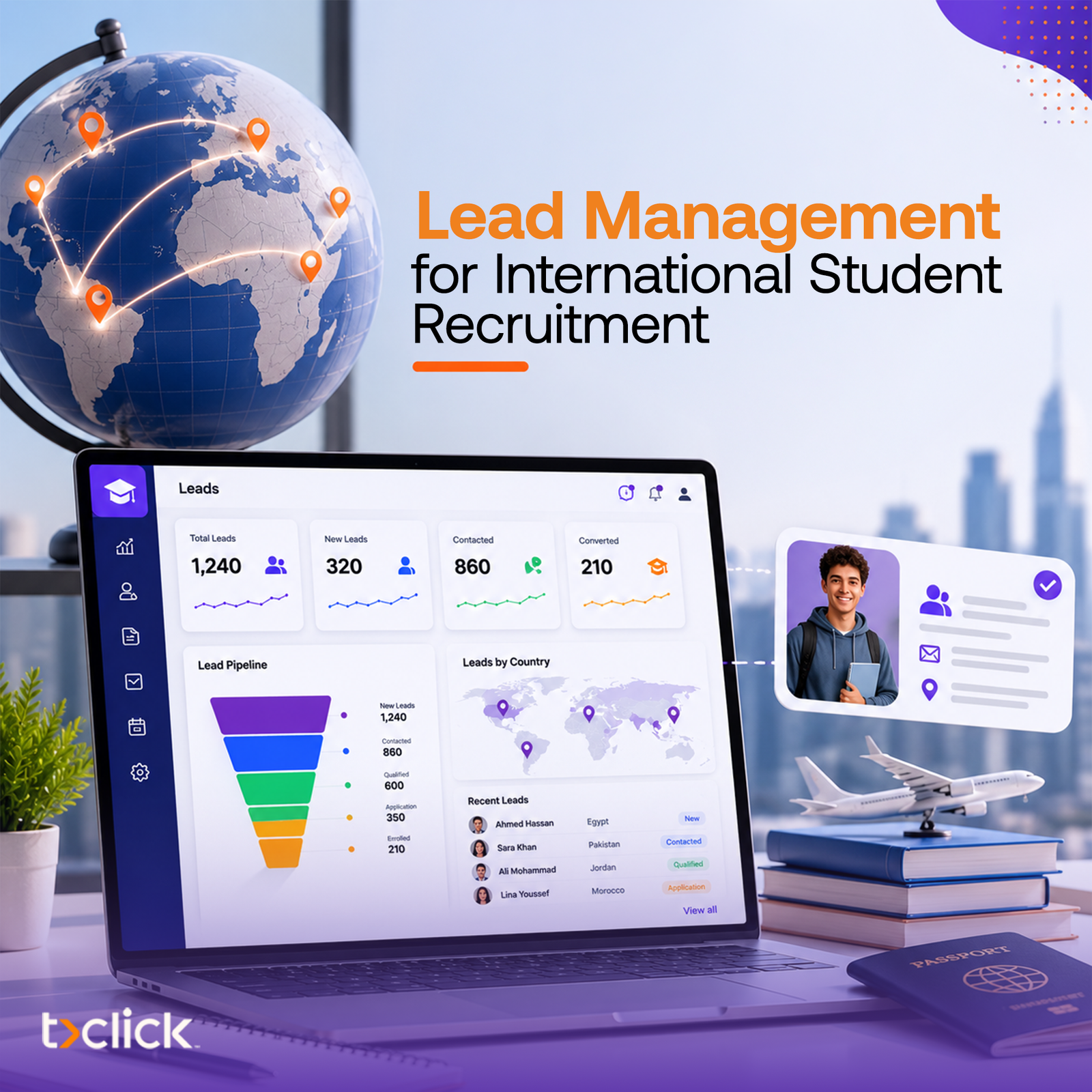
International student recruitment has become more competitive than ever. With students exploring multiple study destinations, comparing education agencies, and interacting across various digital channels, attracting inquiries is no longer the biggest challenge—managing them effectively is.
Every prospective student begins their journey as a lead. Whether they submit a form on your website, attend an education fair, send a WhatsApp message, or inquire through social media, each interaction represents a potential enrollment opportunity. However, without a structured lead management process, many of these opportunities are lost before they ever become applications.
Many education agencies still rely on spreadsheets, shared inboxes, and manual follow-ups to manage student inquiries. While these methods may work for small teams, they become increasingly difficult to maintain as recruitment volumes grow. Delayed responses, duplicate records, inconsistent communication, and missed follow-ups can all reduce conversion rates and negatively impact the student experience.
This is why lead management for international student recruitment has become a strategic priority for modern education organizations.
A dedicated lead management system helps agencies capture inquiries from multiple channels, organize student information, automate follow-ups, assign leads to the right counsellors, and monitor every stage of the recruitment pipeline. Instead of reacting to inquiries manually, recruitment teams can build structured workflows that improve efficiency while providing students with faster and more personalized support.
When integrated into an education CRM, lead management becomes the foundation of the entire student recruitment lifecycle. Every interaction, consultation, application, and enrollment is connected, giving agencies complete visibility into their recruitment performance and helping them convert more inquiries into successful enrollments.
In this guide, we’ll explore how lead management works in international student recruitment, the challenges education agencies commonly face, the essential features of an effective lead management system, and how the right CRM can help organizations recruit more students while scaling their operations.
What Is Lead Management in International Student Recruitment?
Lead management is the process of capturing, organizing, tracking, and nurturing prospective students from their first inquiry until they are ready to apply and enroll.
Rather than treating inquiries as isolated conversations, lead management creates a structured journey that helps recruitment teams understand each student’s needs, monitor progress, and provide timely guidance throughout the decision-making process.
For education agencies, effective lead management ensures that every prospective student receives the attention they need while reducing the risk of missed opportunities.
Understanding Student Recruitment Leads
In international education, a lead is any prospective student who has expressed interest in studying abroad or learning more about your services.
Leads can come from many different sources, including:
- Agency websites
- Google Ads
- Social media campaigns
- Education fairs
- Referral programs
- Email inquiries
- University events
- Live chat
Every lead represents a potential enrollment opportunity.
The faster an agency responds and the better it manages communication, the greater the chances of converting that inquiry into a successful student placement.
👉 Learn how education-focused CRM software helps agencies centralize student recruitment, communication, and admissions.
The Difference Between Lead Management and Student Management
Although these terms are sometimes used interchangeably, they refer to different stages of the recruitment journey.
Lead management focuses on prospective students before they begin the formal admissions process.
Student management begins after a lead has progressed into an active applicant or enrolled student.
Understanding this distinction helps agencies build more efficient recruitment workflows.
| Lead Management | Student Management |
| Captures new inquiries | Manages active applicants and enrolled students |
| Qualifies prospective students | Tracks admissions and enrollment |
| Focuses on lead conversion | Focuses on student success and ongoing support |
| Supports recruitment teams | Supports admissions and student services |
Managing both processes within one CRM creates a seamless experience from the first inquiry through enrollment.
Why Lead Management Matters Before the Application Stage
Many education agencies focus heavily on managing applications but overlook the stage that comes before them.
In reality, the recruitment process is won or lost long before a student submits an application.
Prospective students often compare several agencies before making a decision. They evaluate factors such as response time, communication quality, expertise, and overall service.
Without an organized lead management process, agencies risk:
- Losing inquiries to competitors
- Missing follow-up opportunities
- Providing inconsistent communication
- Delaying consultations
- Reducing application conversion rates
By managing leads effectively from the very beginning, agencies can build stronger relationships, improve trust, and guide students toward successful enrollment.
Who Needs Lead Management Software?
Lead management software is valuable for any organization involved in recruiting or advising international students.
This includes:
- Study abroad agencies
- Universities and colleges
- Language schools
- Exchange program providers
- Educational consultants
- Pathway providers
- Scholarship organizations
Whether an organization manages hundreds or thousands of inquiries each year, a structured lead management system helps improve organization, increase efficiency, and support long-term growth.
👉 Learn how automation improves follow-ups, response times, and student conversion rates.
The International Student Recruitment Journey Starts With a Lead
Every successful enrollment begins with a single inquiry.
While each student’s journey is unique, most international recruitment processes follow a similar path. Understanding this journey allows agencies to create structured workflows, automate repetitive tasks, and provide timely support at every stage.
The typical recruitment lifecycle includes several key phases, each requiring clear communication and careful follow-up.
Lead Generation
The journey begins when prospective students discover your agency through marketing campaigns, referrals, social media, search engines, or education events. At this stage, the goal is to capture accurate contact information and understand the student’s initial interests.
Initial Inquiry
After expressing interest, students typically request more information about study destinations, universities, programs, or admission requirements. Responding quickly during this stage is essential for creating a positive first impression.
Qualification
Recruitment consultants assess the student’s academic background, career goals, budget, preferred destination, and eligibility. This helps determine whether the student is a good fit for specific universities or programs.
Consultation
During consultations, agencies provide personalized recommendations, answer questions, and explain the admissions process. Every interaction should be documented to ensure consistent communication throughout the recruitment journey.
Program Matching
Based on the student’s qualifications and preferences, consultants recommend suitable universities and programs. This stage lays the foundation for a successful application.
Application
Once the student decides on a program, the agency begins preparing applications, collecting documents, and coordinating with university partners.
Enrollment
After receiving an offer, completing visa requirements, and finalizing payments, the student officially enrolls and prepares to begin their studies abroad.
Common Lead Management Challenges Education Agencies Face
As student recruitment grows, managing inquiries becomes increasingly complex.
Education agencies receive leads from multiple channels, work with several counselors, and communicate with prospective students across different platforms. Without a structured lead management system, it becomes difficult to keep every opportunity organized and moving through the recruitment pipeline.
Below are some of the most common challenges agencies face.
Leads Coming From Multiple Channels
Today’s students interact with education agencies through various online and offline channels.
These may include:
- Agency websites
- Google Ads
- Facebook and Instagram
- Education fairs
- Referral partners
- Live chat
When inquiries are scattered across multiple platforms, it’s easy for leads to be overlooked or duplicated.
A centralized CRM automatically captures leads from different sources and stores them in one database, making them easier to manage.
Slow Response Times
Speed plays a major role in student recruitment.
Students often contact several agencies before making a decision, and the first organization to respond professionally is more likely to earn their trust.
Manual lead management can slow response times, especially during busy recruitment periods.
Automated lead notifications and task assignments help agencies respond quickly and maintain consistent communication.
Missed Follow-Ups
Most students don’t enroll after the first conversation.
They often require several consultations, reminders, and follow-up discussions before submitting an application.
Without automated reminders, recruitment teams may forget important follow-ups or contact students too late.
A CRM schedules follow-up tasks automatically, helping consultants stay engaged with every lead.
Duplicate Student Records
When multiple team members manage inquiries separately, duplicate records can quickly appear.
This leads to repeated communication, inconsistent information, and confusion for both staff and students.
A centralized lead management system creates one profile for each prospective student, ensuring every interaction is recorded in the same place.
Poor Team Collaboration
Recruitment often involves multiple departments, including counsellors, admissions teams, visa specialists, and managers.
If student information is stored in different spreadsheets or email threads, collaboration becomes difficult.
With a CRM, every team member can access the latest lead information, communication history, and assigned tasks from one platform.
Manual Lead Assignment
Assigning inquiries manually takes time and may result in uneven workloads across recruitment teams.
Lead management software automatically routes inquiries to the appropriate consultant based on predefined rules such as destination, program, language, or region.
This improves efficiency while ensuring every lead receives timely attention.
Limited Visibility Into Recruitment Performance
Without reporting tools, agencies often struggle to answer questions like:
- Which marketing channels generate the highest-quality leads?
- Which counselors convert the most students?
- Where are leads dropping out of the recruitment funnel?
- How long does it take to convert an inquiry into an application?
Real-time dashboards provide valuable insights that help managers improve recruitment strategies and allocate resources more effectively.
👉 Learn how university partner management software helps agencies manage institutional relationships and recruitment outcomes.
Common Lead Management Challenges
| Challenge | Business Impact |
| Missed follow-ups | Lost enrollment opportunities |
| Manual lead tracking | Reduced productivity |
| Duplicate records | Poor student experience |
| Delayed responses | Lower conversion rates |
| Disconnected communication | Inconsistent student journeys |
| Limited reporting | Slower decision-making |
How CRM Software Improves Lead Management
An education CRM transforms lead management from a manual process into a structured, automated workflow.
Instead of tracking inquiries through spreadsheets or multiple communication tools, agencies can manage every lead from one centralized platform.
This improves visibility, increases efficiency, and helps recruitment teams convert more inquiries into enrolled students.
Centralized Lead Database
A CRM stores every inquiry in one secure location, regardless of where it originated.
This gives recruitment teams immediate access to contact details, communication history, consultation notes, and recruitment progress without switching between different systems.
Automatic Lead Capture
Rather than manually entering student information, a CRM automatically captures leads from websites, online forms, social media campaigns, and other recruitment channels.
This reduces administrative work while ensuring no inquiry is missed.
Lead Assignment
As new inquiries arrive, the system can automatically assign them to the appropriate recruitment consultant.
Assignment rules may be based on:
- Study destination
- Country
- Program type
- Language preference
- Counselor availability
This helps distribute workloads fairly and speeds up response times.
Follow-Up Automation
Consistent communication is essential for converting leads.
A CRM can automatically schedule reminders, create follow-up tasks, and trigger email or WhatsApp messages based on the student’s stage in the recruitment process.
Automation helps ensure every lead receives timely communication without increasing administrative effort.
Communication Tracking
Every email, meeting, phone call, or message is recorded within the student’s profile.
This gives recruitment teams a complete communication history, making it easier to provide personalized support and avoid duplicated conversations.
Recruitment Pipelines
Visual recruitment pipelines allow agencies to monitor where each lead is within the recruitment journey.
Instead of manually updating spreadsheets, consultants can quickly identify which students need follow-up, consultation, or application support.
Reporting and Dashboards
Built-in analytics help agencies measure recruitment performance through real-time reports.
Managers can monitor lead sources, counselor productivity, conversion rates, and pipeline performance to make informed business decisions.
👉 Explore the top CRM features education agencies need to improve recruitment visibility and performance.
Manual Lead Management vs CRM-Based Lead Management
| Manual Process | CRM-Based Process |
| Spreadsheets | Centralized CRM database |
| Manual lead assignment | Automated routing |
| Separate communication tools | Unified communication timeline |
| Manual follow-ups | Automated reminders and workflows |
| Basic reporting | Real-time recruitment dashboards |
Essential Features Every Lead Management System Should Include
The effectiveness of a lead management system depends on the features it offers. While every education agency has unique recruitment processes, there are several core capabilities that every modern CRM should provide.
Multi-Channel Lead Capture
Prospective students interact with agencies through multiple channels.
A good lead management system should automatically capture inquiries from websites, landing pages, social media campaigns, education fairs, and referral sources, ensuring every lead enters the recruitment pipeline without manual data entry.
Student Profiles
Every lead should have a centralized profile containing:
- Contact information
- Academic background
- Preferred destination
- Communication history
- Consultation notes
- Current recruitment stage
Having all information in one place helps consultants provide more personalized support.
Lead Scoring
Not every lead has the same level of interest or readiness.
Lead scoring allows agencies to prioritize prospective students based on factors such as engagement, eligibility, and likelihood of enrollment, helping recruitment teams focus on the highest-potential opportunities.
Pipeline Management
Visual recruitment pipelines provide a clear overview of where every lead is within the recruitment journey.
This helps consultants identify bottlenecks, prioritize follow-ups, and move students through the admissions process more efficiently.
Task and Reminder Automation
Automation reduces repetitive administrative work by creating reminders, assigning follow-up tasks, and notifying consultants about upcoming deadlines.
This ensures that no lead is forgotten while improving consistency across the recruitment team.
Email and WhatsApp Integration
Since students communicate through multiple channels, the CRM should integrate with email and messaging platforms.
This keeps all conversations connected to the student’s profile and provides a complete communication history.
Appointment Scheduling
Built-in scheduling tools allow students to book consultations based on counselor availability, reducing manual coordination and improving the booking experience.
Student Portal Integration
A student portal gives prospective students access to application updates, required documents, and important notifications while reducing the number of routine inquiries received by recruitment teams.
Analytics and Reporting
Real-time reports help agencies evaluate recruitment performance by tracking lead sources, conversion rates, counselor productivity, and pipeline performance.
These insights support better strategic planning and continuous improvement.
Role-Based Permissions
Role-based access ensures employees only see the information relevant to their responsibilities, improving both security and operational control.
👉 Discover how encrypted CRM software helps protect student data and secure recruitment operations.
Lead Management Checklist
| Feature | Essential |
| Multi-Channel Lead Capture | ✅ |
| Student Profiles | ✅ |
| Lead Scoring | ✅ |
| Recruitment Pipeline | ✅ |
| Workflow Automation | ✅ |
| Email & WhatsApp Integration | ✅ |
| Appointment Scheduling | ✅ |
| Student Portal | ✅ |
| Reporting & Analytics | ✅ |
| Role-Based Permissions | ✅ |
Best Practices for Managing International Student Leads
Technology alone doesn’t guarantee successful recruitment. Education agencies also need consistent processes that help teams engage with prospective students effectively.
Some best practices include:
- Respond to new inquiries as quickly as possible.
- Use standardized qualification criteria.
- Automate repetitive follow-up tasks.
- Personalize communication based on student interests.
- Record every interaction within the CRM.
- Review recruitment reports regularly.
- Continuously optimize recruitment workflows.
These practices help agencies improve conversion rates while delivering a more professional student experience.
Key Metrics Every Education Agency Should Track
Monitoring recruitment performance helps agencies identify opportunities for improvement and make data-driven decisions.
Important metrics include:
- Lead Response Time
- Lead-to-Consultation Rate
- Consultation-to-Application Rate
- Application-to-Enrollment Rate
- Cost Per Lead
- Counselor Conversion Rate
- Lead Source Performance
Tracking these KPIs enables agencies to refine recruitment strategies and maximize return on marketing investments.
Why Ticlick Simplifies Lead Management
Ticlick is built specifically for education organizations managing international student recruitment.
Instead of relying on disconnected tools, agencies can centralize lead management, student recruitment, admissions, communication, and reporting within one platform.
With Ticlick, agencies can:
- Capture leads from multiple channels automatically
- Assign inquiries to the right counselors
- Automate follow-ups and reminders
- Track every interaction with prospective students
- Monitor recruitment pipelines in real time
- Measure performance through powerful dashboards
By connecting every stage of the recruitment journey, Ticlick helps education agencies improve efficiency, increase lead conversion, and support sustainable business growth.
Frequently Asked Questions
What is lead management for international student recruitment?
Lead management is the process of capturing, organizing, nurturing, and converting prospective students into enrolled students through structured recruitment workflows.
Why is lead management important for education agencies?
Effective lead management improves response times, reduces missed follow-ups, increases conversion rates, and helps agencies provide a better experience for prospective students.
How does CRM software improve lead management?
A CRM centralizes student information, automates follow-ups, tracks communication, manages recruitment pipelines, and provides real-time reporting, allowing agencies to manage leads more efficiently.
What is lead scoring?
Lead scoring is a method of ranking prospective students based on their engagement, qualifications, and likelihood of enrolling, helping recruitment teams prioritize high-potential leads.
Can lead management software automate follow-ups?
Yes. Modern education CRM platforms automatically schedule reminders, assign tasks, and send notifications, ensuring consistent communication throughout the recruitment process.
How can agencies improve lead conversion?
Agencies can improve conversion by responding quickly, personalizing communication, automating repetitive tasks, tracking every interaction, and using analytics to optimize recruitment strategies.
Conclusion
Every international student begins their journey as a lead, making lead management one of the most important stages in the recruitment process. Agencies that rely on manual tracking and disconnected communication tools often struggle to respond quickly, maintain consistent follow-ups, and convert inquiries into enrollments.
By implementing a dedicated lead management solution, education organizations can centralize student information, automate workflows, improve collaboration, and gain complete visibility into their recruitment pipeline.
With Ticlick, education agencies can manage leads, applications, communication, university partnerships, and admissions from one integrated CRM—helping teams work more efficiently, improve conversion rates, and deliver an outstanding experience to every prospective student.