
CRM Software for Educational Organizations: A Complete Guide to Student Management Systems
Educational organizations around the world are experiencing a major operational shift. As student expectations evolve and digital communication becomes the standard, institutions must manage far more complex interactions than they did just a few years ago. Universities, study abroad agencies, training institutes, and cultural exchange organizations now deal with thousands of student inquiries, application processes, document submissions, and communication touchpoints every year. Managing these processes using spreadsheets, scattered email conversations, and messaging apps often creates operational chaos. Teams struggle to track which students have submitted applications, which documents are missing, and what stage each student is currently in. Without a structured system, even experienced recruitment teams can lose visibility over their pipelines. This is where CRM software for educational organizations becomes a critical part of modern education management. A well-designed CRM platform centralizes student data, organizes recruitment pipelines, automates communication, and provides institutions with real-time visibility into their operations. Solutions such as Ticlick demonstrate how modern CRM systems can support educational organizations by structuring student journeys, automating administrative processes, and improving collaboration between teams. By implementing specialized CRM software for educational organizations, institutions can manage recruitment and student engagement more efficiently while improving the overall student experience. In this article, we explore what CRM software for educational organizations is, why it has become essential for modern institutions, the key features organizations should prioritize, and how platforms like Ticlick support education-focused operations. What Is CRM Software for Educational Organizations? Understanding CRM Technology in the Education Sector Customer Relationship Management (CRM) systems are widely used across industries to manage interactions with customers and prospects. In education, however, CRM systems serve a slightly different purpose. Instead of managing buyers and sales deals, CRM software for educational organizations focuses on managing student relationships. These platforms help institutions track student inquiries, manage admissions processes, organize program applications, and maintain communication throughout the student lifecycle. Every student interaction—from the first inquiry to final enrollment—can be stored and managed within the CRM platform. This allows education teams to maintain structured records of communication, application progress, and required documentation. By organizing this information into centralized systems, institutions gain greater visibility into their recruitment pipelines and can respond more efficiently to student needs. Types of Educational Organizations That Use CRM Many different types of institutions rely on CRM software for educational organizations to manage their operations. These organizations often include: Universities and colleges Study abroad agencies International student recruitment teams Language schools and training institutes Cultural exchange organizations Internship and volunteering program providers Each of these organizations manages multiple student journeys simultaneously. CRM systems allow them to track inquiries, coordinate applications, and maintain clear communication across programs. How Education CRM Systems Differ from Traditional CRM Platforms Traditional CRM platforms were originally designed for corporate sales teams. These systems prioritize deal pipelines, customer accounts, and short-term transactions. Education workflows are significantly different. Student recruitment and admissions processes often take several months and involve multiple stages such as counselling sessions, document collection, application submission, and visa preparation. CRM software for educational organizations is designed to support these long student lifecycles. Instead of simple sales pipelines, education CRM systems include tools for application management, document tracking, and student lifecycle monitoring. Operational Challenges Educational Organizations Face Without CRM Fragmented Communication Channels Educational organizations communicate with students through multiple channels, including email, messaging apps, websites, and social media. Without centralized CRM systems, these conversations often become scattered across different platforms. Recruitment teams may struggle to track previous discussions with students or follow up on important inquiries. Using CRM software for educational organizations centralizes communication history and ensures that teams can easily access student conversations when needed. Difficulty Tracking Student Applications Admissions processes involve multiple stages that must be monitored carefully. Without structured pipelines, teams may lose track of which students have submitted applications, received offers, or completed enrollment. CRM platforms organize these stages into visual pipelines, allowing administrators to monitor the progress of every student application. Managing Documentation and Compliance Many educational programs require students to submit important documents such as academic transcripts, identification records, and financial documentation. Tracking these documents manually can lead to delays and missing files. CRM software for educational organizations allows institutions to collect, verify, and store student documents within a secure centralized system. Limited Visibility Into Recruitment Performance Without reporting tools, it is difficult for institutions to understand which recruitment strategies are working effectively. CRM systems provide analytics dashboards that track recruitment sources, conversion rates, and enrollment performance. These insights help institutions improve their recruitment strategies. Key Features of CRM Software for Educational Organizations Student Inquiry and Lead Management Lead management tools allow institutions to capture student inquiries from multiple channels such as websites, digital campaigns, and education fairs. Each inquiry can be converted into a structured student profile that includes contact information, communication history, and program interests. This allows recruitment teams to maintain organized records and respond quickly to prospective students. Application and Enrollment Pipeline Management Admissions pipelines allow institutions to track students through each stage of the enrollment process. Recruitment teams can easily identify which students are exploring programs, preparing applications, awaiting admission decisions, or ready for enrollment. This visibility ensures that students receive timely guidance and support. Document and Compliance Tracking Document management tools allow students to upload required documents directly to their profiles. Administrators can then verify application requirements and track missing documents. This structured system helps institutions maintain compliance with admissions and visa requirements. Communication Automation Automation tools enable institutions to send scheduled messages, reminders, and updates to students. Many CRM software for educational organizations’ platforms integrate communication tools such as Email automation WhatsApp messaging SMS notifications These features ensure that students receive important updates throughout the application process. Program and Course Management Educational organizations often offer multiple programs, courses, and recruitment pathways. CRM
CRM Software for Overseas Education: Manage Students, Applications & Recruitment

The global demand for studying abroad has expanded rapidly over the last decade. Thousands of students every year seek international education opportunities in countries such as the United States, the United Kingdom, Canada, Australia, and across Europe. This growth has created significant opportunities for education consultants, study abroad agencies, and universities that recruit international students. However, managing overseas education processes is far more complicated than traditional admissions management. Agencies must guide students through multiple stages, including counselling, program selection, application preparation, document collection, visa processing, and final enrollment. At the same time, recruitment teams must coordinate with universities, partner institutions, and immigration processes across different countries. For many organizations, these operations are still managed using spreadsheets, email threads, and messaging apps. While this approach might work for a small number of applicants, it quickly becomes inefficient as student inquiries increase. Important information becomes scattered across different systems, making it difficult to track progress or maintain clear communication. This growing complexity has led many education organizations to adopt CRM software for overseas education. These specialized platforms provide structured tools to manage student inquiries, applications, documents, and communication within a single system. Solutions such as Ticlick show how modern technology can support the international education industry by organizing recruitment pipelines, automating communication, and providing real-time visibility into student progress. By implementing CRM software for overseas education, agencies and institutions can manage recruitment more efficiently while providing a better experience for prospective students. This article explores how CRM software for overseas education works, why it has become essential for international recruitment, the key features organizations should look for, and how platforms like Ticlick support overseas education operations. What Is CRM Software for Overseas Education? Understanding the Role of CRM in International Student Recruitment Customer relationship management systems are widely used across industries to manage interactions with clients and prospects. In the education sector, CRM technology has evolved to support the unique requirements of student recruitment and admissions management. CRM software for overseas education is designed specifically for organizations that guide students through international study opportunities. Instead of focusing on traditional sales processes, these systems are built around the student journey, from the first inquiry to final enrollment. Recruitment teams can store student profiles, track communication history, manage application stages, and monitor document submissions in one centralized platform. This structure allows consultants to maintain better control over their recruitment pipelines. Many agencies that recruit international students also rely on specialized study abroad management software to manage applications, track university placements, and organize student documentation. Who Uses CRM Software for Overseas Education? A wide range of organizations rely on CRM software for overseas education to manage international student recruitment activities. These organizations commonly include: Study abroad agencies Education consultants University international admissions teams Recruitment partners and agents Pathway providers and language schools Each of these organizations handles a large volume of student inquiries and applications. Without structured systems, managing these operations becomes increasingly difficult. CRM platforms help recruitment teams organize student data, monitor application progress, and ensure that no prospective student is overlooked. Why Overseas Education Requires Specialized CRM Platforms International student recruitment involves more complex workflows than typical customer management processes. A single student journey may involve multiple stages, including counselling, program comparison, documentation preparation, application submission, and visa processing. Traditional CRM systems designed for sales teams often lack the tools necessary to support these workflows. They may not provide document tracking, application pipelines, or compliance management features required by overseas education agencies. For this reason, CRM software for overseas education focuses on managing student lifecycles rather than simple contact databases. These platforms are structured to support long recruitment timelines and multi-step admissions processes. Organizations managing exchange programs often require additional compliance tracking. Systems such as Save J1 program CRM support help teams organize documentation and monitor participant progress more effectively. Challenges of Managing Overseas Education Without CRM Software Organizations that manage international recruitment without dedicated CRM systems often encounter operational difficulties that slow down their processes. Managing High Volumes of Student Inquiries Education agencies receive inquiries from multiple channels, including websites, social media, digital campaigns, and education fairs. Handling these inquiries manually often leads to missed opportunities. Without CRM software for overseas education, inquiries may remain buried in email inboxes or messaging platforms. Recruitment teams may struggle to respond quickly, and potential students may choose competing agencies or institutions. CRM platforms automatically capture inquiries and organize them into structured student profiles, ensuring that every lead receives proper follow-up. Handling Complex Documentation Requirements International education applications require numerous documents, including academic transcripts, personal statements, financial documents, and visa paperwork. Managing these documents through email attachments or shared folders can quickly become chaotic. Files may be misplaced, versions may be outdated, and application requirements may not be properly tracked. Using CRM software for overseas education allows agencies to collect, verify, and manage student documents in a structured way, ensuring that all application requirements are completed on time. Coordinating Communication with Universities Education consultants frequently work with multiple universities and partner institutions. Each institution may have different application requirements, deadlines, and admission procedures. Without centralized communication tools, recruitment teams must manually track these interactions, which increases the risk of miscommunication. CRM systems help agencies maintain structured communication records with universities and partners, improving coordination throughout the admissions process. Tracking Long Student Recruitment Journeys Unlike traditional sales transactions, overseas education recruitment often takes several months from initial inquiry to enrollment. Consultants must track each student’s progress across several stages, including counselling sessions, application preparation, admission offers, and visa approvals. CRM software for overseas education organizes these stages into visual pipelines that allow recruitment teams to track progress efficiently. International internship and trainee programs involve additional operational steps. Using an internship and trainee J-1 CRM helps agencies manage placements, participant records, and host organizations efficiently.
Best International Exchange program Software for Cultural & Student Programs
International exchange programs have become an essential part of modern education and cultural collaboration. Universities, cultural organizations, internship providers, and global mobility agencies increasingly rely on these programs to create international opportunities for students and young professionals. Through exchange programs, participants gain valuable cross-cultural experiences, develop professional skills, and build global networks that shape their future careers. However, as the popularity of exchange programs continues to grow, managing them has become significantly more complex. Organizations must coordinate participant applications, verify documentation, communicate with host organizations, track program progress, and maintain compliance with regulatory requirements. These processes involve multiple stakeholders, including participants, host institutions, program sponsors, and administrative teams. Managing these activities manually can quickly become overwhelming. Many organizations still rely on spreadsheets, email threads, and disconnected systems to track participant information and program progress. While this approach may work for small programs, it becomes inefficient and risky as the number of participants increases. This is where international exchange program software plays a critical role. These specialized platforms are designed to help organizations manage exchange programs efficiently by centralizing participant data, automating workflows, and improving visibility across program operations. Solutions like Ticlick demonstrate how modern technology can support exchange programs by organizing participant journeys, streamlining communication, and providing structured program management tools. By implementing purpose-built international exchange program software, organizations can reduce administrative complexity and focus on delivering meaningful international experiences. In this article, we explore what international exchange program software is, why organizations need it, the key features these platforms provide, and how they help institutions manage global exchange programs more effectively. What Is International Exchange Program Software? International exchange programs involve a wide range of operational processes that require careful coordination. From participant recruitment to final program completion, organizations must manage multiple workflows simultaneously. International exchange program software provides the digital infrastructure necessary to support these complex operations. Definition and Core Purpose International exchange program software is a specialized platform designed to help organizations manage exchange programs, participant applications, host placements, documentation, and communication within a single centralized system. Unlike basic databases or spreadsheets, exchange program software structures the entire participant lifecycle into organized workflows. Each participant can be tracked from the moment they submit an application through the placement process and program completion. The primary purpose of international exchange program software is to simplify the administration of exchange programs. By centralizing participant information and automating repetitive tasks, organizations can improve efficiency and maintain clear visibility across their programs. For example, program administrators can use the system to track application submissions, verify participant documents, assign host organizations, and communicate with participants throughout the program lifecycle. Who Uses Exchange Program Software? A wide variety of organizations rely on international exchange program software to manage their global mobility initiatives. These organizations often include: Cultural exchange organizations Universities and academic institutions J-1 visa program sponsors Study abroad agencies Internship and trainee program providers Volunteer program coordinators Each of these organizations manages participant journeys that involve multiple steps and coordination between various stakeholders. Exchange program software helps them maintain structure and visibility throughout these processes. Organizations managing J-1 exchange programs often face complex compliance requirements and documentation workflows. Implementing structured systems such as Save J1 program CRM support can help streamline these processes and maintain full program visibility. Why Exchange Programs Require Specialized Systems Exchange programs differ significantly from traditional business workflows. Managing participants in international programs involves compliance requirements, host placements, and extensive documentation. For example, a typical participant journey may include application review, document verification, interview scheduling, host organization matching, visa processing, and program monitoring. Without a structured system, it becomes difficult to track each participant’s progress accurately. This is why international exchange program software is designed specifically for exchange program operations rather than generic customer management systems. The software focuses on participant lifecycle management rather than sales pipelines, making it far more suitable for program administration. Challenges of Managing Exchange Programs Without Software Organizations that manage exchange programs without specialized systems often face several operational challenges. These challenges can limit program growth and increase administrative workload. Complex Participant Management One of the most significant challenges is managing participant information across multiple programs and locations. Administrators must track application details, communication history, document submissions, and program stages for each participant. Without international exchange program software, this information is often scattered across different files and communication channels. This lack of organization makes it difficult to maintain accurate records and monitor participant progress effectively. Compliance and Documentation Requirements Exchange programs often require extensive documentation to meet regulatory and visa requirements. Participants may need to submit identification documents, academic transcripts, medical forms, and program agreements. Managing these documents manually can be time-consuming and prone to errors. International exchange program software helps organizations track document submissions, verify compliance requirements, and ensure that participants meet program criteria before placement. Multi-Stakeholder Communication Exchange programs involve communication with several parties, including participants, host organizations, program coordinators, and sometimes government agencies. When communication is spread across email threads and messaging platforms, it becomes difficult to maintain a clear communication history. Exchange program software centralizes communication, ensuring that administrators can easily track interactions and respond efficiently. Tracking Program Stages and Progress Another challenge without specialized software is monitoring program progress. Administrators need to know where each participant is in the program lifecycle and which steps still need to be completed. Without international exchange program software, tracking this information manually can lead to missed deadlines and delayed placements. Many institutions that run international mobility programs also rely on specialized study abroad management software to organize applications, track placements, and coordinate communication with global partners. Key Features of International Exchange Programme Software When organizations evaluate international exchange program software, they typically look for features that support participant management, compliance tracking, communication, and program coordination. Participant and Application Management A core feature
CRM Software for Educational Institute: Key Features, Benefits & How to Choose
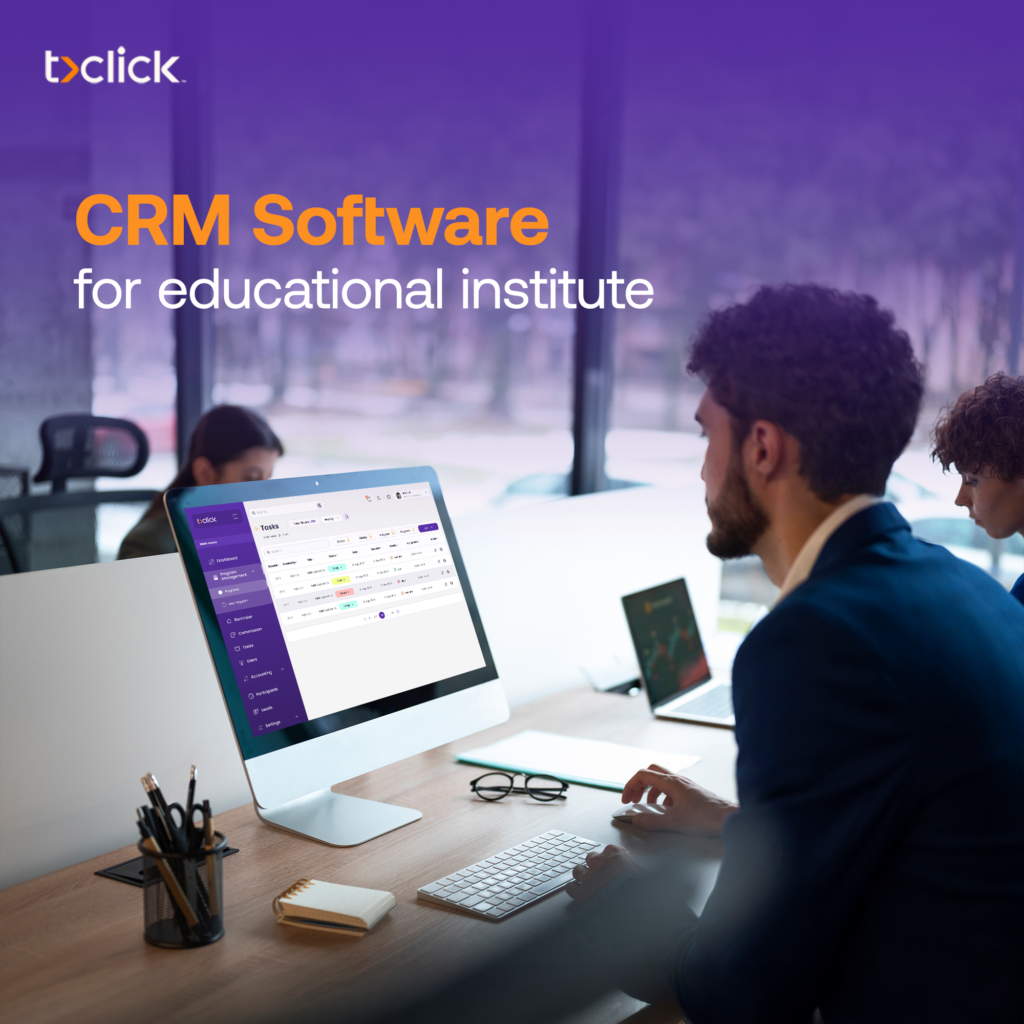
The education sector is experiencing a rapid digital transformation. Universities, colleges, language schools, and training institutes are no longer managing student recruitment and admissions using manual processes alone. Instead, institutions are adopting advanced technologies that help them organize inquiries, track applications, and communicate with prospective students more efficiently. One of the most important technologies driving this transformation is CRM software for educational institute operations. A specialized CRM system allows educational organizations to centralize student data, manage admissions pipelines, and automate communication across multiple channels. As competition for students increases globally, institutions need systems that allow them to respond quickly to inquiries, track application progress, and maintain strong engagement with prospective students. Platforms like Ticlick are designed specifically to support these needs. Unlike generic CRM tools originally built for business sales teams, Ticlick focuses on the unique workflows of education recruitment and admissions. It enables institutions to manage student inquiries, documents, communication, and enrollment pipelines from a single structured platform. Without systems like these, admissions teams often rely on spreadsheets, email inboxes, and messaging apps to manage prospective students. While this approach may work for small teams, it quickly becomes inefficient as inquiry volumes grow. Important messages may be missed, documents can become disorganized, and recruitment pipelines may lose visibility. This is why more institutions are now exploring CRM software for educational institute environments. The right CRM solution helps educational organizations manage complex admissions processes, improve student communication, and scale their recruitment operations more effectively. In this guide, we will explore what CRM software for educational institute management actually means, why educational institutions increasingly rely on these systems, and which features organizations should evaluate when choosing the right platform. What Is CRM Software for Educational Institutes? Educational institutions interact with thousands of prospective students every year. Managing these interactions efficiently requires more than simple contact databases or spreadsheets. This is where specialized CRM systems designed for education become essential. Understanding the role of CRM software for educational institute operations helps institutions see how technology can streamline recruitment, admissions, and student engagement processes. Definition and Purpose of Education CRM Systems CRM software for educational institute environments is a technology platform designed to manage relationships between institutions and their prospective or current students. The system acts as a centralized database where admissions teams can track student inquiries, manage applications, store documents, and monitor communication history. Instead of managing these tasks across multiple disconnected tools, education CRM systems bring everything together into one structured platform. This allows institutions to create organized workflows that guide students through the entire recruitment journey. For example, when a prospective student submits an inquiry through a website form, the CRM system automatically records the information and creates a student profile. Admissions counsellors can then track communication with that student, assign follow-up tasks, and monitor application progress. By providing a clear overview of each student’s journey, CRM software for educational institutes helps institutions maintain consistency in their recruitment processes and ensure that no prospective student is overlooked. 👉 See how an Internship and Trainee J-1 CRM helps manage participants, documents, and program workflows: How Education CRMs Differ from Traditional CRM Platforms Although CRM systems are widely used in business environments, traditional CRM platforms are not always suitable for educational institutions. Most generic CRM tools are designed for sales pipelines where businesses track deals and customer purchases. Student recruitment, however, is far more complex. The journey from inquiry to enrollment often includes multiple stages such as counselling sessions, document submission, eligibility verification, application review, admission offers, and visa preparation. Each of these stages requires careful coordination between students, admissions officers, and sometimes external recruitment agents. Because of this complexity, CRM software for educational institute operations includes features that support application workflows rather than simple sales pipelines. These systems allow institutions to track documents, manage admissions stages, automate communication with applicants, and monitor recruitment performance. In other words, education CRM systems are designed around the student lifecycle, while traditional CRM platforms are designed around the customer purchase cycle. Why Educational Institutions Are Adopting CRM Systems The demand for CRM software for educational institute management has grown significantly as institutions expand their recruitment efforts and adopt more digital marketing strategies. One of the main reasons institutions implement CRM systems is the increasing volume of student inquiries. Universities and colleges now receive inquiries from websites, social media campaigns, recruitment agents, and international education fairs. Managing these inquiries manually can quickly become overwhelming. Another reason is the growing expectation for faster communication. Prospective students expect timely responses, clear application instructions, and regular updates on their admission status. Institutions that rely on manual processes may struggle to provide this level of responsiveness. Additionally, recruitment teams need better visibility into their admissions pipelines. Without structured systems, it becomes difficult to track how many inquiries convert into applications and how many applicants eventually enroll. By adopting CRM software for educational institutes, organizations gain the ability to manage these complex processes more efficiently while improving both operational performance and the student experience. Why Educational Institutes Need CRM Software Educational institutions face several operational challenges in managing student recruitment and admissions. Implementing CRM software for educational institute management helps address these challenges by creating structured workflows and centralized data systems. Managing Student Inquiries and Admissions Efficiently One of the most important advantages of CRM software for educational institute operations is the ability to manage student inquiries efficiently. Prospective students may contact institutions through many different channels. They might fill out inquiry forms on the institution’s website, send messages through social media platforms, attend recruitment events, or communicate through recruitment agents. Without a CRM system, admissions teams must manually track these inquiries using spreadsheets or email folders. This approach often leads to delays in responses and makes it difficult to maintain consistent communication. A CRM system automatically collects inquiries from different channels and organizes
What Are the Key Features to Look for in a Student Recruitment CRM?
International student recruitment has become significantly more complex over the past decade. Universities, colleges, language schools, and study abroad agencies are no longer competing only within their local markets—they are now operating in a global ecosystem where students explore programs across multiple countries, institutions, and pathways before making a final decision. This global competition has dramatically increased the operational demands placed on recruitment teams. Managing student inquiries from websites, education fairs, agents, and digital campaigns requires constant coordination. Recruitment teams must also handle application documentation, monitor multiple intake cycles, manage visa processes, and maintain ongoing communication with students throughout long decision-making journeys. During industry events such as ICEF Dubai, it becomes clear that many organizations struggle with fragmented systems. Recruitment teams often rely on spreadsheets, scattered email threads, and messaging apps to track student progress. While these tools may work for small teams, they quickly become inefficient as recruitment volume grows. This is where specialized platforms like Ticlick come into the picture. Ticlick is designed specifically for international education workflows, helping agencies and institutions centralize inquiries, manage applications, track documents, and automate communication within a single system. Instead of juggling multiple disconnected tools, recruitment teams can operate from a structured platform built for the realities of student recruitment. However, selecting the right system requires understanding what the key features to look for in a student recruitment CRM are. Not every CRM platform supports the complex workflows of international recruitment. Some systems focus on basic contact management, while others provide the infrastructure necessary to manage the full student lifecycle. In this guide, we explore what are the key features to look for in a student recruitment CRM, explaining the capabilities that help agencies and institutions manage recruitment pipelines more effectively, improve communication with students, and scale their operations without losing visibility or control. Why Student Recruitment Requires Specialized CRM Systems Recruitment in the education sector operates very differently from traditional business sales processes. Student journeys are longer, involve multiple stakeholders, and require significant documentation and compliance tracking. Because of this, education providers increasingly rely on specialized CRM systems designed specifically for recruitment workflows. Understanding these operational differences is the first step in identifying what are the key features to look for in a student recruitment CRM. The Complexity of the Student Recruitment Lifecycle One of the biggest reasons institutions search for what are the key features to look for in a student recruitment CRM is the complexity of the student recruitment lifecycle. Unlike traditional sales processes that may close within days or weeks, student recruitment can take several months. A single student journey may include multiple stages such as inquiry, counselling, eligibility assessment, document submission, application processing, offer acceptance, and visa preparation. Each of these stages requires different types of communication and coordination. Recruitment teams must answer questions, verify documents, track application progress, and maintain consistent follow-up throughout the process. If these activities are not structured properly, it becomes very easy for inquiries to be forgotten or for application timelines to slip. A specialized student recruitment CRM addresses this complexity by providing stage-based pipelines that allow teams to visualize where each student is within the recruitment journey. Counsellors can instantly see which students are awaiting document submission, which applications are under review, and which prospects require follow-up communication. This level of visibility dramatically improves operational efficiency and ensures that prospective students receive the attention they need throughout the application process. Why Generic Sales CRMs Fall Short for Education Many organizations initially attempt to manage recruitment using traditional sales CRM platforms. While these systems are powerful for managing commercial pipelines, they are rarely designed to support the unique workflows of education recruitment. Generic CRMs are typically built around simple deal stages such as lead, opportunity, negotiation, and closed sale. Student recruitment, however, involves much more complex processes including document verification, application reviews, agent collaboration, and visa preparation. As a result, recruitment teams using generic systems often find themselves building complicated workarounds. They may rely on spreadsheets to track documents, messaging apps to coordinate with students, and email threads to manage application updates. These fragmented workflows increase operational risk and make it difficult for teams to maintain consistent communication. This is why institutions increasingly search for answers to what are the key features to look for in a student recruitment CRM that specifically supports education processes are instead of forcing teams to adapt their workflows to generic sales software. The Rise of Education-Focused Recruitment Platforms In response to these challenges, the international education sector has seen the rapid development of specialized recruitment platforms designed specifically for student lifecycle management. Modern recruitment systems combine CRM functionality with application management, communication tools, analytics dashboards, and document tracking. These platforms allow institutions to centralize their recruitment operations and manage the entire student journey from a single environment. Platforms like Ticlick reflect this new generation of recruitment technology. Instead of treating student recruitment as a simple sales pipeline, these systems structure the entire workflow around the real operational needs of recruitment teams. By adopting purpose-built recruitment technology, institutions gain better visibility into their pipelines, improve communication with prospective students, and create a scalable infrastructure that supports long-term growth. This shift explains why more organizations are researching what are the key features to look for in a student recruitment CRM before investing in new recruitment technology. Discover how CRM systems can help protect and strengthen cultural exchange initiatives in our detailed guide on Save J1 Program CRM Support. What Are the Key Features to Look for in a Student Recruitment CRM? Once institutions understand the complexity of modern recruitment workflows, the next step is identifying the capabilities that a CRM system must provide. When evaluating what are the key features to look for in a student recruitment CRM, organizations should focus on features that support inquiry management, application tracking, communication automation, and
Top Student Recruitment Technology Trends Highlighted at ICEF Dubai 2026
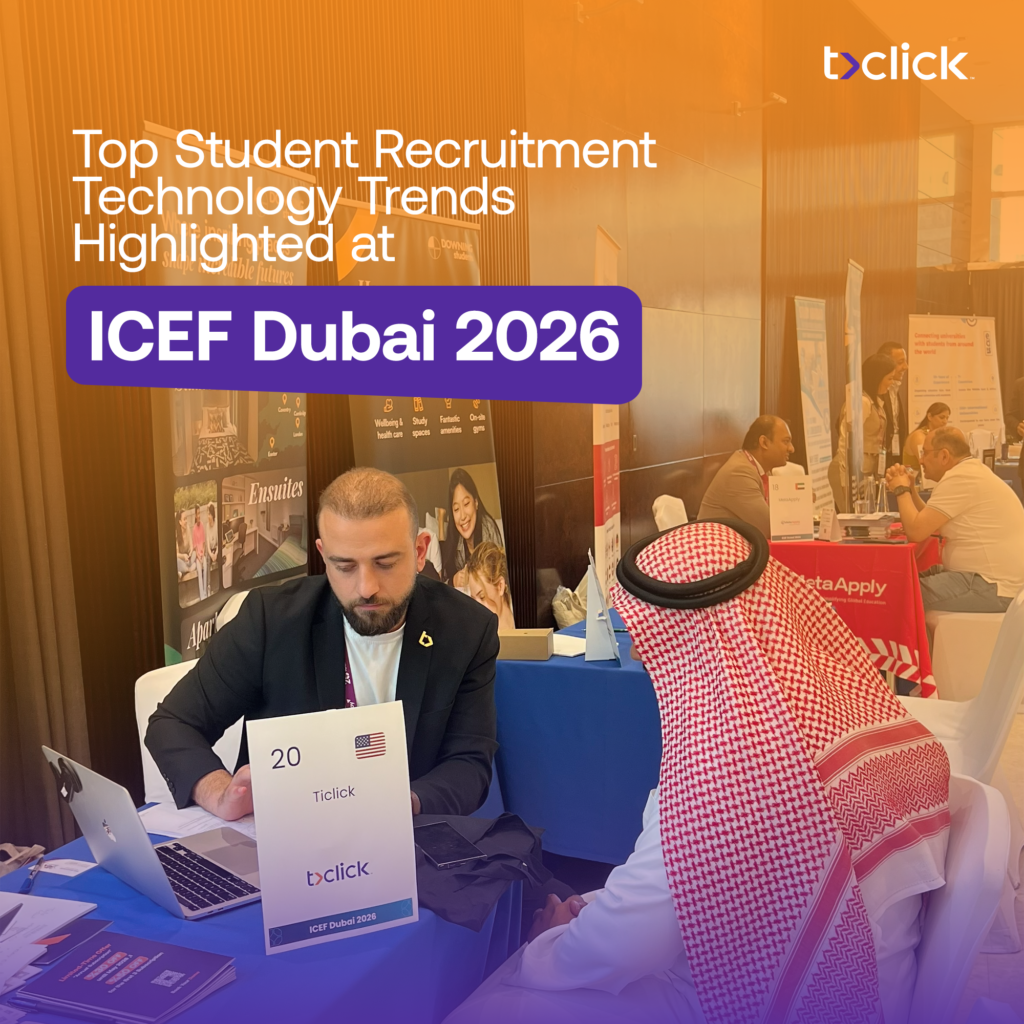
ICEF Dubai has long been recognized as one of the most strategic global hubs for international education partnerships. In 2026, however, the conversations felt different. Beyond program discussions and market expansion plans, one topic consistently dominated meetings across universities, agencies, and service providers: technology. For the team at Ticlick, participating in ICEF Dubai 2026 offered a front-row view into how rapidly student recruitment operations are evolving. Across structured B2B meetings, one theme became unmistakable—recruitment is no longer just about relationships; it is about infrastructure. The year 2026 marks a clear acceleration in digital transformation across international education. Institutions are facing higher student expectations, longer and more complex application journeys, and increased pressure to scale across multiple markets. Technology is no longer a support function; it is central to operational success. This article explores the top student recruitment technology trends highlighted at ICEF Dubai 2026, based on recurring themes, real conversations, and strategic observations from the event. These student recruitment technology trends are not theoretical—they reflect what recruitment leaders are actively prioritizing right now. Why Technology Dominated Conversations at ICEF Dubai 2026 Technology did not appear as a side topic at ICEF Dubai 2026. It was embedded in nearly every strategic discussion. The reason is simple: recruitment operations have reached a level of complexity where manual systems are no longer sustainable. Increasing Operational Complexity International recruitment today involves: Multi-market coordination Agent partnerships across regions Documentation-heavy application processes Visa tracking and compliance requirements Multiple intake cycles Managing this complexity through spreadsheets, email threads, and disconnected tools creates operational risk. One of the top student recruitment technology trends highlighted at ICEF Dubai 2026 was the urgent need to centralize and structure operations. Institutions are realizing that fragmented workflows slow down growth and reduce conversion efficiency. Rising Expectations from Students and Institutions Students in 2026 expect the following: Faster responses Transparent application tracking Clear documentation guidance Real-time updates At the same time, institutions expect the following: Better-qualified applicants Accurate documentation Performance visibility Predictable processing timelines These rising expectations are driving adoption of student recruitment technology trends focused on automation, transparency, and lifecycle visibility. The Pressure to Scale Without Increasing Overhead Recruitment teams are being asked to grow enrollment numbers without proportionally increasing staff size. This creates pressure on efficiency. Scaling without structured systems leads to the following: Burnout Missed follow-ups Document errors Communication gaps Technology is becoming the scalability engine. At ICEF Dubai 2026, leaders repeatedly discussed how digital infrastructure allows teams to handle higher volumes without losing control. Want a closer look at our experience on the ground? Explore how Ticlick CRM at ICEF Dubai 2026 engaged with global recruitment leaders, identified key trends, and contributed to conversations shaping the future of international student recruitment. Top Student Recruitment Technology Trends Highlighted at ICEF Dubai 2026 The following trends consistently surfaced as priority areas during the event. 1. CRM Systems as Operational Infrastructure One of the most significant student recruitment technology trends highlighted at ICEF Dubai 2026 is the evolution of CRM systems. CRM platforms are no longer viewed as simple contact databases. They are becoming fully operational infrastructure. Modern student recruitment CRM systems now support: Application lifecycle management Document tracking Stage-based pipeline progression Agent collaboration Performance reporting The shift is clear: CRM is no longer about storing contacts—it is about structuring recruitment operations end-to-end. 2. Automation Across the Recruitment Lifecycle Automation was another dominant theme among the top student recruitment technology trends highlighted at ICEF Dubai 2026. Recruitment teams are automating: Follow-up emails Document reminders Interview scheduling Payment notifications Pipeline stage transitions Automation reduces repetitive manual work while improving consistency. Instead of relying on memory or inbox searches, workflows trigger actions automatically. This trend is directly linked to efficiency and conversion improvement. 3. Centralized Communication Platforms Fragmented communication was widely acknowledged as a major operational risk. Agencies and institutions operate across: Email WhatsApp SMS Internal chat tools One of the top student recruitment technology trends highlighted at ICEF Dubai 2026 is the integration of communication channels into centralized systems. When WhatsApp and email communication are logged within recruitment platforms, teams gain: Full conversation history Reduced miscommunication Improved accountability Faster decision-making Centralization enhances both internal coordination and external collaboration. 4. Data-Driven Enrollment Strategy Data visibility has become non-negotiable. Institutions are moving away from intuition-based recruitment decisions and toward analytics-driven strategies. Real-time dashboards and performance tracking now allow teams to monitor: Conversion rates Drop-off stages Lead source performance Agent productivity Processing time This data-driven approach was one of the strongest student recruitment technology trends emphasized at ICEF Dubai 2026. 5. Agent & Partner Portal Transparency Transparency between institutions and agents is evolving through shared digital access. Modern recruitment platforms now include the following: Agent portals Shared document tracking Status visibility Task notifications This shared visibility reduces friction and strengthens collaboration. Agent transparency was a consistent discussion point throughout ICEF Dubai 2026. 6. AI-Assisted Lead Qualification & Workflow Optimization Artificial intelligence is increasingly influencing recruitment technology. AI-driven features are being used to: Score and prioritize leads Identify high-conversion prospects Predict bottlenecks Suggest workflow improvements While still evolving, AI-assisted recruitment processes were clearly emerging among the top student recruitment technology trends highlighted at ICEF Dubai 2026. Technology was a major theme at ICEF Dubai 2026 — but agent expectations shaped the conversations just as strongly. Discover what education agents were looking for at ICEF Dubai 2026, from structured communication to transparent workflows and long-term partnerships. What These Technology Trends Mean for Agencies and Institutions Understanding these student recruitment technology trends is not enough — institutions must interpret what they mean strategically. Operational Maturity Is Now a Competitive Advantage Recruitment is no longer defined solely by marketing strength. Operational maturity now differentiates institutions. Teams that
How Student Recruitment CRM Software Supports Agencies After ICEF Dubai
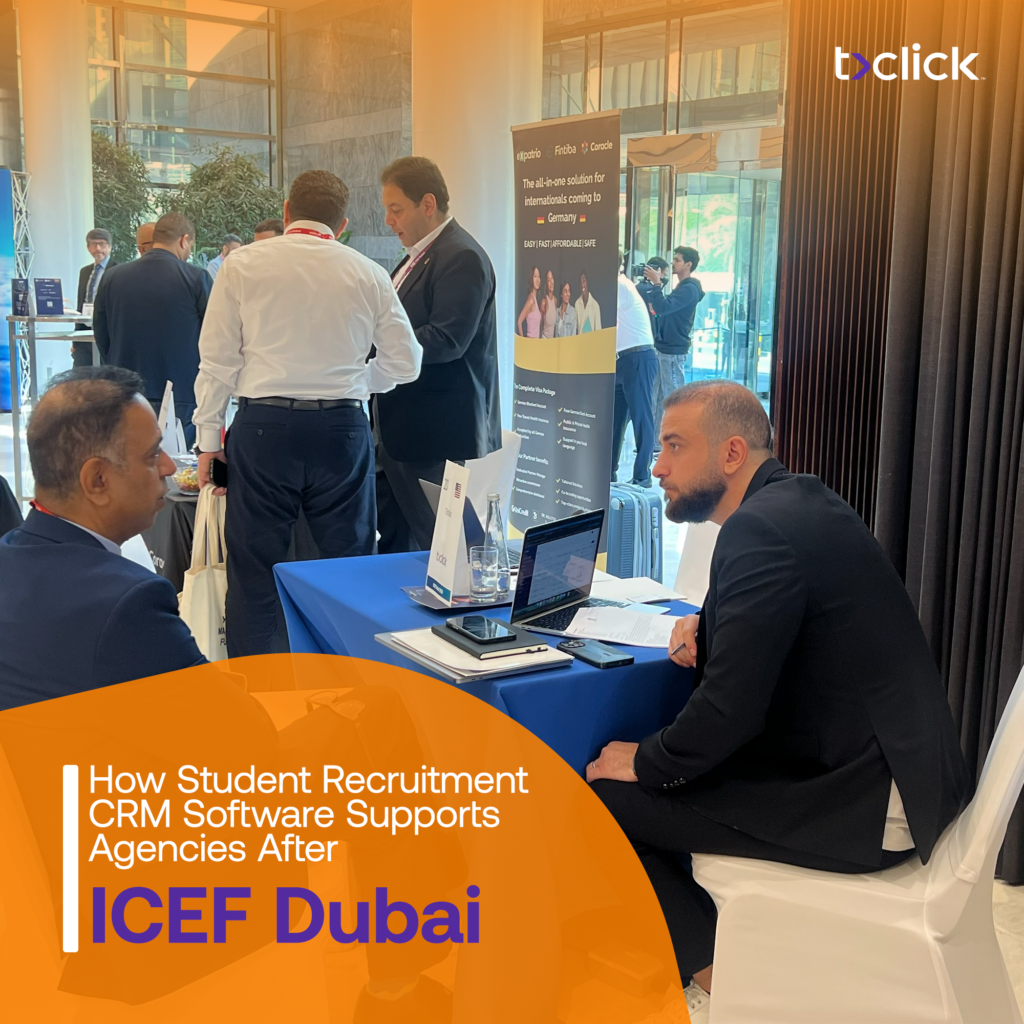
ICEF Dubai 2026 offered education agencies a powerful platform to build international partnerships, explore new destinations, and expand recruitment pipelines. Over just a few days, agencies connected with universities, pathway providers, and institutional representatives from multiple markets—generating new opportunities that could shape their growth for the year ahead. However, for many agencies, the real challenge begins after the event ends. Returning from ICEF Dubai with dozens of new contacts, partnership discussions, and potential collaborations creates immediate operational pressure. Follow-ups must happen quickly. Meeting notes must be organized. Institutional conversations must be structured and progressed. Without a clear system in place, even the strongest conversations risk losing momentum. This is precisely where student recruitment CRM software plays a critical role—and why solutions like Ticlick are increasingly relevant in post-event recruitment strategy. Rather than relying on spreadsheets, email threads, and scattered notes, agencies are turning to structured CRM systems to centralize contacts, automate follow-ups, and track partnership pipelines with clarity. In this article, we explore how student recruitment CRM software supports agencies after ICEF Dubai—and why infrastructure, not improvisation, determines whether event meetings convert into long-term recruitment success. What Happens After ICEF Dubai? The Operational Reality ICEF Dubai generates energy and opportunity. However, once agencies return to their offices, the operational reality begins. Dozens of New Contacts to Organize Within days of attending ICEF Dubai, agencies may accumulate: 20–50 new institutional contacts Multiple program discussions Notes on commission models and intake timelines Potential expansion into new destinations Without structure, this contact information is often stored in scattered formats—notebooks, phone contacts, email threads, or shared spreadsheets. This fragmentation increases the risk of missed opportunities. Student recruitment CRM software allows agencies to immediately convert every contact into a structured lead within a centralized system. Instead of scattered information, each potential partnership becomes trackable, searchable, and actionable. Follow-Ups That Must Happen Fast Speed matters after ICEF Dubai. Institutions expect timely follow-up messages, clarification emails, document exchanges, and next-step discussions. Manual follow-up processes create delays. Agencies that rely on memory, inbox searches, or handwritten notes often respond inconsistently. In competitive markets, even small delays can reduce credibility. Student recruitment CRM software supports immediate and consistent follow-up by: Logging meeting notes directly into contact profiles Scheduling automated follow-up reminders Triggering structured email sequences Assigning next-step deadlines Speed is not just about responsiveness—it is about maintaining professional momentum. Partnership Discussions That Need Structure ICEF Dubai conversations rarely end with a handshake. Most discussions involve future actions: Sharing detailed program materials Reviewing student profiles Setting up formal agreements Planning joint marketing campaigns Scheduling follow-up virtual meetings Without a structured workflow, these discussions can stall. A student recruitment CRM system allows agencies to create stage-based partnership pipelines, ensuring every opportunity progresses logically from introduction to active collaboration. Want a deeper look into our experience at the event? Explore how Ticlick CRM at ICEF Dubai 2026 engaged with agencies, analyzed recruitment trends, and contributed to conversations shaping the future of international enrollment. Why Manual Follow-Up Is No Longer Sustainable As recruitment operations grow more complex, manual systems become increasingly fragile. Spreadsheet Overload Spreadsheets are often the default post-event tool. While they may seem practical at first, they quickly become cluttered, outdated, and disconnected from communication history. Spreadsheets cannot: Automatically remind teams of pending actions Store communication threads Track stage progression dynamically Provide real-time performance insights Student recruitment CRM software eliminates spreadsheet overload by integrating contact data, communication logs, and progress tracking into one unified environment. Lost Emails and WhatsApp Threads Many agencies rely heavily on email and WhatsApp for communication after ICEF Dubai. Over time, important details become buried within long threads or mixed across multiple platforms. This creates risks: Missed follow-ups Duplicate responses Inconsistent messaging Delayed clarification CRM systems centralize communication history so that every conversation is stored under the relevant contact or partnership record. This reduces confusion and increases accountability. No Clear Ownership Inside the Team After large events like ICEF Dubai, multiple team members may be involved in follow-up. Without clear task ownership, responsibilities can overlap — or worse, be forgotten. Student recruitment CRM software allows agencies to assign specific tasks to individual team members, set deadlines, and monitor progress. This structured accountability ensures that every new contact receives consistent attention. How Student Recruitment CRM Software Supports Agencies Post-Event The true value of student recruitment CRM software becomes evident after high-intensity networking events. Centralized Contact Management Every business card, meeting note, and new connection can be instantly converted into a structured lead. Instead of manual contact storage, CRM systems allow agencies to: Create detailed contact profiles Tag by region, institution type, or priority level Store notes from ICEF meetings Attach supporting documents Centralization ensures that no potential partnership is lost in scattered files. Automated Follow-Up Workflows Consistency after ICEF Dubai is critical. Student recruitment CRM software supports: Automated email sequences Scheduled reminder tasks Follow-up alerts Meeting scheduling integrations Automation does not replace personal communication — it ensures it happens on time. This balance between personalization and efficiency strengthens credibility. Pipeline Tracking for New Partnerships Post-event partnerships require visibility. CRM systems allow agencies to track partnerships in clearly defined stages such as: Initial meeting Follow-up discussion Program review Agreement negotiation Active recruitment Stage-based progression ensures that partnerships do not stagnate. Agencies can immediately see which opportunities are moving forward and which require attention. Internal Task Assignment and Accountability Clarity within the team is as important as clarity with institutions. Student recruitment CRM software enables: Task assignment to specific team members Deadline tracking Status monitoring Cross-team visibility When everyone knows their responsibility, post-ICEF follow-up becomes organized rather than reactive. Reporting and ROI Visibility One of the most overlooked post-event questions is the following: Was ICEF Dubai a successful investment? Student recruitment
What Education Agents Were Looking for at ICEF Dubai 2026

ICEF Dubai 2026 once again confirmed its position as one of the most influential meeting points in international student recruitment. Bringing together education agents, universities, recruitment teams, and service providers, the event created a focused environment where real operational conversations took place—not just introductory networking. For Ticlick CRM, participating in ICEF Dubai 2026 was an opportunity to engage directly with the professionals shaping international recruitment across markets. Over the course of structured B2B meetings, our team spoke with education agents managing diverse student pipelines, multiple destinations, and increasingly complex documentation processes. What quickly became clear is that 2026 is a year defined by pressure and change. Agents are handling higher inquiry volumes, faster response expectations, and greater institutional demands for transparency and performance tracking. Their role is expanding—and so are the operational challenges attached to it. This article explores what education agents were looking for at ICEF Dubai 2026, based on real conversations and recurring themes shared during the event. It reflects the priorities agents raised, the expectations they now face, and the structural gaps they are trying to close in order to operate more efficiently in an increasingly competitive recruitment environment. The Evolving Role of Education Agents in 2026 Education agents are no longer viewed as simple intermediaries. In 2026, they are strategic contributors to institutional growth, market expansion, and student success. From Student Placement to Strategic Recruitment Partners The traditional view of agents as student placement facilitators has evolved. Institutions now expect agents to deliver well-prepared, informed, and documentation-ready applicants. Agents are increasingly responsible for: Pre-screening and advising students thoroughly Ensuring documentation accuracy before submission Managing multi-stage student journeys Reducing application errors and delays Protecting institutional reputation through quality control The conversations at ICEF Dubai 2026 reflected this shift clearly. Agents understand that their value is measured not just by volume, but by execution and consistency. Rising Expectations from Institutions Institutions are setting higher standards in 2026. The themes that surfaced repeatedly included the following: Speed Institutions expect faster follow-ups and shorter turnaround times. Accuracy Incomplete applications and documentation gaps are no longer tolerated at scale. Transparency Institutions want visibility into agent pipelines, student progress, and conversion quality. These expectations directly influence what education agents were looking for at ICEF Dubai 2026—structured partnerships that enable them to meet these standards consistently. Many of the technology trends discussed at ICEF Dubai 2026 are especially relevant for J-1 program agencies navigating complex compliance and documentation workflows. Explore the key challenges J-1 agencies face and how CRM systems solve them in our detailed guide. What Education Agents Were Actively Searching for at ICEF Dubai 2026 The central theme of the event was not simply partnership expansion—it was operational alignment. Clear Communication and Faster Institutional Responses Agents emphasized the importance of predictable communication structures. Delayed responses create friction with students and families. They were looking for: Defined contact channels Clear escalation paths Faster clarification on requirements Reduced back-and-forth loops Transparent Application Tracking A recurring challenge agents described was limited visibility after submitting applications. They want to know: Has the application been received? Which stage is it in? What is missing? When is a decision expected? Without transparency, agents spend time chasing updates instead of supporting students. Simplified Documentation and Visa Workflows Documentation complexity continues to increase. Agents manage passports, transcripts, financial forms, language certificates, and visa-related paperwork. They were looking for: Standardized checklists Clear document requirements Fewer repeated submissions Faster document validation Simplification reduces drop-offs and improves processing speed. Reliable Reporting and Performance Visibility Performance accountability is rising. Agents want better insight into: Conversion rates Application processing time Market performance Student progression stages This data is critical for maintaining strong institutional partnerships. Long-Term, Structured Partnerships — Not Short-Term Deals Perhaps the strongest message from ICEF Dubai 2026 was that agents are seeking stability. They want structured, long-term collaboration models supported by operational clarity — not transactional agreements with unclear processes. The student recruitment technology trends highlighted at ICEF Dubai 2026 are only the beginning of a larger digital transformation across international education. To explore what’s next, read our in-depth analysis of the future of international student recruitment software and how it will shape global enrollment strategies. The Operational Challenges Agents Shared Managing High Inquiry Volumes Inquiry growth is accelerating across markets. Without structured systems, high volume leads to delays, missed follow-ups, and inconsistent communication. Fragmented Communication Channels Agents frequently described operating across: WhatsApp Email Excel spreadsheets Shared drives This fragmentation leads to duplicated work and reduced clarity. Document-Heavy Student Journeys Multi-stage international recruitment processes create administrative pressure. Each additional document requirement increases the risk of delay. Limited Visibility After Submission Once an application is submitted, agents often lose real-time visibility. This visibility gap was one of the most repeated concerns during ICEF Dubai 2026 discussions. A Shift Toward Structured Recruitment Infrastructure One of the clearest takeaways when analyzing what education agents were looking for at ICEF Dubai 2026 is the growing shift toward structured recruitment infrastructure. Agents are no longer focused solely on expanding program portfolios or increasing institutional connections. Instead, they are increasingly evaluating how well their operations are supported by systems that allow them to manage complexity efficiently. As recruitment volumes increase and student journeys become more documentation-heavy, informal processes are no longer sustainable. ICEF Dubai 2026 revealed that agents are thinking beyond short-term placement numbers — they are thinking about long-term operational stability. Why Agents Are Asking About Systems, Not Just Programs Historically, ICEF events centred heavily around programs, commission structures, and destination demand. In 2026, however, the tone of many conversations has shifted. When discussing what education agents were looking for at ICEF Dubai 2026, it became evident that agents are now asking questions such as the following: How do institutions manage
Why Ticlick CRM at ICEF Dubai 2026 Matters for Recruitment Leaders

ICEF Dubai has become one of the most strategic meeting points for international student recruitment—especially for organizations building partnerships across the Middle East and North Africa. It isn’t a typical “conference recap” event. ICEF Dubai is designed as a high-impact, B2B networking environment where educators meet trusted, ICEF-accredited agents through structured conversations and scheduled meetings. In 2026, the student recruitment landscape felt noticeably different. Institutions and agencies are navigating faster decision cycles, digital-first expectations from students, and greater pressure to show operational clarity across the entire recruitment funnel. Recruitment is no longer just marketing and lead generation—it’s execution: how quickly teams respond, how consistently they follow up, and how clearly they track progress across long student journeys. That’s why Ticlick CRM took part in ICEF Dubai 2026. Our goal wasn’t only to attend—it was to listen closely to the reality on the ground: what agencies struggle with, what institutions want from partners, and where operational gaps are costing teams time and trust. And while this article includes a clear overview of the event, it goes beyond a recap. It highlights the trends and challenges we heard repeatedly and connects them to the growing role that modern CRM infrastructure plays in international recruitment. ICEF Dubai 2026 – A Global Hub for International Education Partnerships ICEF Dubai is widely recognized as a major international education networking event focused on building recruitment partnerships, particularly connected to outbound mobility from the MENA region. The event is built around purposeful meetings—helping educators and agents use their time efficiently and form relationships that translate into real recruitment outcomes. What Makes ICEF Dubai a Strategic Event B2B networking that’s built for outcomes ICEF Dubai is structured around professional, pre-arranged interaction rather than informal “meet-and-greet” networking. That means conversations are typically more targeted and operational—focused on programs, markets, partner fit, and recruitment performance. Agent–institution matching at scale A core value of ICEF events is connecting educators with ICEF-accredited agencies and giving both sides a structured environment to explore partnerships, requirements, and expectations. The experience is supported by event tools and schedules designed to help participants maximize meetings and insights during the event. A Middle East gateway for international education growth Dubai’s position—and the event’s regional focus—makes ICEF Dubai especially strategic for institutions recruiting from MENA markets and for agencies representing students interested in international study pathways. That regional concentration shapes the conversations, the partnership priorities, and the operational challenges discussed. Who Attended in 2026 ICEF Dubai brings together multiple groups involved in the student recruitment ecosystem—creating a full picture of how international enrollment is changing. Universities and education providers These organizations attend to expand recruitment channels, meet high-quality partners, and understand market expectations—often discussing program demand, admissions processes, and how to maintain conversion rates across multiple markets. Study abroad agencies and recruitment agencies Agencies attend to build new institutional partnerships and to evaluate what institutions expect in terms of communication, responsiveness, and student readiness. Recruitment and admissions teams Beyond partnerships, recruitment leaders attend to benchmark operations: what tools other teams use, what bottlenecks they face, and how they are adapting to multi-channel communication and longer student journeys. EdTech and recruitment technology providers ICEF Dubai also attracts service providers supporting recruitment operations—from automation tools to platforms that help teams manage pipelines, documents, and reporting. The trends highlighted at ICEF Dubai 2026 are only part of a larger transformation. Discover how recruitment and exchange programs are being redefined by technology in our detailed analysis of the future of technology in cultural exchange programs. Ticlick CRM’s Presence at ICEF Dubai 2026 Ticlick CRM participated in ICEF Dubai 2026 as an active contributor to the evolving conversation around international student recruitment. Throughout the three-day event, our team engaged in a series of structured B2B meetings with study abroad agencies, university representatives, international recruitment managers, and operational leaders. Rather than positioning ourselves as observers, we approached ICEF Dubai as an opportunity to evaluate how recruitment operations are being managed in 2026 — and where the gaps are becoming most visible. Each meeting focused on understanding the operational backbone behind partnerships: how institutions coordinate with agents, how applications are tracked across markets, and how recruitment teams maintain visibility over long and complex student journeys. Our presence was centred on one core objective: aligning technology with the real operational demands of international recruitment. Why We Participated Ticlick CRM attended ICEF Dubai 2026 with a strategic purpose rooted in market alignment and operational insight. First, to understand current recruitment workflows at scale. As student recruitment becomes increasingly digital and multi-channel, institutions and agencies are managing more data, more communication streams, and more documentation than ever before. Direct conversations allowed us to assess how teams are structuring these processes—and where inefficiencies are limiting growth. Second, to strengthen international partnerships through operational clarity. Many discussions moved beyond introductions and into process alignment—how institutions expect reporting visibility, how agencies manage student documentation, and how communication speed impacts conversion rates. These conversations highlighted that strong partnerships depend on structured systems, not just agreements. Third, to validate recurring operational challenges in the field. Rather than relying on assumptions, we gathered direct feedback from recruitment professionals actively managing high-volume pipelines across multiple markets. Conversations That Shaped the Week Across our meetings, several consistent themes emerged—and they reinforced the direction the industry is moving toward. Recruitment leaders repeatedly described operational friction in areas such as the following: Fragmented tracking across spreadsheets, email threads, and messaging apps Limited real-time visibility into student progress across stages Manual follow-up processes that slow down conversion Difficulty consolidating reporting across markets and partners Scaling recruitment volume without increasing administrative strain Many conversations naturally shifted toward infrastructure—not just marketing performance. Agencies and institutions are no longer asking how to generate more leads alone; they are asking how to manage complexity without losing control. In this context, Ticlick’s role becomes clearer. Our contribution at ICEF
Best Platforms for Digital Student Recruitment in 2026
Over the past decade, student recruitment has undergone a fundamental transformation. Traditional recruitment strategies—centred around education fairs, printed brochures, and in-person outreach—are no longer sufficient in a world where students research, compare, and apply to institutions entirely online. Institutions that once relied heavily on physical presence must now operate in a digital-first environment where speed, personalization, and data visibility define success. At the same time, global competition for students has intensified. Universities and agencies are no longer competing only within their region—they are competing internationally. Students compare institutions across countries, programs, tuition models, visa processes, and post-graduation opportunities. This shift has forced institutions to rethink how they attract, engage, and convert prospects. Recruitment today is also multi-channel by default. A single prospective student may interact with an institution through a website form, Instagram ad, WhatsApp message, email campaign, webinar, and an education agent—all before submitting an application. Managing this level of complexity manually is nearly impossible. For this reason, institutions are actively searching for the best platforms for digital student recruitment. They are looking for structured systems that can unify communication, track applications, measure performance, and scale operations without increasing administrative burden. This guide will help you understand what digital student recruitment really means, why specialized platforms matter, what features define the best platforms for digital student recruitment, and how to choose the right solution for your organization. What Is Digital Student Recruitment? From Physical Outreach to Digital-First Enrollment Funnels Digital student recruitment refers to the use of online platforms, automation tools, and centralized systems to attract, manage, and convert prospective students through digital channels. Traditionally, recruitment focused heavily on physical outreach: Education fairs School visits Printed materials Face-to-face counseling While these channels still play a role, modern recruitment operates primarily through digital funnels. Students now discover institutions through search engines, social media, webinars, targeted ads, and online communities. The entire decision-making journey—from awareness to application—often happens online. This shift requires institutions to manage structured online student journeys. A digital enrollment funnel may include: Inquiry submission Automated follow-up Program guidance Application tracking Document submission Interview scheduling Offer management Without one of the best platforms for digital student recruitment, managing these stages across thousands of students becomes fragmented and inefficient. Explore the future of international student recruitment software and see how modern platforms are transforming global enrollment strategies. Why Recruitment Platforms Matter in Today’s Enrollment Landscape Digital recruitment platforms are no longer optional tools—they are operational infrastructure. The best platforms for digital student recruitment enable institutions to operate at scale, move faster, personalize engagement, and maintain visibility into performance. Scale Modern institutions handle inquiries from multiple countries and time zones. Recruitment platforms allow teams to manage large volumes of leads and applications without losing control. Speed Response time directly impacts conversion. Automated workflows and integrated communication tools allow institutions to engage prospects immediately, rather than days later. Personalization Students expect tailored communication. Recruitment platforms enable segmented messaging, program-specific follow-ups, and stage-based communication flows. Data Visibility Without centralized reporting, leadership cannot measure performance. The best platforms for digital student recruitment provide dashboards showing conversion rates, funnel health, and team performance metrics. Why Institutions Need Digital Student Recruitment Platforms Growing Competition for Domestic and International Students The international education market has become highly competitive. Institutions are competing not only on academic quality but also on digital responsiveness and student experience. Delayed follow-ups, inconsistent communication, or unclear application processes can push students toward competitors. Digital recruitment platforms give institutions a structured approach to engagement, ensuring that no inquiry is ignored and no applicant falls through the cracks. This competitive pressure is one of the primary reasons institutions invest in the best platforms for digital student recruitment. Managing Multi-Channel Lead Sources Recruitment today is multi-channel by design. Prospective students may enter the funnel from: Website forms Social media campaigns Email marketing WhatsApp or live chat Education agents Webinars and virtual events Without a centralized system, these leads remain scattered across inboxes and spreadsheets. The best platforms for digital student recruitment unify all lead sources into one structured database, allowing institutions to track source attribution and measure channel effectiveness. The Need for Data-Driven Enrollment Decisions Enrollment strategy is no longer based on intuition. Institutions must analyze performance to improve outcomes. Digital recruitment platforms support: Conversion tracking—from inquiry to enrollment ROI visibility—measuring marketing effectiveness Funnel performance analysis—identifying drop-off points Without advanced reporting, institutions cannot determine which markets are growing, which counsellors perform best, or where applicants abandon the process. Data-driven decision-making is a core benefit of the best platforms for digital student recruitment. What Defines the Best Platforms for Digital Student Recruitment Not all recruitment systems are equal. The best platforms for digital student recruitment share specific structural capabilities. Lead Capture and Source Tracking Effective platforms centralize lead intake from all channels. Multi-channel intake ensures every inquiry—regardless of source—enters one unified system. Attribution tracking allows institutions to identify which campaigns, countries, or partners generate the highest-quality leads. This visibility directly influences budget allocation and strategy refinement. Application and Enrollment Lifecycle Management Student recruitment cycles are long and multi-stage. From inquiry to final enrollment, the process may take several months. The best platforms for digital student recruitment support stage-based workflows, allowing institutions to track: Inquiry Application started Documents submitted Offer issued Acceptance confirmed Enrollment completed This lifecycle management ensures clarity for both staff and students. Automation and Communication Integration Recruitment teams spend significant time on repetitive communication tasks. Automation reduces administrative pressure and improves consistency. Modern recruitment platforms integrate: Email SMS WhatsApp Trigger-based reminders for deadlines and documents These tools allow institutions to maintain engagement without increasing staff workload. Agent and Partner Collaboration Tools International recruitment often depends on agents and regional partners. The best platforms for digital student recruitment provide structured collaboration tools where agents can submit applications, track
Study Abroad Management Software | A Smarter Way to Manage Study Abroad
Study abroad programs have evolved significantly over the past decade. What once involved managing a limited number of destinations and partner institutions has expanded into complex, multi-country operations with diverse program types, intake cycles, and regulatory requirements. Agencies and institutions are now expected to deliver a seamless experience while maintaining accuracy, transparency, and accountability across every stage of the student journey. This growth has introduced new challenges for study abroad teams. Managing higher student volumes, coordinating with international partners, handling sensitive documentation, and ensuring consistent communication across time zones all add layers of operational complexity. Traditional approaches—spreadsheets, shared folders, and email threads—were never designed to support this scale or level of coordination. As a result, many organizations are reaching a breaking point. Manual tools slow teams down, increase the risk of errors, and make it difficult to maintain visibility as programs grow. This is why study abroad management software has become essential. Purpose-built software provides the structure, automation, and oversight needed to manage modern study abroad operations efficiently and sustainably. What Is Study Abroad Management Software? Definition and Core Purpose Study abroad management software is a specialized system designed to manage the full operational lifecycle of study abroad programs. Unlike generic tools, it centralizes student data, applications, programs, documentation, communication, and internal workflows into a single, structured platform. The core purpose of study abroad management software is to replace fragmented, manual processes with coordinated, digital workflows. It helps organizations track students from initial inquiry through application, placement, enrollment, and beyond—while maintaining visibility and control at every stage. This type of software is designed specifically for education-focused organizations that manage international mobility, long student journeys, and compliance-sensitive processes. Discover a platform designed to support the next generation of international student recruitment. Who Uses Study Abroad Management Software? Study abroad agencies Agencies use study abroad management software to manage leads, applications, partner universities, documentation, and communication with students across multiple destinations. Universities and international offices Institutions rely on the software to oversee outgoing and incoming mobility programs, coordinate with partner universities, and maintain accurate reporting and compliance records. Exchange and mobility programs Organizations running exchange, internship, or cultural mobility programs use study abroad management software to manage participant lifecycles, placements, and ongoing program monitoring. Why Study Abroad Programs Are Becoming Harder to Manage Increasing Student Volume and Program Diversity Study abroad teams now manage a wider range of programs than ever before—short-term exchanges, full-degree programs, language courses, internships, and hybrid models. Each program may involve different destinations, partners, timelines, and requirements. As student volume increases alongside program diversity, manual tracking becomes unreliable. Study abroad management software provides a structured way to manage multiple programs and partners without losing clarity. Complex Application and Documentation Processes Applications for study abroad programs involve more than basic forms. Teams must manage admissions requirements, visa documentation, placement details, and supporting records—often across multiple institutions and countries. Without centralized systems, tracking what has been submitted, approved, or is still missing becomes time-consuming and error-prone. Study abroad management software centralizes documentation and application status, reducing delays and compliance risk. Communication Across Time Zones and Stakeholders Study abroad operations depend on constant communication between students, partner institutions, host organizations, and internal teams. Coordinating across time zones and cultures adds complexity. When communication is scattered across inboxes and messaging apps, teams lose context and consistency. Study abroad management software keeps communication tied to student and program records, ensuring clarity and continuity. Compliance and Reporting Requirements Accuracy and accountability are critical in international education. Institutions and agencies must maintain reliable records for internal reporting, partners, and regulators. Manual reporting processes are slow and often outdated by the time they are completed. Study abroad management software supports structured reporting and audit-ready records, helping organizations maintain confidence in their data. Explore how Ticlick supports cultural exchange organizations with purpose-built CRM workflows. Key Features of Effective Study Abroad Management Software Student and Application Lifecycle Management Effective study abroad management software tracks the entire student journey—from first inquiry to enrollment and program completion. Each stage is clearly defined, allowing teams to see progress, identify delays, and support students proactively. Program and Destination Management The software organizes programs by destination, university, intake, or program type. This allows teams to manage offerings efficiently, compare performance, and ensure students are matched to the right opportunities. Document and Compliance Tracking Secure document uploads, approval workflows, and status tracking are core capabilities. Study abroad management software ensures documents are complete, up-to-date, and easily accessible—reducing risk and administrative effort. Communication and Automation Tools Automated emails, reminders, and workflow triggers reduce repetitive follow-ups and improve response rates. Communication tools built into study abroad management software keep messaging consistent and contextual. Team Collaboration and Task Management Clear roles, task assignment, and ownership help teams work more efficiently. Collaboration features reduce internal friction and ensure accountability as programs scale. Study Abroad Management Software vs Generic CRMs Program-Based Workflows vs Sales Pipelines Generic CRMs are designed around sales pipelines and deals. Study abroad programs operate through structured stages tied to academic and administrative milestones. Study abroad management software reflects these program-based workflows, not sales logic. Long-Term Student Journeys vs Short Transactions Student journeys often span months or years. Generic CRMs prioritize quick conversions and closed deals, while study abroad management software supports long-term tracking, context preservation, and continuity. Education-Specific Compliance Needs International education involves unique compliance and reporting requirements. Specialized software is built with these needs in mind, while generic CRMs require heavy customization that often falls short. Benefits of Using Study Abroad Management Software Better Operational Visibility Real-time dashboards give teams instant insight into student progress, application status, and program performance—enabling proactive management. Reduced Manual Work and Errors Automation replaces repetitive tasks and reduces reliance on spreadsheets, lowering the risk of human error. Improved Student Experience Clear communication, transparency, and timely updates improve student confidence
CRM for Save J1 Campaign Agencies | How Ticlick Supports Advocacy
The Save J1 campaign has become a critical advocacy effort aimed at protecting cultural exchange programs and preserving their long-term viability. As policy discussions intensify and public scrutiny increases, campaign agencies working on Save J1 initiatives are expected to operate with a high level of coordination, accuracy, and credibility. Their role goes beyond messaging—it involves organizing data, managing stakeholders, and supporting evidence-based advocacy. Over time, the role of Save J1 campaign agencies has expanded significantly. These agencies now coordinate between advocacy organizations, sponsors, partners, and policymakers, while also managing sensitive documentation, case narratives, and ongoing communication. What was once manageable through informal tools has evolved into a complex operational environment. This growing complexity—spanning stakeholders, documentation, communication flows, and compliance narratives—has exposed the limits of manual systems. Spreadsheets and inboxes cannot support the scale or accountability required today. That is why choosing the right CRM for Save J1 campaign agencies is no longer optional. A CRM provides the structure needed to organize advocacy work, preserve context, and ensure campaigns remain credible, coordinated, and sustainable over time. Understanding the Role of Save J1 Campaign Agencies What Is the Save J1 Campaign? The Save J1 campaign is a policy-focused advocacy effort designed to protect J-1 exchange programs and ensure their continued operation within a fair, transparent framework. It centers on preserving cultural exchange opportunities while addressing regulatory, political, and public-interest concerns. Coordination and credibility are essential to the campaign’s success. Advocacy arguments must be supported by accurate data, consistent narratives, and clear documentation. Fragmented or poorly organized information weakens the campaign’s position. This is why operational discipline—and increasingly, a CRM for Save J1 campaign agencies—plays a foundational role in supporting credible advocacy. See how Ticlick helps education agencies prepare for 2026 with structured, scalable CRM workflows. What Do Save J1 Campaign Agencies Actually Manage? Save J1 campaign agencies manage far more than public messaging. Their daily work spans multiple layers of coordination and information management. Advocacy efforts Agencies organize advocacy initiatives, track campaign milestones, and align messaging across stakeholders. These efforts evolve over time and require historical continuity. Stakeholder communication Campaign agencies communicate with advocacy groups, sponsors, partners, and sometimes policymakers. Maintaining consistent, documented communication is essential to avoid misalignment or duplicated efforts. Case data, reports, and narratives Agencies collect and manage case-level information, supporting reports, and narrative context that informs advocacy positions. Losing this context weakens long-term strategy. Collaboration with sponsors, advocacy organizations, and partners Save J1 campaigns are collaborative by nature. Agencies act as coordination hubs, aligning efforts across multiple independent organizations. A CRM for Save J1 campaign agencies helps keep this collaboration structured rather than fragmented. Explore how Ticlick helps student recruitment teams manage leads, applications, and enrollments in one system. Why Traditional Tools Fail Save J1 Campaign Agencies Advocacy Work Is Not Sales or Ticketing Sales CRMs are built around deals, revenue stages, and short transaction cycles. Save J1 advocacy work does not follow this logic. There are no “closed deals”—only evolving campaigns, ongoing coordination, and long-term outcomes. IT ticketing tools also fall short. They treat issues as isolated tickets that are opened and closed quickly, oversimplifying advocacy cases that require context, escalation, and sustained follow-up. This mismatch is why generic tools fail to support the real needs behind a CRM for Save J1 campaign agencies. Fragmented Campaign Data and Stakeholder Records Many campaign agencies rely on spreadsheets, inboxes, and shared documents to manage their work. Over time, this creates fragmentation. Information is duplicated, outdated versions circulate, and critical context is lost when staff changes or responsibilities shift. Fragmentation breaks continuity. Agencies struggle to maintain a clear record of decisions, narratives, and outcomes. A CRM for Save J1 campaign agencies addresses this problem by centralizing campaign data and stakeholder records in one structured system. No Central View of Campaign Progress and Impact Without a centralized system, campaign leaders cannot easily answer fundamental questions: What advocacy efforts are active right now? Which stakeholders are engaged or disengaged? Where are risks emerging? Which narratives are supported by data? The absence of a central view forces agencies into reactive mode. CRM systems provide visibility across campaigns, cases, and stakeholders—turning fragmented activity into measurable progress. Why a CRM Is Critical for Save J1 Campaign Agencies Coordinating Multi-Stakeholder Advocacy Efforts Save J1 campaign agencies coordinate across a complex network that includes advocacy organizations, sponsors, partners, and coalition members. Each stakeholder brings its own priorities, timelines, and communication styles. A CRM for Save J1 campaign agencies acts as a coordination layer. It organizes relationships, tracks interactions, and ensures everyone is working from the same context—reducing friction and misalignment. Centralizing Campaign, Case, and Communication Data Advocacy relies on context. Historical decisions, supporting evidence, and communication history all matter. A CRM centralizes campaign data, case information, and communication records into one source of truth. This centralization preserves institutional memory and allows agencies to build on past work rather than restarting efforts when teams change or campaigns evolve. For Save J1 initiatives, historical context strengthens consistency and strategic clarity. Supporting Transparency and Credibility Credibility is the foundation of effective advocacy. Campaign agencies must demonstrate transparency, accuracy, and consistency—both internally and externally. Data-backed advocacy strengthens arguments and builds trust with partners and stakeholders. A CRM for Save J1 campaign agencies supports transparency by enabling consistent reporting, structured documentation, and traceable decisions. Instead of relying on anecdotal updates, agencies can support their advocacy with clear records and reliable insights—making their work more defensible and impactful. What Makes the Right CRM for Save J1 Campaign Agencies Choosing the right CRM for Save J1 campaign agencies is not about feature quantity—it’s about alignment with how advocacy campaigns actually operate. Campaign agencies manage long-running initiatives, complex relationships, and evolving narratives that require structure, continuity, and accountability. Advocacy-Centered Workflows (Not Sales Pipelines) Traditional CRMs are designed around sales pipelines and deal stages. Advocacy campaigns operate differently. The right