
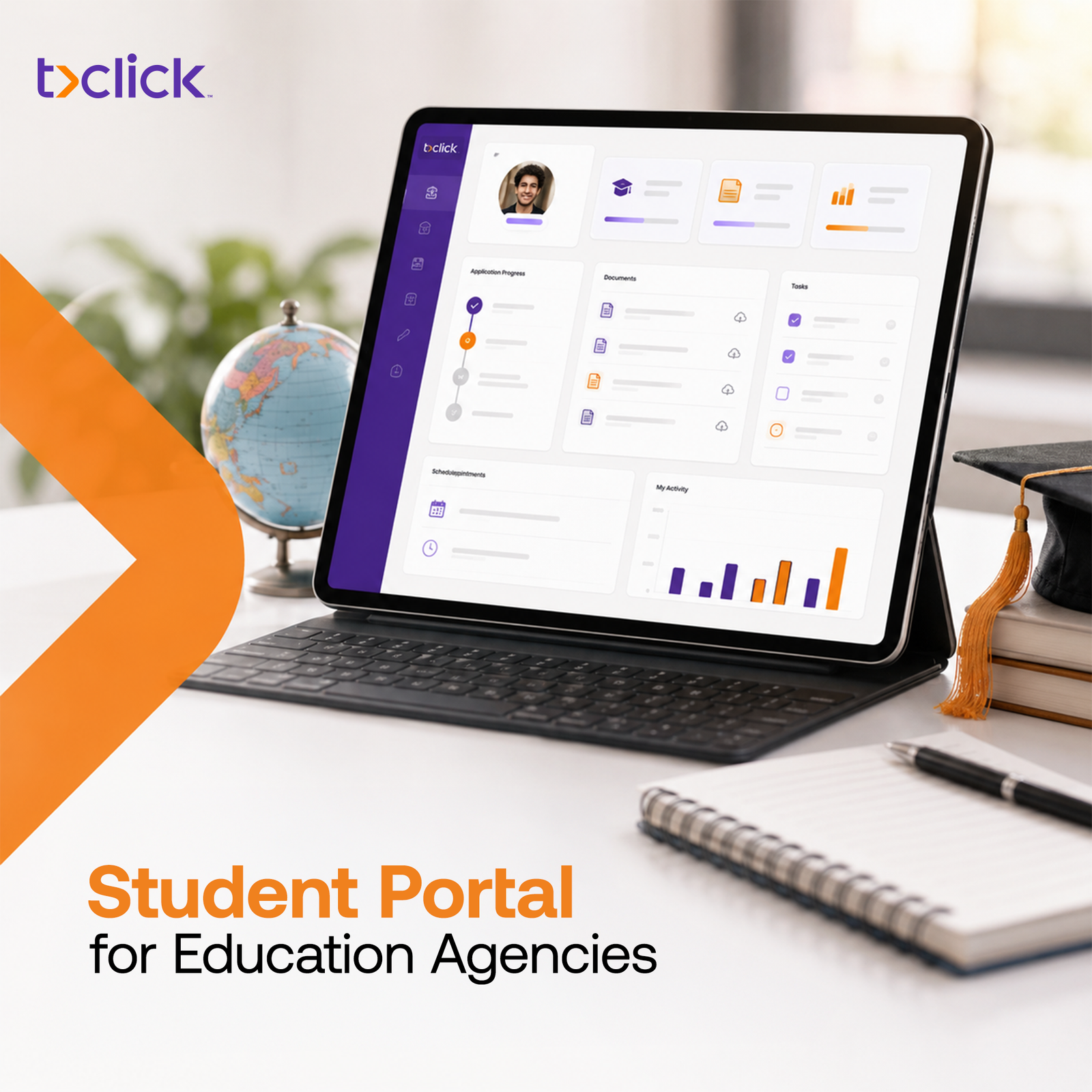
Discover the essential student portal features for education agencies, from application tracking and document uploads to secure communication and student engagement.
The way students interact with education agencies has changed dramatically over the past decade.
Today’s students expect fast responses, digital convenience, and instant access to information throughout their study abroad journey. Instead of relying solely on phone calls or email updates, they want the ability to check their application status, upload documents, communicate with advisors, and manage important tasks from one secure online platform.
For education agencies, meeting these expectations while handling growing recruitment volumes can be challenging.
Recruitment teams often spend a significant amount of time answering repetitive questions, requesting missing documents, scheduling appointments, and providing application updates. While these activities are essential, they also consume valuable resources that could be dedicated to counselling students and building stronger university partnerships.
This is where a student portal becomes a valuable extension of an education CRM.
Rather than acting as a simple login page, a modern student portal creates a self-service environment where students can actively participate in their own recruitment journey. It improves transparency, reduces administrative work, and provides a more connected experience for both students and agency staff.
When integrated with an education CRM, a student portal allows agencies to centralize communication, simplify document management, automate routine tasks, and give students real-time visibility into every stage of the admissions process.
In this guide, we’ll explore the most important student portal features for education agencies, explain how they improve both student satisfaction and operational efficiency, and highlight the capabilities organizations should prioritize when choosing a modern student recruitment platform.
What Is a Student Portal?
A student portal is a secure online platform that allows prospective and enrolled students to access important information, complete tasks, and communicate with their education agency from a single location.
Instead of contacting consultants for every update, students can log in at any time to review their application progress, upload documents, check upcoming deadlines, receive notifications, and stay connected throughout the recruitment journey.
For education agencies, the portal acts as a bridge between students and internal recruitment teams, creating a more transparent and efficient experience for everyone involved.
Rather than relying on multiple communication channels, agencies can offer students one centralized platform that keeps information organized and easily accessible.
More Than Just a Login Portal
Many people think of a student portal as simply a website where students log in to view their applications.
In reality, modern student portals are much more powerful.
They function as an interactive workspace where students can actively manage their recruitment journey while agencies maintain complete visibility into every interaction.
A comprehensive student portal can support activities such as:
- Viewing application progress
- Uploading required documents
- Booking consultations
- Receiving reminders and notifications
- Communicating with recruitment advisors
- Tracking university offers
- Monitoring visa requirements
- Accessing invoices and payment information
Instead of waiting for updates, students gain immediate access to the information they need whenever they need it.
Student portals work best when they are connected to CRM software for educational organizations that centralizes recruitment, admissions, communication, and student data.
How a Student Portal Fits Within an Education CRM
A student portal delivers the greatest value when it is fully integrated with an education CRM.
Rather than functioning as a separate platform, it becomes part of a centralized recruitment ecosystem where student information, applications, communications, and documents remain synchronized.
For example, when a recruitment consultant updates an application’s status within the CRM, the student can immediately see the latest progress through the portal.
Similarly, when a student uploads a missing document, the admissions team receives instant access without requesting files through email or messaging applications.
This seamless flow of information improves collaboration while reducing administrative work for both students and agency staff.
Who Benefits From a Student Portal?
Although student portals are designed primarily for students, they provide value across the entire organization.
Students benefit from greater transparency, faster access to information, and a more convenient recruitment experience.
Recruitment consultants spend less time answering routine questions and more time providing personalized guidance.
Admissions teams receive documents more efficiently and can monitor application progress without switching between multiple systems.
Agency managers gain better visibility into recruitment activities while improving operational efficiency across departments.
In many cases, university partners also benefit from receiving more accurate documentation and better-organized application submissions.
As a result, a well-designed student portal improves collaboration throughout the entire recruitment ecosystem.
Agencies evaluating portal functionality should also explore the top CRM features for education agencies to understand which capabilities support recruitment and student success.
Student Portal vs Traditional Communication
As education agencies continue to digitize their operations, many are replacing manual communication methods with self-service student portals.
The difference extends far beyond convenience—it fundamentally changes how students and recruitment teams interact throughout the admissions journey.
| Traditional Process | Student Portal |
| Students request updates by email or phone | Students view real-time application status anytime |
| Documents shared through email attachments | Secure online document uploads |
| Consultants manually answer routine questions | Students access information independently |
| Multiple communication platforms | One centralized communication hub |
| Manual deadline reminders | Automated notifications and alerts |
| Information stored across different systems | All student information connected in one platform |
For education agencies, this shift means fewer repetitive administrative tasks, better communication, and a more professional digital experience for prospective students.
Why Education Agencies Need a Student Portal
As student expectations continue to evolve, education agencies must provide a more connected and transparent recruitment experience.
A student portal helps agencies achieve this by reducing manual work while giving students greater control over their own journey.
Some of the biggest advantages include the following:
- Faster access to application updates
- Better communication between students and consultants
- Reduced administrative workload
- Secure document sharing
- Improved transparency throughout the admissions process
- Higher student satisfaction
- More efficient recruitment operations
Instead of constantly responding to routine inquiries, recruitment teams can focus on delivering strategic guidance and personalized support that adds real value to the student experience.
Essential Student Portal Features Every Education Agency Should Offer
Not all student portals provide the same level of functionality.
While basic portals may simply allow students to log in and view their profiles, modern education agencies require a platform that supports the entire student journey—from inquiry to enrollment.
The following features can significantly improve both the student experience and operational efficiency.
Personalized Student Dashboard
The dashboard is the first screen students see after logging into the portal.
It should provide a clear overview of their recruitment journey, including:
- Current application status
- Upcoming appointments
- Outstanding tasks
- Recent notifications
- Important deadlines
- Required documents
A personalized dashboard helps students stay informed without needing to contact the agency for updates.
Secure Student Login
Because student portals contain sensitive personal and academic information, security should be a top priority.
A secure login system ensures that only authorized users can access student records while protecting confidential information such as applications, documents, and communication history.
This builds trust while supporting data privacy and compliance.
Application Status Tracking
One of the most valuable portal features is real-time application tracking.
Instead of emailing or calling to ask for updates, students can log in and instantly see where their application stands.
Typical statuses may include:
- Application Submitted
- Documents Under Review
- Awaiting University Decision
- Offer Received
- Visa Processing
- Enrollment Completed
Providing this visibility improves transparency and reduces unnecessary inquiries.
Document Upload and Management
Collecting student documents manually can slow down the admissions process.
A student portal allows applicants to upload required files directly through a secure interface.
Students can easily submit:
- Academic transcripts
- Certificates
- Passport copies
- English language test results
- Financial documents
- Visa paperwork
Recruitment teams can immediately review uploaded documents, making the process faster and more organized.
Appointment Booking
Scheduling consultations through email or messaging apps often results in unnecessary back-and-forth communication.
A portal with appointment booking functionality allows students to choose available consultation times based on the agency’s schedule.
This simplifies scheduling while reducing administrative workload.
Messaging and Communication Center
Clear communication is essential throughout the recruitment journey.
A built-in messaging center keeps all conversations in one place, allowing students and recruitment consultants to communicate securely without switching between multiple platforms.
Centralized communication also creates a complete history of interactions that both students and staff can reference when needed.
Task and Deadline Management
Missing deadlines can delay applications and affect enrollment opportunities.
A student portal helps students stay organized by displaying upcoming tasks and important deadlines, such as:
- Document submissions
- University application deadlines
- Offer acceptance dates
- Tuition payment deadlines
- Visa appointments
This encourages students to complete each step on time while reducing the need for manual reminders.
University Offer Tracking
When students apply to multiple institutions, keeping track of offers can become confusing.
A student portal provides one place where students can review admission decisions, compare offers, and monitor acceptance deadlines.
This makes decision-making easier while keeping the agency informed about each student’s progress.
Visa Progress Tracking
For many students, the visa stage is one of the most stressful parts of studying abroad.
Providing visibility into visa requirements and application progress helps reduce uncertainty.
Students can monitor completed steps, outstanding requirements, and important milestones directly from the portal, creating a more transparent experience.
Notifications and Alerts
Timely communication keeps students engaged throughout the recruitment process.
Automatic notifications can remind students about:
- Missing documents
- Upcoming consultations
- New application updates
- University decisions
- Visa milestones
- Payment deadlines
These alerts help students stay on track while reducing manual follow-up by recruitment teams.
Mobile-Friendly Access
Most students prefer accessing information through their smartphones.
A responsive, mobile-friendly portal ensures students can check updates, upload documents, communicate with advisors, and manage their applications from anywhere.
Providing a seamless mobile experience increases engagement and makes the recruitment process more convenient.
A strong portal should connect directly with student recruitment software for developing markets to help agencies manage applications, documents, and enrollment workflows more efficiently.
Student Portal Feature Checklist
| Feature | Essential |
| Personalized Dashboard | ✅ |
| Secure Login | ✅ |
| Application Tracking | ✅ |
| Document Upload | ✅ |
| Appointment Booking | ✅ |
| Messaging Center | ✅ |
| Task & Deadline Management | ✅ |
| University Offer Tracking | ✅ |
| Visa Progress Tracking | ✅ |
| Notifications & Alerts | ✅ |
| Mobile-Friendly Access | ✅ |
How Student Portals Improve Student Recruitment
A student portal is more than a convenience feature—it plays an important role in improving recruitment performance.
By giving students instant access to information and reducing communication delays, agencies can provide a more responsive and transparent experience throughout the recruitment journey.
Some of the key recruitment benefits include:
- Faster student engagement
- Improved communication
- Greater transparency
- Reduced response times
- Higher student satisfaction
- Better conversion rates
When students can easily access updates, submit documents, and communicate with advisors, they are more likely to remain engaged and complete the admissions process.
Student Journey Using a Portal
Inquiry
↓
Portal Registration
↓
Consultation
↓
Application
↓
Document Upload
↓
Offer Letter
↓
Visa Process
↓
Enrollment
The portal keeps students informed at every stage while allowing recruitment teams to monitor progress from one centralized platform.
Benefits for Education Agencies
While students enjoy greater convenience, education agencies benefit from increased efficiency and improved operational control.
A student portal helps agencies:
- Reduce repetitive administrative work
- Improve collaboration across departments
- Centralize student information
- Speed up application processing
- Improve communication consistency
- Increase operational visibility
- Scale recruitment more efficiently
Instead of spending time answering routine questions, consultants can focus on providing strategic guidance and personalized support.
Automated reminders are part of a stronger recruitment workflow. Learn how to automate student recruitment process to reduce manual follow-ups.
Before vs After Student Portal
| Without a Student Portal | With a Student Portal |
| Frequent status inquiries | Self-service application tracking |
| Manual document collection | Secure online uploads |
| Scattered communication | Centralized messaging |
| Manual reminders | Automated notifications |
| Higher administrative workload | More efficient operations |
How to Choose the Right Student Portal Solution
Not every student portal offers the same capabilities.
When evaluating a solution, education agencies should look for features that improve both the student experience and internal operations.
Key considerations include:
- Easy-to-use interface
- CRM integration
- Secure document management
- Mobile accessibility
- Workflow automation
- Real-time reporting
- Scalability for future growth
Choosing a portal that integrates seamlessly with your CRM creates a more connected and efficient recruitment process.
Why Ticlick’s Student Portal Supports Modern Education Agencies
Ticlick’s Student Portal is designed to enhance both the student and agency experience by providing secure, self-service access to the entire recruitment journey.
With Ticlick, students can:
- View their application progress in real time
- Upload and manage required documents
- Receive automatic reminders and notifications
- Book appointments with recruitment consultants
- Communicate securely through one centralized platform
- Track important milestones from inquiry to enrollment
For education agencies, Ticlick reduces administrative workload while improving collaboration, transparency, and student engagement—all within a fully integrated education CRM.
Frequently Asked Questions
What is a student portal for education agencies?
A student portal is a secure online platform that allows students to access application updates, upload documents, communicate with advisors, and manage their recruitment journey in one place.
Why is a student portal important?
It improves transparency, reduces administrative work, enhances communication, and gives students greater control over their admissions process.
What features should a student portal include?
Essential features include a personalized dashboard, secure login, application tracking, document uploads, messaging, appointment scheduling, notifications, and mobile access.
Can students upload documents through a student portal?
Yes. Modern student portals allow students to securely upload required documents, enabling agencies to review files more efficiently and reduce delays.
Does a student portal reduce administrative work?
Absolutely. By enabling self-service access to information and automating routine communication, student portals reduce repetitive tasks and allow recruitment teams to focus on higher-value activities.
Is a student portal different from a CRM?
Yes. A CRM is the central system used by education agencies to manage recruitment operations, while a student portal is the interface that allows students to securely access information and interact with the agency. When integrated together, they create a seamless recruitment experience.
Conclusion
As digital expectations continue to grow, students expect more than occasional email updates and manual communication. They want convenient, secure, and transparent access to every stage of their recruitment journey.
A modern student portal empowers students to take an active role in the admissions process while helping education agencies reduce administrative work, improve communication, and deliver a more personalized experience.
When integrated with an education CRM, a student portal becomes a powerful tool for streamlining recruitment, strengthening student relationships, and supporting long-term organizational growth.
Solutions like Ticlick combine a comprehensive education CRM with a secure student portal, enabling agencies to manage recruitment, admissions, communication, and student engagement from a single platform while delivering the digital experience today’s students expect.