
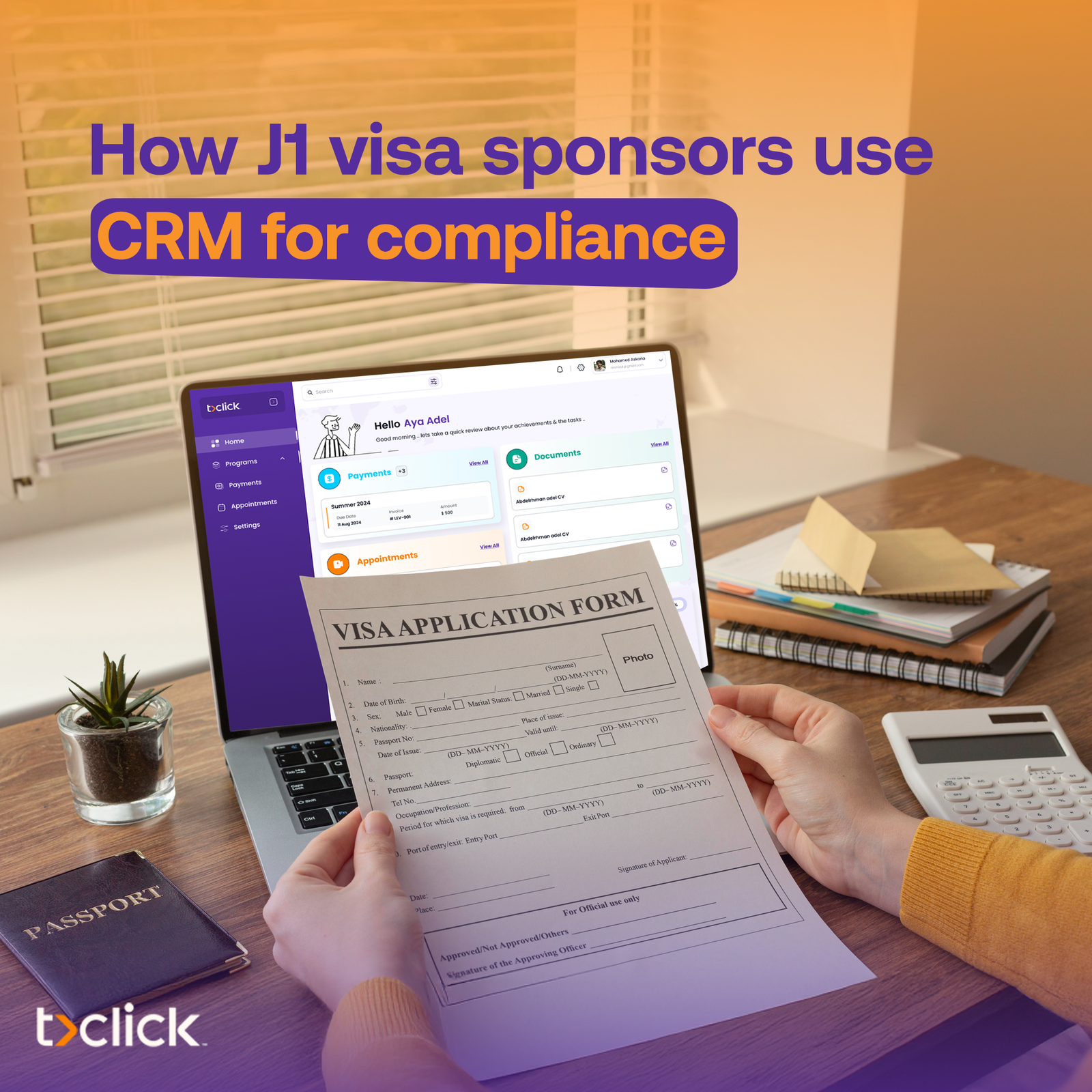
Compliance is the backbone of every successful J-1 Exchange Visitor Program. J-1 visa sponsors operate under strict U.S. Department of State regulations and are legally responsible for monitoring participants, maintaining accurate records, and reporting program activity throughout the entire exchange period. Any failure to comply can lead to audits, penalties, or even loss of sponsor designation.
As J-1 programs grow in scale and complexity, manual processes are no longer sufficient to meet these regulatory demands. This is why the conversation around how J1 visa sponsors use CRM for compliance has become increasingly important. CRM systems are no longer viewed as optional administrative tools—they are now critical infrastructure for ensuring accuracy, consistency, and accountability.
Modern sponsors manage hundreds or even thousands of participants across different categories, such as intern, trainee, and work & travel. Each participant generates documents, deadlines, evaluations, and reporting obligations. Without centralized systems, compliance becomes reactive instead of proactive. Understanding how J1 visa sponsors use CRM for compliance begins with understanding the regulatory responsibilities they must meet on a daily basis.
What J1 Visa Sponsors Are Required to Comply With
To fully understand how J1 visa sponsors use CRM for compliance, it is essential to examine the core regulatory requirements governing J-1 programs. Sponsors must adhere to a structured framework designed to protect participants, host organizations, and program integrity.
SEVIS Reporting and Record Accuracy
J-1 sponsors are required to maintain accurate and up-to-date records in the Student and Exchange Visitor Information System (SEVIS). This includes participant status updates, address changes, program extensions, and early terminations. Missed or delayed updates can result in serious compliance violations. CRM systems help sponsors organize and track these reporting obligations in one centralized environment.
DS-2019 Issuance and Lifecycle Management
Sponsors are responsible for issuing and managing Form DS-2019 for every participant. This includes tracking issuance dates, program changes, extensions, and cancellations. Understanding how J1 visa sponsors use CRM for compliance often starts here, as CRM platforms provide structured tracking and documentation for every DS-2019 action.
Ongoing Monitoring and Participant Welfare
Compliance does not end once a participant arrives in the U.S. Sponsors must conduct regular check-ins, evaluations, and monitoring activities to ensure participant safety, training quality, and regulatory adherence. These activities must be documented and easily retrievable—something that is extremely difficult without a CRM-based system.
Host Organization Oversight
J-1 sponsors must also monitor host employers or training sites, ensuring they meet program requirements and provide appropriate supervision. CRM systems help link participants to hosts, track evaluations, and document communication—key elements in demonstrating compliance during audits.
Ready to Strengthen Compliance and Simplify Recruitment Operations?
👉 Discover the Best CRM for Student Recruitment & Compliance:
Common Compliance Challenges for J1 Visa Sponsors
Despite clear regulations, many organizations struggle with execution. These challenges explain why how J1 visa sponsors use CRM for compliance has become a critical topic across the exchange visitor industry.
Fragmented Data and Disconnected Systems
One of the most common challenges is having participant data spread across spreadsheets, email inboxes, shared folders, and standalone tools. This fragmentation makes it difficult to maintain a single source of truth and increases the risk of errors, outdated records, and missed reporting deadlines.
Manual Tracking and Missed Deadlines
Without automation, sponsors rely on calendars, reminders, or manual follow-ups to track compliance tasks. This approach is highly error-prone, especially when managing large participant volumes. Many compliance failures occur not due to lack of knowledge, but due to missed deadlines—one of the main reasons how J1 visa sponsors use CRM for compliance is gaining attention.
Inconsistent Monitoring and Documentation
Sponsors are required to document participant check-ins, evaluations, and communications. When these records are inconsistent or incomplete, sponsors struggle to demonstrate compliance during audits. CRM systems standardize monitoring workflows and ensure documentation is consistent and audit-ready.
Limited Visibility for Compliance Teams
Compliance officers and program managers often lack real-time visibility into participant status, outstanding tasks, or risk areas. Without dashboards and structured reporting, identifying potential compliance issues becomes reactive rather than preventative—undermining the entire compliance strategy.
👉 Why Education Agencies Need a CRM in 2026—Discover the key reasons agencies are adopting smarter systems to scale and compete:
How J1 Visa Sponsors Use CRM for Compliance
Understanding how J1 visa sponsors use CRM for compliance starts with recognizing CRM as a compliance management system—not just a database. For J-1 sponsors, CRM platforms act as a centralized operational hub that connects participant records, documentation, deadlines, communication, and monitoring activities in one structured environment.
J-1 visa sponsors use CRM systems to maintain complete participant profiles that include DS-2019 records, SEVIS-related data, host organization details, insurance verification, and program timelines. By consolidating this information, sponsors reduce the risk of errors caused by scattered data and manual updates.
Another critical way how J1 visa sponsors use CRM for compliance is through automated alerts and reminders. CRMs notify staff about upcoming SEVIS updates, evaluation deadlines, document expirations, and required participant check-ins. This automation ensures that compliance tasks are completed on time, even when managing large volumes of participants across multiple program categories.
CRM systems also support real-time monitoring by allowing sponsors to track participant status throughout the program lifecycle. From pre-arrival documentation to on-program evaluations and final reporting, every action is logged and time-stamped. This creates a clear compliance trail that can be easily reviewed during internal audits or Department of State inspections.
The Role of CRM in Simplifying Sponsor Responsibilities
The regulatory responsibilities placed on J-1 visa sponsors are extensive, and manual processes significantly increase compliance risk. This is why the role of CRM is central to how J1 visa sponsors use CRM for compliance in a sustainable way.
CRM platforms simplify sponsor responsibilities by standardizing workflows. Instead of relying on individual staff members to remember compliance steps, CRMs embed regulatory requirements directly into daily operations. Tasks such as participant onboarding, document verification, host evaluations, and periodic check-ins follow predefined workflows that reduce human error.
Another key role of CRM is improving internal visibility and accountability. Compliance officers, program managers, and coordinators can instantly see participant status, outstanding tasks, and potential risk areas through centralized dashboards. This visibility allows sponsors to proactively address issues before they escalate into violations—an essential aspect of how J1 visa sponsors use CRM for effective compliance.
CRMs also streamline communication with participants and host organizations. Automated emails, reminders, and secure portals ensure that all stakeholders receive timely information and that communication records are properly documented. This not only supports compliance but also strengthens program governance and transparency.
Business Benefits of Using CRM for J1 Visa Compliance
While compliance is the primary driver, there are significant operational and strategic benefits tied to how J1 visa sponsors use CRM for compliance.
First, CRM systems dramatically reduce administrative workload. Automation replaces manual tracking, follow-ups, and document chasing, allowing teams to focus on higher-value tasks such as program quality, participant support, and sponsor relationships.
Second, CRM adoption improves audit readiness. With centralized, searchable, and time-stamped records, sponsors can respond to audits and information requests quickly and confidently. This reduces stress, minimizes disruption, and lowers the risk of penalties or corrective actions.
Third, CRM systems enhance scalability. As programs grow, sponsors can manage more participants without proportionally increasing staff or operational complexity. This scalability is a direct outcome of structured workflows and real-time visibility—key advantages highlighted in discussions around how J1 visa sponsors use CRM for compliance.
Finally, education-focused CRM platforms such as Ticklick enable sponsors to align compliance with operational efficiency. By combining participant lifecycle tracking, automated compliance alerts, and structured documentation in one system, sponsors can maintain regulatory control while improving overall program performance.
Why Generic Tools Fall Short and What Sponsors Really Need
Many J-1 visa sponsors still rely on spreadsheets, shared folders, email chains, or generic CRM tools to manage compliance-related tasks. While these tools may appear sufficient on the surface, they are fundamentally misaligned with the regulatory complexity of J-1 programs. This gap explains why discussions around how J1 visa sponsors use CRM for compliance increasingly emphasize the need for purpose-built systems rather than improvised solutions.
Generic tools lack compliance awareness. They do not understand SEVIS timelines, DS-2019 lifecycles, mandatory participant check-ins, or audit documentation requirements. As a result, sponsors are forced to rely on manual reminders, individual knowledge, and fragmented tracking methods—significantly increasing the risk of missed deadlines, inconsistent records, and audit exposure.
What J-1 sponsors truly need is not just a place to store data, but a compliance-driven operational system. This includes centralized participant records, automated compliance alerts, structured monitoring workflows, audit-ready documentation, and real-time visibility for compliance teams. These capabilities are essential to executing how J1 visa sponsors use CRM for compliance in a reliable, scalable way.
How Ticklick Supports J-1 Visa Compliance at Scale
Built specifically for education, exchange, and mobility programs, Ticklick addresses the exact gaps that generic tools leave behind. Ticklick is designed around complex participant lifecycles, making it a natural fit for J-1 visa sponsors managing compliance-heavy programs.
Ticklick centralizes all participant data—including DS-2019 records, host organization details, documents, evaluations, and communication—into a single, structured platform. Automated reminders and task workflows help sponsors stay ahead of SEVIS updates, monitoring requirements, and reporting deadlines. This proactive approach is a practical example of how J1 visa sponsors use CRM for compliance to reduce risk and maintain regulatory control.
Turning Compliance Into Operational Confidence With Ticklick
Beyond meeting regulatory requirements, Ticklick helps sponsors transform compliance from a constant operational burden into a structured, predictable process. By standardizing workflows and maintaining audit-ready records, sponsors gain full visibility into participant status, outstanding tasks, and potential compliance risks—at any moment.
As J-1 programs scale across categories such as Intern, Trainee, and Work & Travel, Ticklick enables sponsors to grow without increasing administrative complexity. Its education-focused design ensures that compliance logic is embedded directly into daily operations, aligning perfectly with best practices around how J1 visa sponsors use CRM for compliance—and positioning sponsors for long-term sustainability and audit readiness.
FAQs
What does J-1 visa compliance mean for sponsors?
J-1 visa compliance refers to a sponsor’s obligation to follow U.S. Department of State regulations, including accurate SEVIS reporting, DS-2019 management, participant monitoring, documentation, and audit readiness. Understanding how J1 visa sponsors use CRM for compliance helps sponsors meet these requirements consistently and efficiently.
How does a CRM help J-1 visa sponsors stay compliant?
CRM systems centralize participant records, automate compliance alerts, track deadlines, and document all required monitoring activities. This structured approach reduces human error and ensures that sponsors can demonstrate compliance at any time—one of the key reasons how J1 visa sponsors use CRM for compliance has become a best practice.
Is CRM necessary for small J-1 visa sponsor organizations?
Yes. Even small sponsors face the same regulatory requirements as large organizations. A CRM helps smaller teams manage compliance tasks efficiently, avoid missed deadlines, and scale programs safely—making CRM adoption essential regardless of organization size.
Can CRM systems support multiple J-1 program categories?
Modern CRM platforms can manage different J-1 categories such as Intern, Trainee, and Work & Travel through customizable workflows and pipelines. This flexibility is critical to executing how J1 visa sponsors use CRM for compliance across diverse program structures.
How does CRM improve audit readiness for J-1 sponsors?
CRM systems maintain centralized, time-stamped records of documents, communications, evaluations, and compliance actions. This creates a clear audit trail that allows sponsors to respond quickly and confidently to audits or regulatory reviews.
Conclusion
J-1 visa sponsors operate in one of the most compliance-intensive environments within international exchange programs. Managing participant records, meeting SEVIS reporting requirements, tracking DS-2019 lifecycles, and documenting ongoing monitoring activities cannot be handled reliably with manual tools or generic systems.
This is why understanding how J1 visa sponsors use CRM for compliance is no longer optional—it is essential. CRM platforms provide the structure, automation, and visibility sponsors need to reduce risk, maintain regulatory control, and support program growth without operational strain.
Education- and exchange-focused platforms like Ticklick demonstrate how compliance can be embedded directly into daily operations. By centralizing data, automating time-sensitive tasks, and maintaining audit-ready records, sponsors can move from reactive compliance management to a proactive, confident, and scalable compliance strategy.