
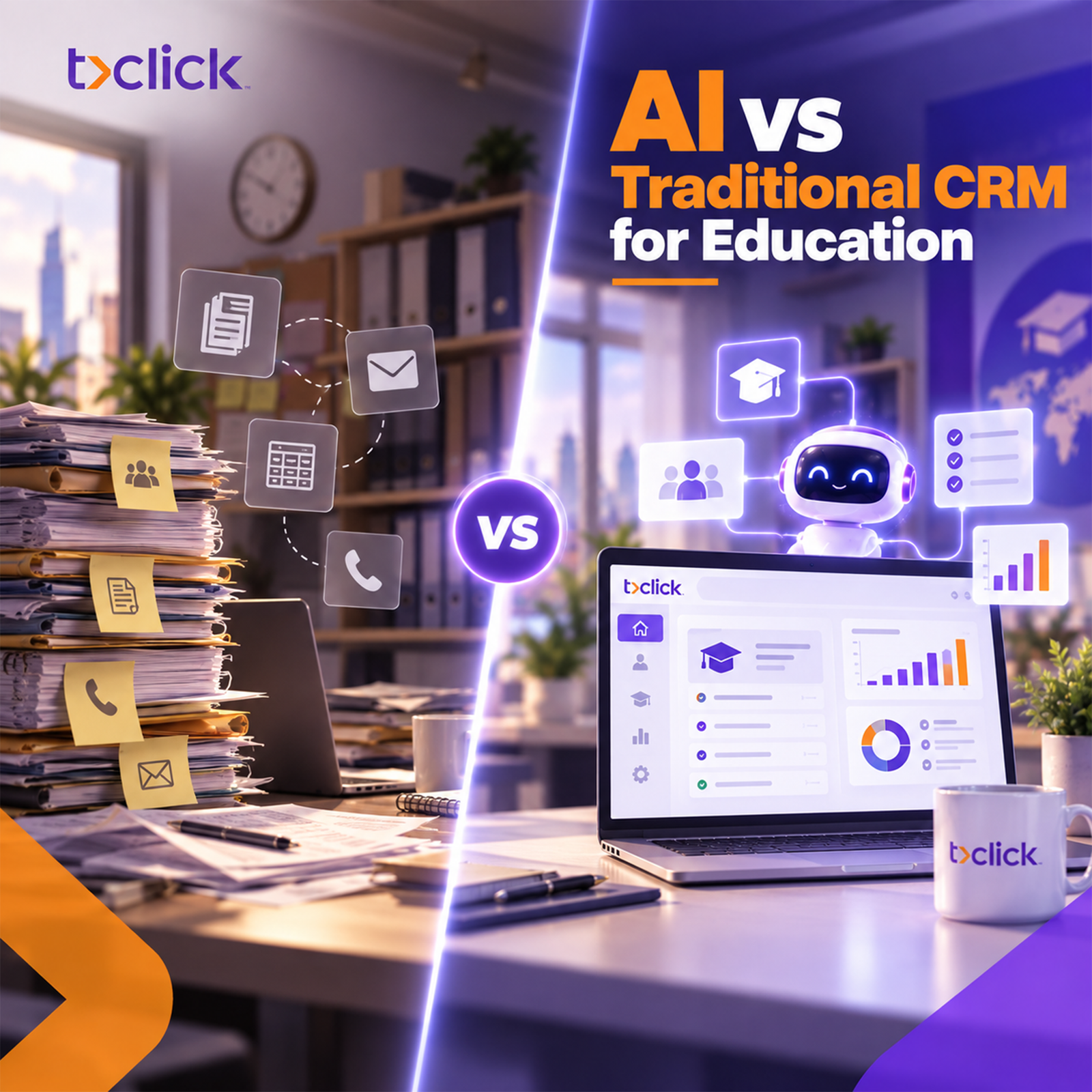
Education organizations have spent years moving student information out of spreadsheets, inboxes, and disconnected files and into CRM systems. That shift solved an important problem: teams finally had one place to manage inquiries, student records, recruitment stages, communication, applications, tasks, and performance.
But having the information in one place does not automatically make it easy to use.
A counselor may still need to open several records before a student call. A recruitment manager may see that applications are slowing down without immediately knowing where the problem is. Teams may have thousands of interactions stored in their CRM but still spend hours searching, summarizing, writing follow-ups, and deciding which records need attention.
This is where artificial intelligence is beginning to change the role of CRM.
The discussion around AI vs. traditional CRM for education is therefore not simply about replacing an old system with a newer one. Traditional CRM provides the structure required to manage the student journey. AI can add another layer that helps teams interpret information, prepare communication, identify patterns, and determine what may require attention.
Understanding that distinction is essential before deciding whether an education organization actually needs an AI-powered CRM.
What Is a Traditional CRM for Education?
A traditional CRM for education is a system used to organize and manage relationships with prospective students, applicants, current students, partners, or other contacts throughout the education journey.
Depending on the organization and platform, it can support activities such as:
- Capturing and managing inquiries
- Maintaining student records
- Tracking leads through recruitment stages
- Recording communication
- Assigning tasks to team members
- Managing applications
- Automating repetitive workflows
- Segmenting prospective students
- Monitoring recruitment performance
- Generating reports
The word “traditional” should not be confused with “outdated.”
A well-designed CRM using structured workflows and rule-based automation can still handle sophisticated recruitment operations without generative AI.
For example, an education agency might create a workflow such as
New Enquiry → Assign Counselor → Create Follow-Up Task → Send Confirmation → Update Recruitment Stage
The CRM does not need to interpret the situation. The organization has already decided what should happen, and the system follows those rules consistently.
That predictability remains extremely valuable.
For a deeper look at the capabilities required to manage education-specific processes, explore CRM software for educational organizations.
What Is an AI-Powered CRM for Education?
An AI-powered education CRM combines the core capabilities of customer relationship management with artificial intelligence that can help interpret, summarize, generate, predict, recommend, or—in more advanced implementations—perform approved actions using available CRM context.
Potential AI capabilities can include:
- Summarizing student records
- Drafting communication
- Retrieving information through natural-language questions
- Identifying patterns in recruitment data
- Supporting lead prioritization
- Recommending next actions
- Assisting with personalization
- Analyzing unstructured information
- Supporting predictive analytics
- Assisting with document-related workflows
- Powering conversational assistants
This creates an important difference in how information moves through the system.
A traditional CRM primarily works through:
Data → Rule → Action
An AI-powered CRM can add:
Data → Context → Interpretation → Recommendation or Action
That does not mean AI removes the underlying CRM. In fact, AI becomes more useful when the CRM underneath it is structured properly.
AI vs. Traditional CRM for Education: Quick Comparison
The clearest way to understand the difference is to compare how each approach handles common education CRM requirements.
| Area | Traditional CRM | AI-Powered CRM |
| Student data | Stores and organizes records | Uses records as context for AI assistance |
| Information retrieval | Filters, fields, reports, search | May add natural-language retrieval |
| Automation | Rule-based workflows | Rule-based workflows plus AI-assisted actions |
| Communication | Templates and manual writing | Can assist with drafting and contextual personalization |
| Lead management | Tracks, segments, and routes leads | Can add AI-supported insights and prioritization |
| Student summaries | Staff review records manually | Can generate summaries from available context |
| Analytics | Dashboards and reports | Can assist with interpreting patterns |
| Recommendations | Primarily staff-driven | Can suggest possible next actions |
| Workflow behavior | Predetermined | Can become more context-aware |
| Human role | Operates the process and makes decisions | Reviews, interprets, approves, and makes decisions |
| Governance | Data access and workflow controls | Requires CRM controls plus AI governance |
| Main strength | Structure, consistency, and control | Context, interpretation, and assistance |
The central point is simple:
An AI CRM is not a replacement for CRM fundamentals. It is an additional intelligence layer built on top of them.
The Biggest Difference: Recording Information vs. Understanding Context
A traditional CRM can tell a counselor that a student is interested in a postgraduate program, submitted an inquiry two weeks ago, and spoke with another team member, received an application link, and has an outstanding task.
All of that information may already exist in the system.
The challenge is turning several individual records into a useful understanding of what is happening.
With an appropriate AI layer, that information could potentially be summarized into something closer to:
This student is interested in a postgraduate program, previously discussed tuition costs, received an application link, and has not responded since being asked for additional documents.
The underlying information has not necessarily changed.
What changed is how quickly the employee can understand it.
This is one of the most useful ways to think about the difference between AI and traditional CRM:
Record → Context → Assistance
The real value of AI is not necessarily creating more student data. It is helping teams make better use of the data they already have.
AI vs Traditional CRM Across the Student Recruitment Journey
The differences become more practical when both approaches are compared across the actual student recruitment journey.
Lead Capture
A traditional CRM captures structured information through forms, integrations, manual entry, and other predefined sources.
That might include a student’s:
- Name
- Contact information
- Lead source
- Preferred destination
- Program interest
- Intake
- Recruitment stage
AI can potentially add another layer by interpreting information contained in conversational enquiries or other unstructured interactions.
Instead of only capturing information, the system can help make sense of what the prospective student has said.
The shift is:
Capture Information → Capture + Interpret Information
Structured fields do not become unnecessary. They remain important for reliable reporting, workflows, filtering, and data management.
Lead Qualification
Traditional CRM systems can qualify and organize leads using predefined criteria, fields, tags, scoring models, or counselor review.
For example, a team might categorize students according to their intended intake, program, destination, or application readiness.
AI can potentially examine broader context, including previous conversations, engagement, profile information, and recruitment activity.
That can help recruiters identify which students may require attention.
However, AI-assisted prioritization needs careful governance.
A student should not automatically receive less support simply because an algorithm assigns a lower score based on historical patterns.
A better use of AI is to help answer:
Who needs attention, and why?
rather than:
Who is worth our attention?
If your team needs a stronger foundation for organizing enquiries before introducing more advanced intelligence, lead management for international student recruitment explains how structured lead processes can keep student information and recruitment activity connected.
Student Segmentation
Traditional CRM segmentation is highly effective when the organization knows exactly which criteria it wants to use.
For example:
Country = UAE + Intake = September + Program = Business
These rules are clear, predictable, and easy to understand.
AI can potentially introduce more contextual segmentation by considering combinations of profile information, behavior, recruitment stage, and previous interactions.
This can move segmentation from broad static categories toward groups based on what students currently need.
However, more sophisticated does not always mean more useful.
When a recruitment team needs a precise list based on clearly defined criteria, traditional CRM filtering may remain the simpler and more reliable option.
Student Communication
Traditional CRM systems can support email templates, communication histories, automated sequences, and predefined messages.
These tools already remove significant repetitive work.
AI changes communication primarily by making it easier to work with context.
Instead of selecting a generic template and manually adapting it, an employee may use AI to prepare a draft based on the student’s current stage, previous conversation, outstanding actions, and relevant information.
The progression becomes:
Template Personalization → Contextual Personalization
The purpose should not be to make every message appear as though it was individually written.
The purpose is to make communication more useful.
A student who has not selected a program needs different information from someone whose application is waiting for a missing document.
Good personalization reduces confusion. It does not simply increase the amount of automation.
Student Follow-Up
Traditional CRM automation is particularly effective for predictable follow-up.
For example:
No Response for 5 Days → Send Follow-Up Template
The rule is clear and repeatable.
AI can potentially make follow-up more contextual by considering what happened before the student became inactive.
Did the student ask a question?
Are documents missing?
Is an application deadline approaching?
Has the student already received several messages?
Is there an unresolved issue in the previous conversation?
Instead of relying entirely on elapsed time, the system can help the team consider the wider situation.
That creates a distinction between:
Schedule-Based Follow-Up → Context-Aware Follow-Up
Both approaches have value.
If your team is still spending significant time on predictable administrative actions, task automation for education agencies explains how structured workflows can reduce repetitive work before more advanced AI is introduced.
Counselor Preparation
One of the simplest but potentially valuable uses of AI is helping counselors prepare for conversations.
In a traditional CRM, a counselor may open the student record, review notes, check previous emails, look at tasks, inspect application progress, and identify outstanding actions.
That information is useful, but finding the relevant pieces takes time.
AI can potentially turn those records into a concise briefing:
Student History → Current Stage → Important Conversations → Outstanding Actions → Next Deadline
The counselor still decides what matters and how to handle the conversation.
The difference is that less time is spent reconstructing the student’s story.
The counselor spends less time finding the story and more time responding to it.
Application Management
Traditional education CRM systems can use pipelines, stages, tasks, checklists, deadlines, and notifications to organize applications.
Those capabilities remain essential.
AI can add assistance around the information within the application process, potentially helping teams summarize activity, identify incomplete information, surface exceptions, or prepare next-step recommendations.
The distinction between assistance and decision-making is especially important here.
Application assistance is not the same as making an admissions decision.
AI can help an employee understand a record. Decisions involving eligibility, admission, financial implications, or other consequential outcomes require appropriate human control.
For a deeper look at this use case, explore AI for Admissions CRM and how AI can support admissions workflows without removing the need for structured CRM processes and human judgment.
Task Management and Automation
Traditional automation follows rules.
Trigger → Rule → Action
AI-assisted automation can introduce context:
Event → Context → Interpretation → Suggested or Approved Action
The second model is more flexible, but flexibility is not always necessary.
Consider an appointment reminder.
If every student should receive a reminder 24 hours before a scheduled meeting, a deterministic rule is ideal. There is little reason to ask AI to decide whether the reminder should be sent.
Now consider counselor preparation.
If the employee needs a summary of the student’s latest activity before that meeting, AI can add genuine value.
This leads to an important principle:
Do not replace a simple rule with AI when the simple rule solves the problem better.
Reporting and Analytics
Traditional CRM reporting is designed to answer questions such as:
- How many enquiries did we receive?
- How many applications are currently active?
- Which sources generated the most leads?
- What is the conversion rate?
- How many students reached each stage?
AI can potentially help teams investigate what sits behind those numbers.
A manager might ask:
- Which applications appear to be stalled?
- Where is the recruitment pipeline slowing down?
- Which records require attention?
- What changed compared with the previous period?
- Which team members have unusually high workloads?
The difference is not that dashboards become irrelevant.
It is that AI can make it easier to move from:
Reporting → Investigation → Action
Any AI-generated interpretation should still be checked against the underlying data, particularly when the system is suggesting causes rather than simply identifying patterns.
CRM Search and Information Retrieval
Traditional CRM search relies on fields, filters, reports, and record navigation.
When the database is well structured, these tools are highly reliable.
AI introduces the possibility of natural-language interaction with CRM information.
Instead of manually building several filters, an employee might eventually ask:
Which students applying for the January intake still have incomplete applications?
or:
Summarize the students I need to contact today and explain why.
This can reduce the distance between having information and being able to use it quickly.
That is particularly valuable as student databases and communication histories become larger.
Traditional Automation vs AI Automation: They Are Not the Same
AI and automation are frequently discussed as though they mean the same thing.
They do not.
| Traditional Automation | AI-Assisted Automation |
| Follows predefined rules | Can interpret additional context |
| Highly predictable | More flexible |
| Expected input produces expected action | Output may vary |
| Easier to audit | Requires additional monitoring |
| Excellent for repetitive processes | Useful when situations contain ambiguity |
| Works with defined conditions | Can work with less structured information |
The strongest CRM strategy often combines both.
Use traditional automation when the organization already knows exactly what should happen.
Use AI assistance when the work requires interpretation, summarization, generation, or understanding of broader context.
Does AI CRM Replace Traditional CRM?
Not really.
An AI-powered CRM still requires the basic components that made CRM valuable in the first place.
It still needs:
- Student records
- Recruitment pipelines
- Application stages
- Communication history
- Tasks
- Permissions
- Workflows
- Reporting
- Reliable data
AI sits on top of that operational structure.
A useful way to visualize the relationship is:
CRM Foundation
↓
Structured Student Data
↓
Workflows and Automation
↓
AI Assistance
↓
Approved AI Actions
Without the lower layers, the higher ones become less reliable.
AI does not eliminate the need for CRM structure. It increases the value of having good CRM structure in the first place.
When Is a Traditional CRM Still the Better Choice?
An organization does not need AI simply because AI features are available.
A traditional CRM may provide everything a team currently needs when:
- The recruitment operation is relatively small.
- Student volume is manageable.
- Processes are straightforward.
- Most workflows follow predictable rules.
- The organization is still centralizing its data.
- The team has not yet standardized recruitment stages.
- Advanced AI features would add cost without solving an important problem.
- The organization is not ready to manage AI-related governance.
Imagine an agency that still records important student conversations outside its CRM.
Adding an AI assistant will not solve the underlying problem because the assistant cannot reliably use information that was never captured.
The better priority is to fix the process first.
A sophisticated AI layer cannot compensate for an undefined recruitment operation.
When Does an AI-Powered CRM Become More Valuable?
AI becomes more relevant as the amount of information and operational complexity grows.
Potentially stronger use cases appear when an organization manages:
- Large enquiry volumes
- Multiple recruitment markets
- Large counselor teams
- Extensive communication histories
- Complex application processes
- Multiple communication channels
- Significant repetitive writing
- Large amounts of unstructured information
- High demand for personalization
- Frequent internal information retrieval
- Increasing reporting complexity
Even then, volume alone is not enough.
Two conditions need to exist:
Need + Readiness
The organization should have a real problem that AI can help solve and enough operational structure for the technology to work reliably.
What Can AI Do Better—and What Can Traditional CRM Still Do Better?
The most useful comparison is not about declaring one technology the winner.
Different tools are stronger at different kinds of work.
Where AI Can Add More Value
AI is particularly useful for tasks involving:
- Summarization
- Drafting
- Natural-language interaction
- Unstructured information
- Contextual assistance
- Pattern identification
- Information retrieval
- Recommendations
Where Traditional CRM Logic Often Remains Stronger
Rule-based CRM capabilities remain extremely effective for:
- Mandatory workflow stages
- Fixed notifications
- Permission enforcement
- Required approvals
- Structured data collection
- Deterministic tasks
- Standard reporting
- Auditability
The two approaches complement each other.
The strongest education CRM does not necessarily choose between AI and traditional CRM logic. It uses each where it solves the problem more effectively.
AI CRM vs Traditional CRM: What Changes for Counselors?
Traditional CRM gives counselors access to the information they need.
AI can change how quickly they can turn that information into useful context.
The traditional workflow can involve:
Search → Read → Update → Write → Follow Up
AI assistance can reduce some of those intermediate administrative steps, allowing more time for:
Review → Interpret → Decide → Counsel
That changes where counselor value is concentrated.
Less time can be spent searching records or preparing repetitive communication.
More time can be spent understanding individual circumstances, explaining options, managing expectations, solving unusual cases, and building relationships.
This is particularly relevant in study abroad recruitment, where decisions frequently involve personal, financial, academic, and family considerations.
Want to see how that shift could affect the agency as a whole? Explore The Future of AI in Study Abroad Agencies to see how AI could reshape agency workflows, counselor roles, student support, and day-to-day operations.
AI CRM vs Traditional CRM: What Changes for Managers?
Managers often need to turn CRM data into operational decisions.
A traditional CRM provides dashboards, reports, filters, and performance data.
An AI layer can potentially make that information easier to investigate.
Instead of only viewing a report, a manager may be able to ask questions such as:
- Where is the pipeline slowing down?
- Which applications have remained inactive?
- Which counselors currently have the highest workloads?
- Which records have missing information?
- What changed in this recruitment cycle?
The underlying CRM data remains the source.
AI changes the interface between the manager and that information.
For this reason, AI-generated explanations should ideally remain connected to the records or data supporting them.
AI CRM vs Traditional CRM: What Changes for Students?
Students may never see the CRM interface, but they experience the consequences of how well it works.
A strong traditional CRM can already improve student experience through organized follow-up, accurate records, structured communication, and clearer application management.
AI can potentially add:
- Faster access to basic information
- More contextual communication
- Better continuity between interactions
- Multilingual assistance
- Faster first-line support
- Fewer repeated questions
But faster does not automatically mean better.
A student who receives an immediate but incorrect answer has not received a better experience.
The real objective should be:
Speed + Relevance + Accuracy + Human Access
AI contributes most when it strengthens that combination rather than replacing it.
The Data Quality Problem: AI Makes Good CRM Data More Important
Poor CRM data has always caused problems.
It creates inaccurate reports, missed follow-ups, duplicate records, and confusion between team members.
AI can make those problems more consequential.
Imagine that a student’s documents were received through a separate channel but the CRM was never updated.
If an AI assistant uses the CRM record to prepare a follow-up, it may confidently tell the counselor that documents are still missing.
The generated message may sound professional.
The context is still wrong.
The sequence becomes:
Bad Data → Wrong Context → Wrong Assistance → Poor Student Experience
The opposite is also true:
Reliable Data → Better Context → More Useful AI Assistance
This is why AI readiness starts long before an organization activates an AI feature.
It starts with data discipline.
AI can interpret the information available in the CRM. It cannot know about information the organization failed to record.
AI CRM Introduces New Questions About Privacy and Governance
Traditional CRM systems already require strong data security, permissions, and access controls.
AI introduces additional questions.
Education organizations should understand:
- What student data can AI access?
- Why does the AI need that information?
- Where is the information processed?
- How long is it retained?
- Is organizational data used for model training?
- Which employees can use AI capabilities?
- Can AI access be restricted by role?
- Which actions can AI perform?
- Which actions require human approval?
- Are AI actions recorded?
- Can employees verify important outputs?
A useful governance model is:
Data → Permission → AI Access → Action → Audit
The more capable the AI becomes, the more important those boundaries become.
This is also why user roles and permissions in education CRM matter beyond ordinary account administration. Clear access controls help organizations determine who can see and act on different types of student information.
The Accuracy Problem: AI Output Is Not the Same as CRM Data
This distinction can be easy to miss because both pieces of information may appear on the same screen.
Imagine the CRM contains a verified field:
Application Deadline: 15 January
Now imagine an AI assistant responds:
The application deadline is 15 January.
To the employee, the statements look identical.
Technically, however, they are different.
One is stored data.
The other is generated output based on information the AI received.
A reliable AI-enabled workflow should therefore help employees distinguish between:
Stored Fact → Retrieved Fact → Generated Interpretation
This becomes especially important when AI summarizes multiple records or provides recommendations.
Fluent language can create an impression of certainty even when the underlying information is incomplete.
The more confidently AI communicates, the more important source visibility becomes.
Explainability: Can Your Team Understand Why AI Suggested Something?
Suppose an AI system tells a counselor:
Contact this student first.
Why?
Perhaps the application deadline is approaching.
Perhaps the student recently asked an unanswered question.
Perhaps required documents are missing.
Or perhaps a predictive model assigned the student a higher conversion probability.
Those are very different reasons.
Recruitment teams should therefore think about AI recommendations through a simple framework:
Recommendation → Reason → Evidence → Human Decision
not:
AI Recommendation → Automatic Acceptance
Explainability becomes particularly important when AI influences which students receive attention, how applications are handled, or which actions are prioritized.
AI CRM vs Traditional CRM: Cost Comparison
AI CRM should not be evaluated only by comparing monthly subscription prices.
The more useful measure is total cost of ownership.
Traditional CRM Costs Can Include
- Subscription fees
- Implementation
- Configuration
- Integrations
- Employee training
- Ongoing administration
- Support
AI CRM May Add Costs Related to
- AI usage
- Premium AI modules
- Data preparation
- Additional integrations
- Governance
- Monitoring
- Employee training
- Quality assurance
At the same time, effective AI may reduce the cost associated with repetitive administrative work, manual drafting, information retrieval, or some routine support activities.
A more realistic comparison is therefore:
CRM ROI = Operational Value − Total Cost of Ownership
The cheapest platform is not necessarily the most cost-effective.
Neither is the platform with the longest AI feature list.
The important question is whether the system creates measurable operational value.
AI CRM vs Traditional CRM by Organization Size
The right balance between traditional CRM capabilities and AI depends partly on the complexity of the organization.
Small Education Agencies
A small agency may gain more immediate value from centralizing student records, creating a clear pipeline, and automating basic workflows than from deploying advanced AI.
Simplicity can be an advantage.
Growing Education Agencies
As enquiry volume increases, task automation, communication management, reporting, and counselor coordination become more important.
AI can begin adding value where employees repeatedly search, summarize, write, or interpret large amounts of information.
Multi-Branch and High-Volume Agencies
Larger operations may have stronger use cases for AI-assisted retrieval, contextual summaries, workload analysis, advanced reporting, and scalable personalization.
They also need stronger permissions and governance.
Universities and Large Recruitment Organizations
Larger organizations may require integrations, complex workflows, extensive permissions, auditability, institutional governance, and clear controls around how AI accesses and uses student information.
The right CRM therefore depends less on organization size alone and more on operational complexity.
Which CRM Should an Education Organization Choose?
Choosing between a traditional CRM and an AI-enabled platform should start with the organization’s recruitment operation, not the technology label.
Ask:
- Is student data already centralized?
- Is the recruitment pipeline clearly defined?
- Which processes consume the most staff time?
- Which tasks are repetitive and predictable?
- Which tasks require professional judgment?
- How many student interactions does the team manage?
- Does the CRM need to support application workflows?
- Which communication channels need to be connected?
- What information would AI be permitted to access?
- How would AI-generated outputs or actions be reviewed?
These questions reveal whether the organization needs better CRM fundamentals, stronger automation, AI assistance, or a combination of all three.
For a broader buying framework, Top CRM Features for Education Agencies covers the capabilities worth evaluating before choosing a platform.
Choose the CRM that solves today’s operational problems while giving the organization a realistic path toward the capabilities it may need next.
Red Flags When Comparing AI CRM Platforms for Education
The term “AI-powered” can make a product sound more advanced without explaining whether its AI capabilities solve a meaningful problem.
When comparing platforms, watch for several warning signs.
“AI-Powered” Without a Clear Explanation
The vendor should be able to explain what AI actually does and where it appears in the workflow.
No Clear Data Policy
Education organizations should understand how student information is processed and protected.
Recommendations Without Explanations
If AI prioritizes a student or recommends an action, teams should understand the basis for that recommendation where appropriate.
No Human Approval Controls
AI should not be given unrestricted authority over sensitive or consequential actions.
AI Added to a Weak CRM Foundation
Advanced AI is of limited value if basic lead, application, communication, and workflow management is poor.
No Education-Specific Workflow Support
A sophisticated AI assistant does not compensate for a CRM that cannot properly manage the student journey.
Weak Permission Controls
Different employees should not automatically have access to every piece of student information or every system capability.
No Way to Evaluate Accuracy
Teams need a process for identifying, correcting, and learning from inaccurate AI output.
The buying principle is straightforward:
Do not choose an education CRM simply because it has AI. Choose it because it improves the way the organization works.
What Features Matter More Than the “AI” Label?
Before comparing AI assistants, predictive models, or agents, evaluate the foundation.
An education CRM should be assessed for capabilities such as:
- Lead management
- Student records
- Recruitment pipelines
- Application tracking
- Communication management
- Workflow automation
- Student portals
- Agent management where relevant
- Roles and permissions
- Reporting
- Integrations
- Data accessibility
- Security
Only then should AI capabilities be evaluated in context.
The order matters:
CRM Fundamentals First → AI Capabilities Second
An impressive AI demonstration can attract attention.
Reliable daily operations create long-term value.
How Ticlick Supports a Smarter Education CRM Foundation
The move toward more intelligent recruitment technology makes the CRM foundation more important, not less.
Before an education organization can make meaningful use of AI, it needs connected student information, clearly defined recruitment stages, organized applications, consistent workflows, controlled access, and visibility across the student journey.
Ticlick CRM is built specifically around the operational requirements of international education and student recruitment organizations.
Its capabilities include:
- Lead and student management
- Recruitment pipelines
- Applications and document management
- Task and workflow automation
- Student and agent portals
- Communication management
- Invoices and payments
- Reporting
- User roles and permissions
Together, these capabilities create a structured operational foundation:
Student Data → Recruitment Pipeline → Communication → Workflow → Reporting
If you are evaluating the fundamentals first, Best CRM for Student Recruitment provides a closer look at what recruitment organizations should expect from a purpose-built CRM.
The objective is not to add technology for the sake of having more technology. It is to create a connected recruitment operation where information can move with the student instead of being scattered across separate tools and teams.
Ready to strengthen the foundation behind your recruitment operation? Explore Ticlick CRM and see how student data, applications, communication, workflows, and reporting can work together in one system.
How AI and Traditional CRM Can Work Together
The long-term direction of education CRM is unlikely to be a simple choice between traditional CRM and AI.
A stronger model combines the advantages of both:
CRM System of Record + Predictable Automation + AI Assistance + Human Judgment
Consider a prospective student enquiry.
The CRM creates and stores the record.
A predefined rule assigns the appropriate counselor.
AI may help summarize the enquiry and previous context.
The workflow creates the required next action.
The counselor reviews the information, makes the appropriate decision, and communicates with the student.
The CRM records what happened.
The process becomes:
Student Enquiry
↓
CRM Captures the Record
↓
Rules Coordinate Predictable Actions
↓
AI Helps Interpret Context
↓
Human Reviews and Decides
↓
CRM Records the Outcome
Each layer does what it is best suited to do.
For education agencies considering where this model may lead next, The Future of AI in Study Abroad Agencies explores how AI could reshape agency workflows, counselor roles, student support, and day-to-day operations.
Frequently Asked Questions About AI vs Traditional CRM for Education
What Is the Difference Between AI CRM and Traditional CRM for Education?
Traditional education CRM primarily organizes student data, recruitment stages, communication, workflows, and reporting using structured records and predefined rules. An AI-powered CRM can add capabilities such as summarization, natural-language interaction, contextual assistance, recommendations, and other forms of AI-supported analysis.
What Is an AI-Powered Education CRM?
An AI-powered education CRM combines CRM capabilities with artificial intelligence designed to help teams understand and use student information more efficiently. The exact AI functionality varies between platforms.
What Does a Traditional Education CRM Do?
A traditional education CRM can manage leads, student records, recruitment pipelines, applications, communication, tasks, workflows, segmentation, and reporting without requiring generative AI.
Is AI CRM Better Than Traditional CRM?
Not automatically. AI can be valuable for context-heavy tasks such as summarization, drafting, information retrieval, and analysis. Traditional CRM logic can be better for predictable workflows, fixed rules, permissions, and structured processes. The right approach depends on the organization’s needs and readiness.
Does AI CRM Replace Traditional CRM?
No. AI capabilities generally depend on the CRM foundation beneath them. Student records, pipelines, workflows, permissions, communication history, and reliable data remain essential.
Can AI CRM Automate Student Recruitment?
AI can assist with parts of student recruitment, while traditional automation can handle many repetitive workflows. Complex counseling and consequential decisions should retain appropriate human involvement.
Can AI CRM Help Education Agencies Manage Leads?
Yes. AI can potentially help summarize lead information, identify context, assist with prioritization, prepare communication, and make large amounts of lead data easier to navigate.
How Does AI Improve Student Communication?
AI can assist with drafting, summarizing previous interactions, multilingual communication, and contextual personalization. Human review remains important, particularly for sensitive or high-impact communication.
Can AI CRM Help With Admissions?
AI can assist with activities such as information retrieval, summaries, communication, application monitoring, and certain document-related tasks. It should not automatically be treated as a replacement for human admissions judgment.
Is AI CRM Safe for Student Data?
Safety depends on the specific platform, implementation, data policies, access controls, integrations, and governance practices. Education organizations should evaluate how student information is accessed, processed, retained, and protected.
What Are the Risks of AI in Education CRM?
Potential risks include inaccurate outputs, privacy issues, bias, weak explainability, over-automation, poor-quality source data, inappropriate access, and excessive reliance on AI-generated recommendations.
Does a Small Education Agency Need an AI CRM?
Not necessarily. A small agency may receive more immediate value from centralizing student information, defining its pipeline, and automating repetitive workflows. AI becomes useful when it addresses a specific operational problem.
Is AI CRM More Expensive Than Traditional CRM?
It can be, depending on the vendor, AI usage model, implementation requirements, integrations, and governance needs. Organizations should compare total cost of ownership and operational value rather than subscription price alone.
What Should I Look for in an AI CRM for Education?
Evaluate the CRM foundation first, including lead management, pipelines, applications, communication, automation, permissions, reporting, security, and integrations. Then assess what the AI does, which data it accesses, how outputs are verified, and where human approval is required.
Can AI and Traditional CRM Automation Work Together?
Yes. In many cases, this is the strongest approach. Rule-based automation can manage predictable processes, while AI assists with tasks requiring interpretation, summarization, generation, or broader context.
Why Does Data Quality Matter for AI CRM?
AI relies on the information available to it. Missing, outdated, or inaccurate CRM data can lead to poor summaries, irrelevant recommendations, and incorrect communication.
Will AI CRM Replace Education Counselors?
AI can reduce some administrative work and support counselors with information, summaries, and communication. Human counselors remain important for judgment, trust, complex student circumstances, and consequential decisions.
The Real Choice Is Not AI or CRM
The comparison between AI vs traditional CRM for education can sound like a choice between an old generation of software and a new one.
In practice, that is not the most useful way to think about it.
Traditional CRM introduced the structure education organizations needed to manage growing student journeys:
Structure → Visibility → Automation → Control
AI can add another layer:
Interpretation → Assistance → Personalization → Recommendations → Context-Aware Support
But the second layer depends heavily on the first.
An organization with fragmented student data, inconsistent processes, and poorly defined workflows does not become operationally intelligent simply because an AI assistant is added to its software.
The stronger long-term model combines reliable CRM data, predictable automation, appropriate AI assistance, and human judgment.
That is the real distinction behind AI vs traditional CRM for education: not which technology should replace the other, but how each can be used for the work it handles best.