
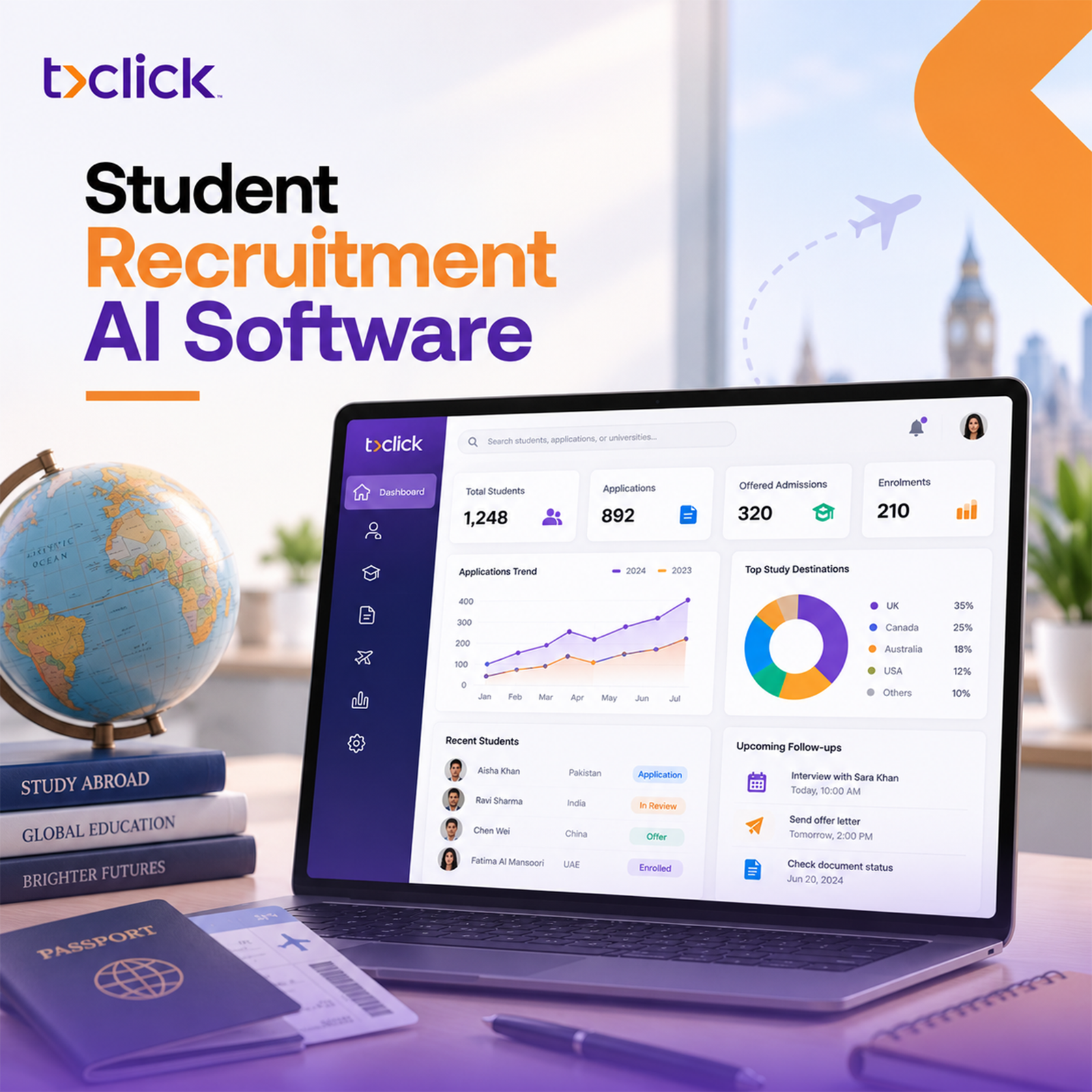
Generating student inquiries is only one part of recruitment. The harder part begins after those inquiries arrive.
Every prospective student creates a series of tasks. Someone needs to respond, understand what the student wants, capture the right information, determine the appropriate next step, maintain follow-up, arrange counselling, track applications, collect documents, and keep the student informed as the journey progresses.
When inquiry volume is manageable, teams can handle much of this work manually. As recruitment expands across more markets, channels, programs, and intakes, the same approach becomes difficult to scale.
The problem is not necessarily a shortage of leads. It is a shortage of time and attention.
Student recruitment AI software can help education organizations address this challenge by combining recruitment data, artificial intelligence, workflow automation, communication, and human expertise across the student journey.
The objective is not to replace counsellors with algorithms. It is to determine which parts of recruitment genuinely require human expertise and which repetitive tasks can be handled more efficiently with technology.
The real opportunity is not using AI to recruit students instead of people. It is using AI to stop people spending their time on recruitment work that never required their expertise.
What Is Student Recruitment AI Software?
Student recruitment AI software is technology that uses artificial intelligence to help education organizations manage and improve recruitment activities such as inquiry handling, lead qualification, student communication, follow-up, application workflows, task automation, prioritization, and recruitment analysis.
The term does not describe one specific feature.
Depending on the platform, AI student recruitment software may include capabilities such as:
- AI-assisted student engagement
- Lead qualification
- Conversational AI
- AI assistants for recruitment staff
- Lead prioritization
- Workflow automation
- Intelligent routing
- Conversation and record summaries
- Application support
- Knowledge retrieval
- Recruitment analytics
- Next-action recommendations
- AI agents for approved workflows
This distinction matters when comparing platforms.
A chatbot added to a website may use artificial intelligence, but that alone does not create a complete AI student recruitment platform.
The more useful question is whether AI connects with the wider recruitment operation.
Can it understand relevant student context? Can it help employees identify what requires attention? Can it reduce administrative work? Can it support the next appropriate action without losing human oversight?
Those questions reveal much more than an “AI-powered” label on a product page.
Why Student Recruitment Needs More Than Traditional Automation
Automation has already improved many recruitment processes.
A conventional automation system typically follows predefined rules:
If X happens → Do Y
For example:
New inquiry → Send confirmation email
Application submitted → Create counselor task
No response for three days → Send reminder
These workflows are useful because they make predictable processes more consistent.
AI introduces a different capability.
Rather than only reacting to a predefined event, AI can potentially help interpret information within the recruitment process.
The model becomes closer to:
What is happening? → What information is relevant? → What does the context suggest? → What should happen next?
For instance, traditional automation can send the same follow-up after three days.
AI-assisted recruitment may help staff understand whether a lead has already asked a complex question, whether an important deadline is approaching, or whether a conversation requires human attention.
This does not make rules obsolete.
In fact, clear rules become even more important when AI is introduced.
Automation follows rules. AI can help interpret context within those rules.
Where Does AI Fit Across the Student Recruitment Lifecycle?
Recruitment is not a single transaction. It is a sequence of connected stages.
A typical journey may look like:
Awareness → Inquiry → Qualification → Counseling → Application → Documents → Offer → Enrollment
AI can support different types of work at each stage.
Inquiry
A prospective student may begin with a simple question about a country, course, intake, or service.
AI can help provide appropriate first-line information, identify the purpose of the inquiry, and capture useful context before human intervention is required.
Qualification
Not every inquiry has the same level of intent or readiness.
AI can assist with collecting structured information such as study level, destination interest, target intake, timeline, and other agency-defined qualification criteria.
The purpose should be to organize opportunities, not make consequential decisions about students automatically.
Counseling
Before a consultation, counselors may need to review messages, previous activities, student preferences, and outstanding questions.
AI-generated summaries or information retrieval can reduce preparation time and allow the counselor to begin with more context.
Follow-Up
Students rarely move from inquiry to application in one interaction.
AI and automation can support appropriate reminders, task creation, communication drafting, and follow-up workflows so that opportunities are less dependent on individual memory.
Application
Once an application begins, teams need visibility into progress, pending actions, communication, and ownership.
AI can support employees by surfacing relevant information and helping them understand what needs attention.
Document Collection
Document collection often creates repetitive administrative work.
Automated reminders, workflow tasks, and intelligent assistance can help teams manage the process more consistently while keeping unusual cases under human review.
Offer Stage
Students receiving offers may need guidance about next steps.
AI can assist with routine information and internal coordination, while individual academic, financial, or immigration questions remain with qualified staff.
Enrollment
The final stage still requires continuity.
Important recruitment context should not disappear simply because the student has moved further down the pipeline.
Across all these stages, one principle remains important:
The value of AI increases when it supports the recruitment journey rather than solving one isolated task.
What Problems Should Student Recruitment AI Software Solve?
Before comparing AI features, education organizations should identify the operational problems they actually need to fix.
| Recruitment Problem | AI-Supported Approach |
| Slow inquiry response | Immediate first-line engagement |
| High volume of early-stage inquiries | Structured qualification support |
| Repetitive counselor questions | AI-assisted routine responses |
| Inconsistent follow-up | Workflow and follow-up automation |
| Student information spread across tools | Connected recruitment context |
| Staff spending time searching records | AI summaries and information retrieval |
| Leads becoming inactive unnoticed | Engagement signals and alerts |
| Manual lead routing | Intelligent assignment support |
| Application bottlenecks | Workflow visibility and reminders |
| Limited management visibility | Recruitment analytics and prioritization |
This approach changes the buying conversation.
Instead of asking:
“How many AI features does the platform have?”
Ask:
“Which recruitment bottlenecks will these features remove?”
A long feature list has little value if the team still spends hours copying data, searching for information, chasing routine updates, and rebuilding student context between systems.
The Five Layers of Student Recruitment AI Software
A useful way to evaluate AI recruitment technology is to look beyond individual features and examine the layers underneath them.
Layer 1: Recruitment Data
AI needs context.
That context may include:
- Student profiles
- Lead sources
- Recruitment stages
- Applications
- Communication history
- Tasks
- Activities
- Counselor ownership
- Program interests
- Relevant dates
Without organized data, AI has less reliable information to work with.
Layer 2: Intelligence
The intelligence layer helps interpret available information.
Depending on the platform and use case, it may identify intent, summarize records, recognize patterns, retrieve relevant information, or surface signals that deserve attention.
Layer 3: Assistance
AI begins supporting employees directly.
It may help:
- Summarize a student history
- Draft routine communication
- Retrieve relevant information
- Prepare a counselor before a call
- Explain what has happened in a record
- Suggest an appropriate next step
Layer 4: Automation
Appropriate repetitive work can then be automated.
This might include task creation, routine reminders, routing, workflow triggers, or other predefined operational steps.
Layer 5: Action
The final layer connects intelligence with actual recruitment work.
Instead of merely displaying information, the system helps move the process forward within the permissions and controls established by the organization.
The complete model becomes:
Data → Intelligence → Assistance → Automation → Action
AI becomes operationally useful when intelligence is connected to recruitment work.
Student Recruitment AI Software vs. Traditional Student Recruitment Software
Traditional student recruitment software and AI-powered recruitment software share many of the same foundations.
The difference lies in how the system helps employees work with the information it contains.
| Traditional Student Recruitment Software | AI Student Recruitment Software |
| Stores student records | Can help interpret student context |
| Tracks recruitment stages | Can surface relevant priorities or signals |
| Uses rule-based automation | Can support more context-aware assistance |
| Provides dashboards | Can help summarize information |
| Requires staff to search records | Can surface relevant information faster |
| Staff writes routine communication manually | AI can assist with drafting |
| Uses predefined workflows | AI can support more adaptive assistance |
| Reports historical activity | AI can help teams understand what may require attention |
However, AI should not distract buyers from the fundamentals.
A platform still needs reliable student records, usable pipelines, communication history, permissions, workflows, reporting, and integrations.
AI does not make weak recruitment software strong. The underlying CRM, data, and workflows still matter.
Student Recruitment AI Software vs. a Student Recruitment CRM
A CRM and AI recruitment software should not automatically be viewed as competing technologies.
They can serve complementary roles.
A student recruitment CRM acts as the operational foundation or system of record.
It manages information such as:
- Leads
- Students
- Activities
- Recruitment stages
- Applications
- Communication
- Tasks
- Ownership
- Reporting
AI can operate as an intelligence and assistance layer around that information.
The stronger model therefore looks like:
Student Data + Recruitment Pipeline + Communication + Workflow + AI
For a deeper explanation of the underlying CRM environment, see CRM Software for Educational Organizations.
The key question is not whether an organization needs CRM or AI.
AI is most useful when it understands the recruitment process it is supposed to improve.
Student Recruitment AI Software vs. Generic AI Tools
General-purpose AI tools can be extremely useful for everyday work.
They can help employees brainstorm, draft text, summarize supplied information, or answer general questions.
However, they do not automatically understand an organization’s recruitment operation.
A purpose-built or properly integrated student recruitment AI system may have access, within appropriate permissions, to context such as:
- Student records
- Recruitment stages
- Previous interactions
- Applications
- Tasks
- Counselor ownership
- Internal workflows
That changes what the AI can help with.
A generic AI tool may be able to draft a follow-up email.
Recruitment AI connected to operational context may be able to help the employee understand why the follow-up is needed before assisting with the message.
General AI understands language. Recruitment AI becomes valuable when it also understands where the student is in the journey.
Student Recruitment AI Software vs. Conversational AI
Conversational AI is another important part of the technology landscape, but it represents a narrower layer.
Conversational AI primarily manages interactions.
A prospective student might ask:
“Which postgraduate programs can I apply for?”
Conversational AI can help understand the question, provide approved information, collect relevant details, and guide the interaction.
Student recruitment AI software covers the wider operation around that conversation.
For example:
Conversation → Student Identified → Information Captured → Lead Qualified → Record Updated → Counselor Assigned → Task Created → Journey Continues
This distinction is especially important for study abroad agencies that receive high volumes of inquiries through messaging platforms and website chat.
Conversational AI manages the conversation. Student recruitment AI software should connect that conversation to recruitment operations.
What Can Student Recruitment AI Software Actually Automate?
Not every platform offers the same capabilities, but several areas of recruitment can benefit from AI assistance or automation.
Inquiry Capture
AI can support the collection and organization of information from prospective students.
Routine First Responses
Common questions can be answered using approved knowledge sources where the system supports this functionality.
Lead Qualification Support
AI can help collect and organize relevant information before a counselor becomes involved.
Lead Routing
Requests can be directed according to destination, program, language, market, workload, or other configured rules.
Follow-Up Tasks
Systems can help create or trigger appropriate next steps so opportunities do not rely entirely on memory.
Appointment Coordination
Where scheduling functionality is available, students can move more easily from inquiry to consultation.
Conversation Summaries
Long message histories can be summarized to help counselors understand the situation quickly.
Counselor Preparation
Relevant student information can be surfaced before meetings or calls.
Routine Communication Drafting
AI can help staff prepare messages while leaving review and approval with the appropriate person.
Application and Document Reminders
Routine follow-up can reduce the manual effort involved in chasing incomplete steps.
Recruitment Reporting
AI can potentially help teams interpret recruitment information and access insights more quickly.
The important distinction is that something being technically automatable does not mean it should be automated.
Automation eligibility is not the same as automation desirability.
AI Lead Qualification: Useful Signal or Dangerous Shortcut?
Lead qualification is one of the most attractive AI use cases in student recruitment.
It is also an area where poor implementation can create problems.
A useful qualification framework may consider:
Fit + Intent + Timing + Readiness
Fit
Does the student’s interest align with the programs, destinations, or services the organization supports?
Intent
Is the student casually researching, actively comparing options, or ready to move forward?
Timing
When does the student hope to begin?
Readiness
Has the student reached a point where counseling, application support, or another action makes sense?
These signals can help teams organize their workload.
They should not become an unquestioned decision about whether a student deserves attention.
AI can work with incomplete data. Students can change their plans. Unusual profiles do not always fit historical patterns.
Lead qualification should help counselors decide where to look first, not decide who deserves to be helped.
AI Lead Scoring vs. AI Lead Prioritization
Lead scoring and prioritization are often discussed as if they were identical.
They are not.
Lead scoring assigns a value or category to a lead according to defined signals or a predictive model.
Lead prioritization helps determine which opportunity may require attention now.
Imagine two leads.
One has a high lead score but has only recently entered the pipeline.
Another has a slightly lower score but has an important deadline tomorrow and an unresolved question.
Which one needs immediate attention?
Probably the second.
This is why recruitment teams should not allow a single score to replace operational context.
The highest-scoring lead is not always the lead that needs attention first.
How Can AI Help Counselors Without Replacing Them?
Student recruitment is a relationship-driven process.
Students make decisions involving education, finances, relocation, careers, and sometimes major changes in their lives.
Human expertise remains essential.
AI can create value around the counselor’s work rather than trying to replace it.
Before the Conversation
AI may help summarize:
- Previous communication
- Student interests
- Recruitment stage
- Outstanding questions
- Recent activity
During Daily Work
AI can assist with:
- Finding information
- Drafting routine messages
- Understanding record history
- Identifying pending tasks
- Preparing next steps
After the Conversation
Depending on the platform, AI may help summarize interactions, prepare follow-up communication, or support workflow actions.
This changes the role of technology.
AI should prepare the counselor for the conversation, not become the counselor.
Human Judgment vs. AI: Where Should the Boundary Be?
A useful rule is to increase human involvement as the consequence of a decision increases.
| Appropriate for AI Assistance | Strong Human Involvement |
| Routine FAQs | Complex counseling |
| Student summaries | Individual academic recommendations |
| Basic qualification | Final eligibility decisions |
| Lead routing | Unusual exceptions |
| Routine reminders | Sensitive circumstances |
| Information retrieval | Individual visa or immigration guidance |
| Communication drafts | High-stakes financial discussions |
| Task creation | Consequential student decisions |
An AI-generated summary that contains a small error can be corrected.
An incorrect promise about admission or immigration can have much greater consequences.
The higher the consequence of the decision, the stronger the case for human control.
Why Recruitment Data Quality Determines AI Quality
AI does not eliminate the importance of clean CRM data.
It increases it.
Consider what happens when the system contains:
- Duplicate leads
- Incorrect pipeline stages
- Missing activities
- Outdated contact details
- Inconsistent fields
- Unassigned records
- Fragmented communication histories
AI working with that information may produce incomplete or misleading assistance.
The relationship is straightforward:
Incomplete Data → Weak Context → Weak AI Output
Organizations preparing to adopt student recruitment AI software should therefore examine their data practices alongside their AI strategy.
This includes:
- Standardizing important fields
- Defining pipeline stages
- Removing unnecessary duplicates
- Maintaining ownership
- Recording important activities
- Connecting relevant communication channels
- Establishing data governance
AI does not remove the need for CRM discipline. It makes poor CRM discipline more visible.
Why CRM-Native AI Matters in Student Recruitment
The closer AI is connected to recruitment data and workflows, the more operational context it may be able to use.
For example, an AI capability working within or closely with a CRM may be able to understand:
- Which student is involved
- Their current recruitment stage
- Recent communication
- Assigned counselor
- Pending tasks
- Relevant application information
This can make assistance more useful than asking a disconnected tool to work from manually copied information.
However, the word “native” should not become a purchasing shortcut.
A native AI feature is not automatically better simply because it is built into the platform.
The real evaluation should focus on data access, workflow context, permissions, security, reliability, and the actions the AI can safely support.
The question is not whether AI appears inside the CRM interface. It is whether it can work safely with the recruitment context required for the task.
Can Student Recruitment AI Software Improve the Student Experience?
AI is often evaluated from the organization’s perspective: productivity, automation, efficiency, and cost.
Students experience the consequences of those decisions.
When implemented well, AI can contribute to:
- Faster initial responses
- More consistent communication
- Fewer repeated questions
- Clearer next steps
- Better continuity between teams
- More relevant follow-up
- Smoother human handoffs
Poor implementation can have the opposite effect.
Students may receive repetitive messages, inaccurate answers, irrelevant personalization, or automated responses when they genuinely need a person.
A recruitment process can become more efficient internally while becoming worse for the student.
That is why efficiency and student experience should be measured together.
Students should feel the benefit of better operations without feeling like they are being processed by a machine.
Personalization at Scale Without Becoming Generic or Intrusive
Personalization is often presented as one of AI’s major recruitment benefits.
The term needs to be used carefully.
Useful personalization might recognize that a student is interested in postgraduate business programs for a particular intake.
The system can then avoid sending irrelevant undergraduate information.
That is useful context.
Personalization becomes uncomfortable when the system uses unnecessary personal information simply because the data is available.
A safer framework is:
Relevant Context + Clear Purpose + Minimum Necessary Data
The purpose of personalization is not to prove how much the organization knows about a student.
It is to make the next interaction more relevant.
How Can AI Help Prevent Student Leads From Going Cold?
Many leads do not disappear because they explicitly reject the organization.
They simply stop moving.
A counselor becomes busy. A follow-up task is missed. The student forgets to respond. An application remains incomplete. A deadline approaches unnoticed.
AI-supported recruitment workflows can help identify signals such as:
- No recent activity
- Unanswered inquiries
- Incomplete applications
- Missed appointments
- Overdue tasks
- Pending documents
- Approaching deadlines
The system can then support an appropriate next step, such as alerting a counselor, creating a task, or triggering an approved workflow.
However, easier follow-up should not become excessive follow-up.
A lead should not receive more messages simply because AI makes sending those messages cheaper.
Frequency, relevance, consent, and communication preferences still matter.
Omnichannel Recruitment and AI
Student journeys rarely stay inside one communication channel.
A prospective student may discover an organization on social media, ask a question through the website, continue through WhatsApp, receive an email, and eventually speak with a counselor.
If each channel maintains its own isolated history, staff repeatedly lose context.
The better model is:
Website + Messaging + Email + Voice + Portal → Student Record
AI can then become more useful because the system has a more complete view of relevant interactions.
That does not mean every employee or AI feature should have unrestricted access to every message.
Permissions still apply.
The goal is continuity.
Students change channels. Their recruitment history should not disappear when they do.
Can AI Predict Which Students Will Enroll?
Some AI systems can use historical and behavioral data to generate predictive scores or identify patterns associated with particular outcomes.
These capabilities can help teams allocate attention.
They should not be confused with certainty.
Prediction quality depends on factors such as:
- Data volume
- Data quality
- Historical patterns
- Model design
- Changes in student behavior
- Changes in markets
- External economic conditions
- Recruitment strategy
- Bias in historical data
A model trained on yesterday’s successful students may not perfectly represent tomorrow’s opportunities.
Predictive insights should therefore support judgment rather than replace it.
A probability should inform attention, not become a verdict about a student.
AI Agents in Student Recruitment: What Changes?
AI assistants generally respond to a human request.
The pattern is:
Human asks → AI assists
AI agents introduce the possibility of systems performing approved multi-step activities in response to a goal or event.
The pattern becomes:
Goal or Event → AI Coordinates Approved Steps → Human Oversight Where Required
Potential recruitment applications may include:
- Routine follow-up coordination
- Information collection
- Scheduling
- Task management
- Record updates
- Workflow progression
The key word is approved.
As AI becomes capable of taking more actions, organizations need stronger governance around permissions, escalation, monitoring, and human approval.
The more AI can do, the more important it becomes to define what it is allowed to do.
Data Privacy, Permissions, and AI Governance
Student recruitment AI software may work with personal information, communication histories, applications, and other sensitive records.
Governance cannot be an afterthought.
Use Role-Based Access
AI should respect the same principle applied to employees: access should reflect responsibilities.
For more detail, see User Roles and Permissions in Education CRM.
Use Only Necessary Data
The presence of data in a CRM does not automatically mean every AI capability needs access to it.
Define Human Approval Points
Organizations should determine which actions can happen automatically and which require review.
Maintain Auditability
Important AI-supported actions should remain traceable.
Control Knowledge Sources
Teams need to understand where AI obtains information and how that information is updated.
Define Retention Rules
Conversation and student data should be handled according to appropriate organizational and legal requirements.
Review AI Performance
AI systems should be monitored for errors, weak recommendations, inappropriate automation, and changing business requirements.
Responsible AI is not a feature that can simply be switched on.
It is an operating practice.
What Features Should Student Recruitment AI Software Have?
Feature requirements vary between organizations, but a strong evaluation should look beyond AI itself.
Lead and Student Management
The platform needs a reliable foundation for managing student records.
Recruitment Pipelines
Teams should be able to understand where students are in the journey.
AI Assistance
AI should solve identifiable staff problems rather than exist only as a marketing feature.
Lead Qualification
The system should help organize early-stage inquiries using configurable criteria where appropriate.
Intelligent Prioritization
Teams should be able to understand which records may require attention.
Workflow Automation
Repeatable recruitment processes should not depend entirely on manual work.
Communication Management
Student interactions should remain connected with the recruitment record.
Omnichannel Capabilities
Organizations using several communication channels should evaluate how those channels connect.
Application Tracking
Recruitment does not stop when a lead becomes an applicant.
Document Workflows
Teams need visibility into outstanding steps and responsibilities.
AI Summaries
Employees should be able to understand long histories without manually reading every interaction.
Analytics and Reporting
Managers need visibility into recruitment performance.
Role-Based Permissions
Data access should reflect responsibilities.
Integrations
The software should fit the wider technology environment.
Configurable AI Controls
Organizations need to determine what AI can access, recommend, or do.
Auditability
Important AI actions should remain reviewable.
The best feature set is not necessarily the longest.
It is the one that supports the organization’s actual recruitment model.
20 Questions to Ask Before Choosing Student Recruitment AI Software
A vendor demonstration should answer practical operational questions.
Ask:
- Is the software designed specifically for education recruitment?
- Which parts of the recruitment process actually use AI?
- What data does the AI use?
- Can the AI work with current student context?
- How are permissions controlled?
- Can the software support lead qualification?
- Can we configure our own qualification criteria?
- Can the system help prioritize leads?
- Where is human review required?
- Can AI trigger recruitment workflows?
- Can it update CRM records, and under what controls?
- Can it summarize student conversations or histories?
- Which communication channels are supported?
- How does human handoff work?
- Can staff review AI-assisted actions?
- What happens when the AI is uncertain?
- Which systems can the platform integrate with?
- How is student data protected?
- Which recruitment KPIs can we measure?
- What specific work will this software remove from our team’s current process?
Then ask for one complete demonstration:
“Take one student from first inquiry to application and show me every point where AI helps, every point where a human takes control, and every record the system updates along the way.”
That demonstration is far more useful than watching isolated AI features perform under perfect conditions.
Red Flags When Evaluating AI Student Recruitment Software
Several warning signs deserve attention.
AI Exists Only as a Chatbot
Conversational AI can be useful, but a chatbot alone does not create an AI recruitment operation.
The Vendor Cannot Explain the AI Use Cases
“Powered by AI” is not an operational benefit.
The vendor should be able to show exactly which recruitment problems AI addresses.
AI Is Disconnected From Student Records
Without context, employees may still need to move information manually between systems.
There Are No Human Approval Controls
Sensitive actions need appropriate oversight.
Permissions Are Unclear
AI access to student information should be controlled.
AI Actions Cannot Be Reviewed
Teams need to understand what the system has done.
Lead Scoring Is Treated as an Absolute Decision
Scores should support recruitment judgment, not replace it.
The AI Cannot Handle Uncertainty
A system that always provides an answer may eventually provide one it should not.
The CRM Foundation Is Weak
AI cannot compensate for poor student management, fragmented communication, or unreliable workflows.
Every Recruitment Process Is Presented as Automatable
Some decisions should remain human.
The Demo Avoids Difficult Student Cases
Ask vendors to demonstrate exceptions, uncertainty, escalation, and incomplete information.
There Are No Meaningful Recruitment Metrics
Technology should be connected to measurable outcomes.
The central principle is simple:
AI should make the recruitment system more useful, not simply make the software easier to market.
How Should You Test Student Recruitment AI Software Before Buying?
Do not limit evaluation to a polished sales demonstration.
Create realistic scenarios from your own recruitment operation.
Test 1: A New Inquiry
Can the system capture useful information and direct the student appropriately?
Test 2: A Vague Inquiry
Can it recognize what information is missing?
Test 3: A Returning Student
Can relevant existing context be used appropriately?
Test 4: A High-Intent Lead
Does the opportunity reach the right employee quickly?
Test 5: An Inactive Lead
Can the system identify that follow-up may be required?
Test 6: An Application Bottleneck
Can staff understand what is preventing progress?
Test 7: A Sensitive Question
Does AI stop at the right boundary?
Test 8: Incorrect CRM Data
How does bad underlying data affect the output?
Test 9: Restricted Information
Can AI access information the current user should not see?
Test 10: An Unknown Question
Does the AI acknowledge uncertainty or invent an answer?
Evaluate each scenario using:
Accuracy → Context → Action → Control → Continuity → Measurement
This gives the organization a much more realistic picture of how the platform will perform after launch.
How Do You Measure the ROI of Student Recruitment AI Software?
AI ROI should be connected to recruitment outcomes and workload.
Useful metrics may include:
- First response time
- Counselor administrative time
- Qualified lead rate
- Inquiry-to-appointment conversion
- Appointment-to-application conversion
- Lead-to-application conversion
- Application completion rate
- Follow-up completion rate
- Lead response time
- Number of inactive leads
- Time spent searching for student information
- Manual data-entry time
- Cost per application
- Cost per enrollment
- Counselor capacity
- Recruitment cycle time
- Escalation rate
- Error and correction rate
Before implementation, establish a baseline.
If counselors currently spend several hours each week preparing records and writing repetitive follow-ups, measure it.
If qualified leads wait too long for first contact, measure it.
If applications repeatedly stall at the same stage, measure it.
Then evaluate whether the software changes those numbers.
The strongest AI ROI is not the number of AI features used. It is measurable recruitment work removed or improved.
The Cost of AI Software vs. the Cost of Recruitment Friction
Software pricing is easy to see.
Operational friction is harder to see because its cost is distributed across the organization.
Consider the cost of:
- Missed inquiries
- Slow follow-up
- Duplicate data entry
- Employees searching for information
- Forgotten tasks
- Manual reporting
- Incomplete applications
- Fragmented communication
- Poor lead visibility
- Counselors spending time on repetitive administration
The buying decision should therefore consider more than subscription price.
A more useful equation is:
Software Cost vs. Cost of Delay + Manual Work + Lost Opportunities
This does not mean expensive software automatically produces better ROI.
It means price should be evaluated against the operational problem the software is expected to solve.
When Does Student Recruitment AI Software Make Sense?
AI recruitment software can be particularly useful when an organization has:
- Growing inquiry volumes
- Recruitment across several markets
- Multiple counselors or admissions staff
- High levels of repetitive administration
- Several communication channels
- Large application volumes
- Inconsistent follow-up
- Increasing pressure to scale without proportional administrative growth
However, AI may not be the first problem to solve if:
- Recruitment processes are undefined
- CRM data is unreliable
- Pipeline stages are inconsistent
- Staff do not use existing systems
- Inquiry volume is extremely low
- The organization cannot define what AI should and should not do
AI can make a good process more scalable.
It can also make a bad process run faster.
AI scales processes. If the process is broken, AI can scale the problem too.
How Ticlick Supports the Foundation for Smarter Student Recruitment
AI delivers more value when it has an organized recruitment environment to work around.
Ticlick CRM is purpose-built for international education and student recruitment organizations, helping teams manage leads and students, recruitment pipelines, applications, communication, workflows, portals, permissions, and reporting in a more connected environment.
Instead of treating the student record, application, communication, and operational tasks as separate pieces of information, a purpose-built CRM gives recruitment teams a shared foundation for managing the journey.
That foundation can be represented as:
Student Record → Recruitment Stage → Communication → Workflow → Data → Intelligence
Before adding more intelligence, the organization needs reliable context.
Ticlick helps establish that operational structure so teams can reduce fragmented work and maintain better visibility as recruitment grows.
For organizations looking to improve early-stage lead management, see Lead Management for International Student Recruitment.
To reduce repetitive operational work, explore Task Automation for Education Agencies.
You can also read The Future of International Student Recruitment Software for a broader look at how recruitment technology is evolving.
Or explore Ticlick CRM to see how a purpose-built platform can support your international student recruitment operation.
The Evolution of Student Recruitment Software
Student recruitment technology has evolved from simple record keeping toward increasingly active operational support.
Stage 1: Database
The system stores student and lead information.
Stage 2: CRM
The organization manages relationships, activities, pipelines, and communication.
Stage 3: Automation
Repeatable workflows can happen more consistently.
Stage 4: AI Assistance
Employees receive help understanding information, creating content, summarizing records, and completing routine work.
Stage 5: AI-Supported Recruitment Operations
AI becomes more closely connected with context, prioritization, workflows, and recruitment decisions that still operate within defined controls.
Stage 6: Agentic Recruitment
AI systems may increasingly coordinate approved multi-step tasks while humans retain oversight of sensitive or consequential activity.
The direction is clear.
Student recruitment software is moving from systems that primarily record work toward systems that increasingly help teams understand, prioritize, and execute that work.
Frequently Asked Questions
What Is Student Recruitment AI Software?
Student recruitment AI software uses artificial intelligence to support education recruitment activities such as inquiry management, lead qualification, communication, workflow automation, prioritization, application processes, and recruitment analysis.
How Is AI Used in Student Recruitment?
AI can support routine student engagement, lead qualification, information retrieval, conversation summaries, communication drafting, lead prioritization, workflow automation, application support, and recruitment analytics, depending on the platform.
What Can Student Recruitment AI Software Automate?
Possible use cases include routine first responses, lead capture, routing, follow-up tasks, reminders, appointment coordination, summaries, and predefined workflow actions. High-risk decisions should remain under appropriate human control.
What Is the Difference Between Student Recruitment AI Software and a CRM?
A CRM primarily manages student records, relationships, pipelines, communication, and workflows. AI software adds intelligence and assistance that can help teams interpret information, reduce repetitive work, and support appropriate actions. Many platforms increasingly combine both.
Is AI Student Recruitment Software the Same as a Chatbot?
No. A chatbot primarily manages conversations. Student recruitment AI software can cover a much wider recruitment operation, including CRM data, qualification, workflow automation, prioritization, applications, reporting, and employee assistance.
Can AI Qualify Student Leads?
AI can help collect and analyze information relevant to lead qualification. However, qualification should support human prioritization rather than automatically excluding students from meaningful consideration.
Can AI Predict Which Students Will Enroll?
Some systems may use historical and behavioral data to estimate probabilities or identify patterns. These predictions are not guarantees and should be treated as decision-support signals rather than final judgments.
Can Student Recruitment AI Software Integrate With a CRM?
Yes. Depending on the software, AI capabilities may be built into a CRM or integrated with one. The quality of the integration affects how much student and workflow context the AI can use.
Can AI Replace Student Recruitment Counselors?
AI can reduce repetitive administrative work and support counselors with information, summaries, and automation. It should not replace human expertise in complex counseling, sensitive cases, or consequential student decisions.
Is Student Recruitment AI Software Suitable for Study Abroad Agencies?
Yes, particularly for agencies managing high inquiry volumes, multiple markets, several counselors, repetitive follow-up, and complex student journeys. The specific benefits depend on the agency’s processes and software configuration.
Can Universities Use AI Recruitment Software?
Yes. Universities can use AI-supported recruitment technology for areas such as inquiry management, prospective student engagement, admissions workflows, follow-up, and recruitment analysis, subject to institutional policies and governance requirements.
Is Student Recruitment AI Software Secure?
Security depends on the platform and its implementation. Organizations should evaluate data access, permissions, storage, integrations, auditability, retention, and AI governance before deployment.
What Features Should Student Recruitment AI Software Have?
Important capabilities can include student and lead management, recruitment pipelines, AI assistance, workflow automation, qualification, prioritization, communication management, application tracking, reporting, permissions, integrations, and configurable AI controls.
How Much Does Student Recruitment AI Software Cost?
Pricing varies considerably depending on the provider, number of users, AI capabilities, integrations, communication channels, implementation requirements, and recruitment volume. Organizations should compare cost against the operational work and recruitment friction the software can realistically reduce.
How Do You Measure the ROI of Student Recruitment AI Software?
ROI can be measured using response times, counselor workload, qualified lead rates, conversion rates, application completion, recruitment cycle time, manual data-entry time, cost per application, cost per enrollment, and other metrics connected to the organization’s goals.
What Should AI Never Automate in Student Recruitment?
Organizations should retain strong human oversight for consequential decisions, complex counseling, individual eligibility judgments, sensitive financial discussions, immigration guidance, unusual exceptions, and other situations where context, expertise, or empathy is essential.
The Best Student Recruitment AI Software Should Improve the Work, Not Just Add AI to It
AI is changing what recruitment software can do, but adding artificial intelligence to an existing process is not automatically an improvement.
The value comes from knowing where intelligence belongs.
A routine inquiry may need an immediate answer.
A new lead may need qualification.
A counselor may need a summary.
An inactive application may need attention.
A repetitive process may need automation.
A complex student decision may need a person.
The strongest recruitment environment connects those needs instead of treating AI as an isolated feature.
The journey remains:
Inquiry → Context → Qualification → Prioritization → Counselor → Application → Enrollment
Technology should make each transition clearer, reduce unnecessary administrative work, and preserve the context employees need to support students effectively.
The best student recruitment AI software is not the platform with the longest list of AI features. It is the platform that knows where intelligence can remove friction, where automation can save time, and where a student’s journey still needs a person.